FW
Bangladesh switches from China to India for synthetic yarn, fabric imports
Bangladesh has turned its focus towards India for importing man-made fibre yarn and fabric instead of China.
Competitive pricing, improved lead time with the opening of two new land ports, and growing global demand for this key raw material for apparel have contributed to this shift in focus. The United States' anti-China stance may have also played a role in Bangladesh's shift towards India for man-made fibre.
According to industry stakeholders, the move towards alternative sources for raw materials will help support the growth of the man-made fibre industry in Bangladesh and reduce dependence on China. The Bangladesh government's decision to allow the import of man-made yarn and fabric through Benapole and two other new land ports has also facilitated this shift.
The global market for man-made fibre clothing is steadily increasing while demand for cotton made clothing is decreasing. However, Bangladesh's reliance on cotton-based apparel exports accounts for 72%, while man-made fibre apparel accounts for 24%. According to a research report by Research and Policy Integration for Development (RAPID), the apparel market for man-made fibre will continue to grow larger than that of cotton in the coming years.
While local textile mills supply about 65 per cent of Bangladesh's cotton-based garments, according to RAPID's calculations, man-made fibres account for only 15 per cent. However, industry experts feel that this share will decrease as demand for man-made fibre increases.
BGMEA believes that imports from India will likely double in the next five years but emphasizes on increasing local capacity
Adidas profits go south after dropping Kayne West’s signature brand Yeezy

The fact that celebrity endorsements can make or break a company is now a hot topic of discussion after Adidas cancelled its partnership with American rapper and fashion designer Ye - formerly known as Kanye Wes. He was the face of Yeezys signature brand and the partnership was cancelled after a series of antisemitic comments bringing public outrage. Now, the German sportswear company could lose around $1.3 billion in revenue in 2023 if it is unable to sell its existing Yeezy stocks after the partnership cancellation in October 2022.
Business challenges surmount
Adidas’s operating profit would drop by about €500 million if the company fails to shift the products in some other way. Sales figures may decline at a high single-digit rate this year. Unsold Yeezy’s add up to a whopping $1.3 billion and just letting go of its remaining Yeezy products, could further hike the loss figures.
With a pair of Kayne West’s signature chunky rubber Yeezy 350 V2s selling for around $220, which was further resold at a price that is much higher than the at retail price, this partnership had rescued Adidas while creating an all-new brand image and level-pegging field with competitors Nike’s Air Jordans. However, following Ye’s series of pro-Nazi tirades, the hope that Yeezy shoes would account for around 7 per cent of all Adidas sales in 2022, was gone with the wind.
After this fallout, many companies such as S&P Global Ratings that looks at a company’s ability to pay back borrowings, have cut off both their long and short-term credit ratings for Adidas and downgraded its debt ranking for Adidas from ‘A+ to A-’ with the warning that this score could fall again soon.
As per S&P “Adidas faces a multitude of business challenges, including the termination of its Yeezy partnership, ongoing competitive pressures in the Chinese market, and a contraction of consumer demand in Western countries. Adidas faces a multitude of business challenges, including the termination of its Yeezy partnership, ongoing competitive pressures in the Chinese market, and a contraction of consumer demand in Western countries.”
Sustainability issues to be addressed before discarding
Besides facing financial losses, Adidas is also in an ethical dilemma about how to discard this infamous brand of shoes without triggering another outrage over the social impact and sustainability issues. Footwear industry experts opine Adidas cannot just simply discard the shoes but could maybe use this as an opportunity to set a new standard of practice by being fully transparent and taking control of this unique predicament that may later affect other brands with celebrity endorsement.
Adidas is known for launching products that aim at repurposing waste and its Adidas Terex Futurecraft loop Anorak, made of recycled ocean plastic, is extremely popular in the rugged outdoors. Analysts feel, they could use Yeezys to test similar new innovative products as this material could be perfect for testing, especially since the material composition and how it can be recycled is crucial information known to Adidas.
Although Adidas can set up new collections that showcase the brand's long history or even rename and resell the collection in a socially approved way, the fact remains that Adidas will find it harder to repay its debts and its brand's name has been tarnished. Celebrity endorsements might be a great way to build up brand appeal, but sometimes the shoe pinches where it hurts the most, and this Adidas partnership fallout saga is a learning process for other premium brands in the apparel segment.
E-commerce fuels global men’s wear growth
The global men’swear market is growing by six per cent a year. Men’s wear refers to clothing that is specifically designed for male consumers.
The escalating product demand on account of the growing fashion consciousness and awareness of the importance of personal appearance among men is primarily driving the men’swear market. Besides this, the expanding e-commerce industry and the rising popularity of purchasing clothes through online shopping platforms, as they save time, offer convenience, and provide several diverse options, are further augmenting the market growth. Apart from this, the introduction of ecological clothing made from organic materials in place of synthetic fabrics that can cause skin allergies is also catalyzing the global market.
Moreover, the launch of specialized men’swear sections by premium brands is acting as another significant growth-inducing factor.
Uzbekistan upgrades clothing sector
Uzbekistan is reforming its textile and clothing industry.
Credit lines for a period of ten years, with a three-year grace period, at a rate of four per cent per annum, will be opened in commercial banks for projects for the production of fabrics, carpets, finished garments and knitwear, dyeing and finishing. The following conditions must be met for preferential loans:export of 50 per cent of the total volume of products (in case of non-compliance with export obligations, the interest rate during the grace period increases to five per cent);participation of own funds, including buildings and structures, working capital in the amount of at least 30 percent; and absence of overdue debts on credit obligations. The banks’ margin for preferential loans is set at one per cent.
In addition, commercial banks will provide loans for a period of 24 months, including a six-month grace period and with a bank margin not exceeding two per cent. The requirement of a monthly advance payment for electricity consumption to textile and clothing and knitwear enterprises has been abolished.
Textile and clothing enterprises will be able to transfer funds abroad up to a certain amount without separate solutions for creating trading houses and shops.
PDS expands partner network
PDS will expand its partner factory network in India as well as its own factories and partner network in Bangladesh, Sri Lanka, China and Turkey.
The company’s topline grew 29 per cent in the nine months ended December 2022. It has already crossed theRs10,000-crore mark in the last 12 months, making it the largest multinational B2B apparel company in terms of the size of business.The company aspires to double revenue over five years though short-term challenges persist in terms of the global slowdown and high inflation suppressing demand in select markets.
The company has signed an agreement with Asda in the UK, which should open up an annual merchandise value of $350 million. PDS works with a network of about 600 factories across the globe to fulfill its sourcing contracts. It takes about a year to get a factory onboard after ensuring all the criteria laid down by the retailers are met.
PDS intends to allocate Rs 50 crores annually for capital expenditure in both sourcing and manufacturing, while ramping up its ESG compliance.It is also planning to build a solar facility at its plants in Bangladesh.
PDS, based in India, is a fashion and apparel company.
Innovative OTW line of woolen yarns
Sudwolle offers yarns made from selected natural raw materials. Research and technical innovation are combined with a high level of quality.
Wools, almost all certified, are enriched by a significant level of performance that continues to evolve. The production process attempts to limit carbon footprint. The company uses certified fibers, chlorine-free anti-shrinkage treatments and long-lasting products that can be washed at home at low temperatures.
It uses state-of-the-art technologies such as digitization, and develops innovative spinning techniques, new processes and services to benefit customers. It creates products and services that are compliant with recycling standards and contribute to the circular production chain. Negative environmental impact is reduced by developing eco-friendly products, processes and technologies.
One of the most recent results of the company’s technical innovation is the new OTW line of yarns for weaving. The products and services are compliant with recycling standards and contribute to the circular production chain.
Based in Germany, Sudwolle is a world leader in the production of pure wool worsted yarns and wool blends for weaving and circular and flat knitting. It has more than 3,000 employees world-wide, with production plants in Germany, Italy, Poland, Romania, Bulgaria, China and Vietnam. Sustainable excellence in all its dimensions is the philosophy guiding all the company’s activities, planning and investments.
US to host Techtextil and Texprocess
Techtextil and Texprocess organized by the organizers — Messe Frankfurt and SPESA, will be held in the US, May 10 to 12, 2023.
Techtextil is about agriculture, construction, furniture and apparel. The technologies on display can be applied across diverse industry sectors, making it a must-visit platform for visitors to make sourcing decisions.
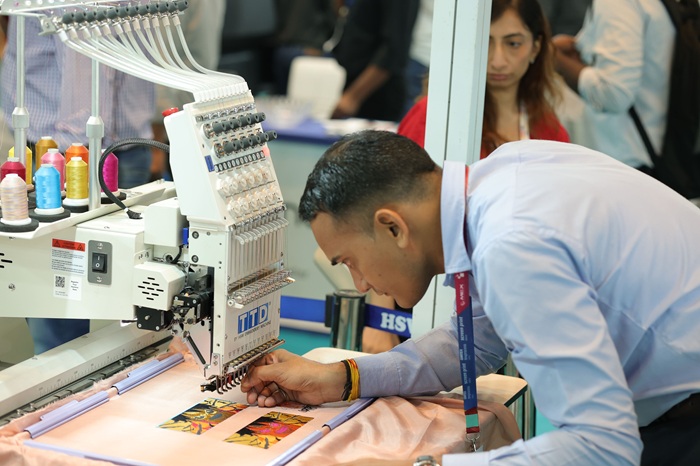
Texprocess is a business platform for professionals involved in the sewn products industry — including retail, brand, and manufacturing executives — to meet with manufacturers and distributors of machinery, equipment, parts, supplies, systems, technology, supply chain solutions, and other products and services used for the development of sewn products.
Together, believe Techtextil and Texprocess aim at empowering attendees to integrate technology and fuel innovation that will drive the textile and sewn product industries forward. Development in future-oriented fields such as 3D design, blockchain, and advanced processes are providing multi-faceted insights for businesses to upgrade their shop floors, and Techtextil and Texprocess serve as the ideal industry meeting point to see these advancements in person.
At the 2023 edition, visitors can expect to find the most relevant, on-trend innovations and can discover for themselves how new R&D developments and technologies are revolutionizing all kinds of industries from apparel to upholstery to agriculture to construction — opening doors for the industry’s diverse sourcing needs.
Bangladesh: Growth in economy drives growth in yarn and fabric sales
Bangladesh’s yarn and fabrics sales are rising. Consumption has grown 50 per cent since the financial year of 2016-17.
Among the reasons are rising per capita income, stricter anti-smuggling measures and the production of value-added apparel items. The buying capacity of the people of the country has increased, so a lot of consumers can afford more apparel items and are paying additional prices for value-added items.
Bangladesh's per capita income has more than quadrupled since 2009. This has driven up the overall consumption of fabrics in the local market. On an average, a woman consumes 40 meters and her male counterpart consumes 25 meters of fabrics. Currently, 250 spinning mills and 600 weaving mills produce seven billion meters of fabrics a year to meet the domestic demand.
Investment has been made to set up mills to produce yarn and fabrics. There are many other small and medium-sized spinning and weaving mills in various parts of Bangladesh. They make a few million meters of fabrics a year. Mainly salwar kameezes, lungis, saris and shirts are supplied by local millers.
At the peak of the coronavirus pandemic in 2020, fabric production slowed owing to a fall in demand and there was a lot of stockpiling of unsold fabrics and yarns at the factory level.Following the receding of the outbreak, the demand for textile items made a comeback and millers almost ran out of stock.
Bangladesh exports to EU up 16 per cent
Bangladesh’s apparel exports to the EU increased by 16 per cent during the first half of the current fiscal year compared to the same period of the previous fiscal.
Now the country’s manufacturers have asked for an additional two per cent cash incentives on export of garment products to Sweden and Poland. Currently, garment exporters enjoy four per cent cash incentives if they export goods to non-traditional markets, excluding the EU, the UK, Canada and the US. Besides, they enjoy existing additional cash incentives for shipments to the countries under the EU block.But apparel exporters to Sweden and Poland are not getting such special benefits unlike exporters to other EU countries.
Currently, garment exporters are facing difficulties due to the Russia-Ukraine war and its impact is now visible. Prices of raw materials of the sector have increased due to higher inflation in different countries, including the US and the UK.
Currently, the EU region is considered the major market for Bangladesh’s readymade garment items.Bangladesh’s apparel exports to the European Union grew by 16 per cent during the first half of the fiscal 2022-23. Garment exports to Germany grew three per cent year on year. Exports to Spain and France grew by 17 per cent and 33 per cent respectively during the last six months.
Victoria’s Secret launches recycled bras
Victoria’s Secret has debuted a bra with elements that can be recycled into new bras.
This is seen as a step forward in solving the textile waste problem for undergarments that are most frequently tossed in the trash at the end of their useful life.
The product, named the Forever Bra, has pads made with a plant-based fabric that’s easier to recycle than synthetics like polyester that are derived from petroleum.
Victoria’s Secret customers can take the bras back to any US store, and the pads will be removed for recycling. This innovative approach to waste management is a beacon of hope in the fight against environmental degradation.
Victoria’s Secret has leadership positions in intimates and beauty. After nearly a year and a half as an independent, publicly-traded company, the company continues to make significant progress in its transformation and mission to celebrate and champion all women.
It has created a solid financial platform with a new, more agile operating structure, and even in a very challenging macroeconomic environment was able to deliver third quarter operating income and earnings per diluted share results above the previous guidance. The strategic growth plan is to strengthen the core, ignite growth and transform the foundation.