FW
Coats revenues down two per cent
Coats’s revenues fell two per cent in the four months ending October. Sales were affected by the recent weakening of certain emerging market currencies in which it operates, particularly the rupee, yuan, and lira. On a constant exchange rate basis, group revenues increased three per cent from July 1 to October 31.
The company’s strong first-half performance helped it offset the recent decline in revenue, and group sales for the year to October are still ahead of the same period last year, up three per cent. On a constant exchange rate basis, revenue increased by four per cent in the year to October.
Coats’ high technology performance material threads are enjoying strong growth, up four per cent between July and October, and there is increasing momentum in its industrial division.
But the company’s apparel and footwear division was hit by mixed demand from retailers, and despite growing four per cent on a constant exchange rate basis, it fell by one per cent on a reported basis. Crafts, which accounts for 11 per cent of group sales, continued its fall due to lower sales in both North America and Latin America. Craft revenues fell by 31 per cent between July and October, and have fallen by 17 per cent in the year to date.
China tops luxury spending
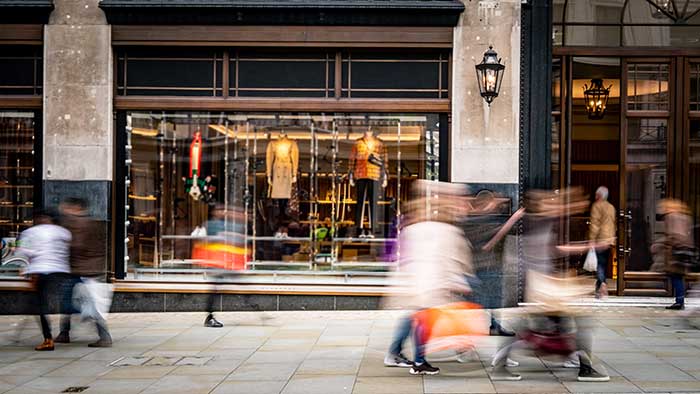
China’s luxury goods market is expected to grow by 20 per cent this year. In Mainland China, luxury sales grew 18 per cent at current exchange rates, driven by rising demand rather than by price increases. Luxury purchases in Japan softened slightly this year. However, retail sales still grew at three per cent at current exchange rates.
Across the rest of Asia retail sales grew seven per cent at current exchange rates, due to dynamic growth in South Korea. Brisk growth in other Asian countries – Singapore, Thailand and Taiwan – also contributed while Hong Kong and Macau benefitted from Chinese purchases. Europe lagged in 2018 due to a strong euro that impacted tourists’ purchasing power. Local consumption was positive overall, despite mixed country performance, helping to boost retail sales one per cent at current exchange rates.
The Americas grew five per cent at current exchange rates. A positive US economy boosted disposable income and overall luxury spending from locals, even as brands remained wary of continued economic prosperity. In other areas, there was nil growth, mainly due to stagnation in the Middle East. Luxury shopping online continued to accelerate this year compared with physical channels, growing 22 per cent.
Use of hemp fiber up amongst Indian brands
More and more brands are using hemp fiber in their collections. These include brands like Armani, Ralph Lauren, Calvin Klein, Nike and Patagonia. In Mumbai, Boheco has been working with policy makers, scientists and farmer groups to position India in the exploding cannabis space worldwide. They are researching on the wild cannabis that is widespread in North India to standardise low THC seeds that could eventually be used to grow industrial hemp within the country’s legal stipulations.
Boheco has developed hemp denim in conjunction with Arvind Mills. The brand is also working with IIT Delhi on technology to process hemp fibres from the plant and has also launched two hemp fabric brands. Brand Label B sells hemp clothing at affordable prices via Boheco.org and is present in 10 boutiques across the country including Creo in Mumbai, People Tree in Goa and Mo Studio in Ahmedabad. The second label is called Hemp Fabric Lab.
British Wool updates on benefits of refocused strategy
British Wool held its 65th Annual Conference last week in Bradford. The conference focused on two key areas: increasing value per kilo and improving operational efficiency. Some of the projects delivered so far include:
New tactical approach to structuring auctions, allowing trends and buying patterns to be analysed ahead of each sale. This has helped to support prices.
A new office in Shanghai, China, which opened in October 2018, designed to support local marketing and allow British Wool to penetrate new markets.
Ongoing marketing of British wool as a distinct quality fibre, explaining its unique features and benefits in a way that is relevant to each product range. This activity is delivered through retailers, consumer facing digital advertising channels, and at carefully selected consumer focused shows such as Grand Designs.
Delivery of a £600,000 labour cost saving during the 2017 season.
Syed Ali Ahsan elected new chairman of APTMA
Syed Ali Ahsan is All Pakistan Textile Mills Association (APTMA) new chairman. He is the chief executive of Ashiana Cotton Products. His uncle was among the founders of APTMA in 1957.
He aims to focus on the revival of the industry and double exports in five years; ensure provision of regionally competitive energy, both electricity and gas, to the exporting industry; double infrastructure of garment plants; reintroduce the enhanced industrial credit allocation policy; and induce international brands and retail chains to source from Pakistan.
Naveed Gulzar of Crescent Cotton Mills and Asif Inam of Diamond International Corporation are central vice chairmen. APTMA is the premier national trade association of the textile spinning, weaving, and composite mills representing the organized sector in Pakistan. APTMA represents 396 textile mills, out of which 315 are spinning, 44 weaving and 37 composite units.
The total installed capacity of APTMA member mills accounts for 9,661,366 spindles, 61,608 rotors, 10,452 shuttle less/airjet looms and 1897 conventional looms. The association’s members produce spun and open-¬end yarn, grey, printed dyed fabrics and bed linen.
Pakistan wants to compete with regional competitors including India, Bangladesh, Sri Lanka and Vietnam for enhancing the county’s exports and achieving the target of economic stability and growth.
US consumers most affected by Trump’s tariffs and ongoing trade war
"Around 23 years ago, the General Agreement on Tariffs and Trade (GATT) was refurbished as the WTO with almost every country in the world joining the organisation. As per agreed norms, trade tariffs amongst member countries are reduced through negotiations and the agreed rates applied uniformly to all trade partners. However, China which joined the organisation in 2001 does not adhere to these rules. It shakes down foreign investors for technologies it fancies besides giving subsidy to its own industries."
 Around 23 years ago, the General Agreement on Tariffs and Trade (GATT) was refurbished as the WTO with almost every country in the world joining the organisation. As per agreed norms, trade tariffs amongst member countries are reduced through negotiations and the agreed rates applied uniformly to all trade partners. However, China which joined the organisation in 2001 does not adhere to these rules. It shakes down foreign investors for technologies it fancies besides giving subsidy to its own industries. While there are enough reasons for penalising China for flouting multilateral trade rules, through overproduction, dumping overseas and excessive restrictions on market access, however, the primary loser from this trade war is likely to be the American consumer as the hypothetical benefits of more manufacturing jobs will negated by the higher prices that the consumer has to pay.
China’s advantage over the US
It’s common knowledge that China grants vast and opaque subsidies to its state-owned firms. The US is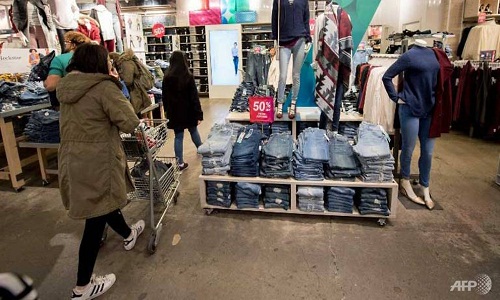 therefore, right in demanding fair play. Its now looking to force manufacturing supply-chains back to America and has identified China as a strategic competitor. The White House may interlink China’s abuse of rules; the trade deficit and the decline of American industry. However, this is not the case. Even without subsidies, China, like most other emerging markets, would enjoy a substantial cost advantage over the US.
Altering the global business map
The trade war is altering business equations amongst nations. According to the IMF, in 2017, EU exports to Asia were bigger than those to the US. While Asia’s exports to the EU are growing fast, making the Union increasingly more important to Asia. China is now the largest market for an expanding list of countries, including Australia, Brazil, Russia, South Africa, South Korea and Indonesia, among others.
Indeed, if the current growth rates of imports in the US and China hold in the next few years, by 2021 China will surpass the US to become the largest market for imports in the world, according to the IMF. Against this backdrop, Trump’s trade war is creating new impetus for the EU and Asia to speed up opening their markets to forge closer economic ties.
Need to expedite India-EU FTA
India’s exports and imports of goods and services is around 42 per cent of its GDP. Any trade war is thus likely to have implications for the country. Turkey recently imposed a 21 per cent customs duty on Indian products. Additionally, local value addition of 51 per cent in case Indian companies wish to sell their products in Turkey, forces them to create capacity in a sub-optimal manner by investing significantly in the local country.
The trade barriers that Indian textile companies face pose obstacles in their access to some of the most important markets. For over four decades, Indian manufacturers designed their production, investment and sourcing strategies around the assumption that the movement of goods across the world’s borders would continue to grow ever freer. In the process, many of them built complex, intricately linked and cost-efficient supply chains that span the globe. The US and EU markets absorb about 60 per cent of the Indian output in apparel. The country, therefore, needs to expedite an FTA with the EU.
Knitting and Stitching show to exhibit potential health benefits of arts and crafts
The Knitting and Stitching Show, to be held in London’s Harrogate from November 22-25, 2018, will showcase the health benefits of arts and crafts. It will include dress-making and children’s workshops, drop in knitting and crochet class, mindfulness area, etc.
Artist Jenni Dutton will displayher series 'The Dementia Darnings' which depicts her mother's journey through life including living with dementia over the last few years. The art which is created out of fine wool explores the mother-daughter relationship along with the emotional changes of a person living with dementia.
Another display from artist Caren Garden will focus on the difficulties of eating disorders. The bedroom installation features hospital and domestic furniture, with one of the main items on display is a quilt which features a pattern designed by a talented young lady who sadly passed away after suffering from an eating disorder.
Pollution from cotton, linen fibers make up 80 per cent of all deep-sea microfibers
A new research on Southern European seas reveals, pollution from cellulose fibers such as cotton and linen accounted for 80 per cent of all deep-sea microfibers. Polyester microfibers accounted for just 13 per cent of the 202 microfibers identified in 29 surface sediment samples analysed, while acrylic made up 4.5 per cent. The researchers presented new data on the distribution of microfibers after a widespread survey of seabed sediments in southern European seas including the northeast Atlantic Ocean (Cantabrian Sea), the Mediterranean Sea (Alboran Sea, Catalan Sea, Cretan Sea and Levantine Sea) and the Black Sea at depths from 42 m at the continental shelf to 3,500 m in the abyssal plain.
In contrast, synthetic fibers dominate the global fiber market, with 65 per cent of the share, while natural and man-made cellulosic fibers altogether comprise only a 35 per cent. Shedding of fibers is a relatively new concept in textile development and, no studies have yet investigated microfiber shedding from cellulose vs. plastic textiles. Assuming a roughly equivalent release of fibers of each polymer to the aquatic environment, data suggest that polymer density is the key component controlling the spreading of microfibers to the deep.
US cotton industry introduces plan to meet sustainability goals
Cotton Council International President Ted Schneider, at the Cotton Sourcing USA Summit, revealed plans to introduce the US Cotton Trust Protocol to help the US cotton industry meet its 2025 sustainability goals. The protocol is an integrated data collection, measurement and verification procedure which will benchmark farmers’ gains towards the industry goals and provide the global textile supply chain additional assurances that U.S. cotton is produced in a responsible manner.
The details of the Protocol are being fine-tuned, and a pilot program will be launched in 2019 and fully implemented with the 2020 cotton crop year. Participating growers would be required to adopt a data tool that allows for the quantitative measurement of key sustainability metrics, such as the FieldPrint Platform from Field to Market.
Growers would also complete a self-assessment checklist of best management practices; with a sampling of participating producers subjected to independent verification. The online interface and associated databases are currently being developed by a Memphis-based company The Seam.
Japanese lifestyle brand Muji to relaunch Toronto store
Japan-based global lifestyle brand Muji will relaunch its store in Toronto, Eastern Canada. The retailer has tripled the size of the original store from 5,658 sq. ft. to 19,110 sq. ft..
Additionally, it will provide in-store customisation services including the Digital Fabric Printing Service that will enable shoppers to print a photo directly from their phone on to select Muji apparel and home fabric items, and the Laser Engraving Service, which will allow consumers to have letters engraved onto a selection of Muji products.
The new outlet will stock Muji Canada’s full range of products that includes over 4,000 items like household goods, apparel and accessories. Furthermore, a pop-up exhibition named ‘What is Muji’ will also be carried out by the retailer from November 19-23 at the retailer’s previous location. The company will showcase some of its most iconic products at the do.