FW
WTiN to replace Innovate Textile & Apparel Asia with virtual conference
The information provider to the global textile and apparel industry has announced the upcoming launch of Innovate Textile & Apparel Online – enabling knowledge exchange and networking continuity amid the Coronavirus outbreak
Innovate Textile & Apparel (ITA) Asia, originally scheduled to take place in Singapore in May, has been cancelled due to the Coronavirus outbreak, according to organisers WTiN. Instead, the information provider will organise a virtual conference that will enable delegates to access the presentations remotely across multiple devices. ITA Online will be available to stream from 5 May 2020 at midnight (GMT) until 30 June 2020. All presentations will be pre-recorded, with videos conveniently linked to the presentation slides. Users will be able to post questions to each presenter and can also participate in virtual networking opportunities.
Discussing the new format, Chinky Tyagi, head of Business Development, WTiN, says: “The WTiN team is following the development around the Coronavirus closely, and the health of our delegates and employees is of paramount importance to us which is why we made the decision to cancel ITA Asia for this year. However, rather than cancel the event altogether, we’ve pooled our expertise in digitalisation to offer a virtual solution: ITA Online. The online event will give attendees the opportunity to access all presentations in one go. They can watch presentations at their own pace with no extra cost of travel or accommodation; the virtual format aims to provide all the functionality of the in-person event including the networking.”
Innovate Textile & Apparel brings together strategic decision-makers determined to implement digitalisation in the textile and apparel sector. According to WTiN, ITA is more than a conference, but an experience that illuminates the emerging manufacturing technologies, material innovations and business models that are set to deliver the ‘next wave of opportunity’ for the global textile and apparel manufacturing community. As part of the Textile 4.0 track, registrants of ITA Online can access presentations on topics such as blockchain for creating an efficient supply chain, the digitally connected circular economy, skills evaluation in the digital age, 3D design and development and digital inspections. Re:Think Materials track will feature presentations on topics such as bio-graphene-infused textile fibres, the future of smart textiles, challenges in creating e-textiles, and the product development process for smart garments and wireless technology etc.
World Textile Information Network (WTiN) provides specialist insight and data-driven intelligence to businesses in the textile and apparel value chain, enabling them to make better decisions faster and gain competitive advantage. Its primary focus is on the high growth markets of materials innovation, industry digitalization and technical textiles.
Digital printing to transform apparel production, increase sustainability
"Its ability to print with bold colors in a precise and controlled manner makes screen printing an immensely popular method of production in the fashion industry. However, this method gained commercial popularity in fashion only after 1960s when the first rotatable, multicolor garment screen printing machine was developed in the US."
 Its ability to print with bold colors in a precise and controlled manner makes screen printing an immensely popular method of production in the fashion industry. However, this method gained commercial popularity in fashion only after 1960s when the first rotatable, multicolor garment screen printing machine was developed in the US.
Following the launch of digital printing machine, which enabled manufacturers to print logos on bowling uniforms, screen printing machines became the go-to technology for the fast-fashion movement, particularly as production moved to cheaper labor countries such as China and India.
However, high screen and screen storage costs of these machines along with their technological limitations restricts the use by designers. Some other barriers include: the labor-intensive work required in applying ink to screen to clothing; high-water consumption that arose from washing the screens; and the inability to design complex imagery with the screens’ mesh. To solve these issues, the industry needs to introduce innovative printing technology that offers greater flexibility and personalisation.
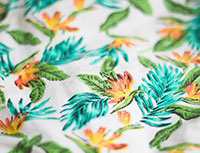
Although the popularity of screen printing continues to rise, digital printing can not only reduce environmental footprint but also enable greater flexibility, personalisation, and give designers the flexibility to experiment with their styles. Inkjet technologies can provide brands with high-resolution complex floral and animal prints alongwith details photorealistic visuals. Besides changing the way in which designers create garments, Inkjet printing also impacts fashion seasons, business models and supply chains.
Transforming fashion cycles
Digital textile printing is also transforming the customary two-season fashion cycle as brands like Zara, a subsidiary of Inditex are launching collections all year rounds. Inkjet technology helps designers test and amend samples and designs on-the-spot by the designer, or print house, which helps to lower turnaround times.
Inkjet technologies help brands offer customised offerings to their customers. Brands can create apparels of greater variety and individuality with these technologies. Though initially, this technique was used for printing directly onto T-shirts but it now increasingly being used for other garments such as dresses and jeans. OEMs, like Israeli-based Kornit Digital, are also promoting the role of DTG printing in the home textiles sector.
A new beginning for digital transformation
As these technologies continue to proliferate in the global fashion and apparel sector, new business models and designs will continue to evolve. Though these technologies enable fashion and apparel markets to break down barriers and enable new possibilities, they also face certain challenges such as metallic or glitter inks and connecting the supply chain in the Fourth Industrial Revolution.
Thus streamlining production workflows, connecting digital textile printers with siloed processes both up and downstream will reduce the cost of printed fashion and apparel goods for the end consumer. It will also reduce proximity to the end consumer, improve lead times and create garments only when they are ordered.
A beginning of the digital transformation in the fashion and apparel supply chain, digital printing will never fully replace screen printing, However, it will transform the industry in terms of production, rebalancing power in the industry and increasing sustainability in the garment printing space.
FTA to boost Vietnam’s exports to the EU
Vietnam’s textile and garment export turnover to the EU is expected to increase by 81 per cent following the free trade agreement.
Enterprises are expected to enjoy plenty of room to expand into new markets due to the regulations setting out tax reductions. Most notably, in the context of unpredictable global developments such as trade protectionism, trade tensions, and the ongoing impact of the Coronavirus, the trade deal could help Vietnamese garment and textile firms boost their exports, diversify markets, and achieve higher value add through the establishment of fresh supply chains.
However, rules of origin are a barrier. In order to qualify for tariff exemption under the free trade agreement, companies will need to increase localisation of fabrics because the rules of origin are applicable from the fabric stage onward. But for Vietnamese companies, China cannot be replaced as the main supplier due to its much lower costs. A significant portion of the textile industry's feedstock is from China. Even when the delays in supply from China due to the coronavirus pushed them to look for raw material imports from other markets such as South Korea, India, Bangladesh, and Brazil, many saw this as nothing more than a temporary solution.
Italy hosts footwear event Micam
Micam was held in Italy from February 16 to 19, 2020. This Italian footwear trade show was attended by 1,205 exhibitors, closed with five per cent lesser number of visitors than last year. There was a noticeable absence of British and Asian buyers. Presentations, workshops, fashion shows, special installations and other initiatives dedicated to innovation were developed around three key themes for the industry: materials, sustainability and retail.
Micam is the leading international exhibition of the footwear industry. It is a unique event of its kind with footwear collections at each edition, successfully merging business and fashion. It confirms its role as a privileged stage for the promotion of new collections and, at the same time, a decisive business opportunity to forge contacts. Micam is a one-of-a-kind event with over 1700 footwear collections at each edition, successfully combining business and fashion. Participation is restricted to manufacturers, distributors, agents and representatives of the footwear industry. The exhibition is a unique visitor experience, with a host of collections bringing tradition, innovation and design to the fore. The format is aimed at exploring the transformation taking place in the shoemaking industry, from avant-garde materials to the most revolutionary consumer trends and from sustainability to new retailing methods. It is a focal point for guest speakers and innovative enterprises from all over the world.
India’s textile, garments shipments fall six per cent
India’s shipments of textiles and garments shrank 6.4 per cent in April to January, aiding a decline in overall exports that have contracted for a sixth straight month through January. The sector’s share in overall merchandise exports has been sliding consistently in recent years, having dropped from as much as 13.7 per cent in fiscal ’16 to just 10.6 per cent this fiscal, the lowest in around a decade.
The indirect tax structure in India’s manmade textile segment needs to be corrected. There is no parity in the goods and services tax rates between cotton-based and man-made textiles. The historical imbalance in favor of the natural fiber-dominated value chain has hurt the country’s export prospects. While GST on cotton and textiles made from it stands at a uniform five per cent across the value chain, the rate for synthetic fiber is 18 per cent. Manmade filament/spun yarn are taxed at 12 per cent and fabrics five per cent. This is despite the fact that manmade textiles make up as much as 65 per cent to 70 per cent of global demand and consequently hold immense export potential. In India, however, cotton textiles account for around 70 per cent of the market. Coupled with rigid labor laws and elevated logistics costs, this distortion — caused by policy interventions for decades — has stunted the country’s ability to raise garment exports exponentially.
Raf Simons new creative director of Prada
Raf Simons is joining Prada as creative director. Simons has been creative director roles at Dior and Calvin Klein. He will work alongside Miuccia Prada with equal responsibilities for creative input and decision-making. The first collection designed by the creative powerhouse duo will be for the spring/summer 2021 women’s wear show. This partnership, encompassing all creative facets of the Prada label, is expected to open a new dialogue, between designers widely acknowledged as two of the most important and influential today. Conceptually, it is also a new approach to the very definition of creative direction for a fashion brand — a strong challenge to the idea of singularity of creative authorship, while also a bold reinforcement of the importance and power of creativity in a shifting cultural landscape. It is also seen as the first step towards broader scopes of interaction — an initiation of free exchange and collaboration, a questioning of creative conventions.
Prada, founded in 1913, is an Italian luxury fashion house specializing in leather goods such as handbags, shoes, and small fashion accessories which include wallets, pouches and belts, with a range of ready-to-wear items like shirts, jackets and knits. With this move Prada hopes to bring together each designer’s individual history of reinvention, provocation, brave exploration and the power of ideas.
Philippines aims to increase garments exports to EU
Philippine trade department’s export marketing bureau (EMB) plans to request the European Union (EU) to allow garment exports under its preferential trade scheme. Under the Generalised Scheme of Preferences (GSP+), up to 6,274 Philippine products can enjoy zero-tariff entry to the EU as long as the product originates from the Philippines.
A recent GSP+ monitoring report showed that the Philippines slowly increased its use of GSP+ preferences to 26 per cent of its total exports to the EU in 2018. In comparison, Bangladesh led GSP+ beneficiaries by placing 96.4 percent of its exports to the EU under GSP+, followed by Cambodia at 94.9 per cent.
The Philippines’ use of GSP+ compared with all eligible exports was 73.1 per cent. While this move will not make up for the remaining 26.9 per cent utilisation, the “principle” will bode well for other exports.
EMB, in partnership with the Bureau of Customs, will also conduct roadshows to Region 3, Region 4A, Cebu, Davao, and General Santos City throughout 2020 to promote self-certification of origin among exporters.
Indian government hopes to be textile champion
Indian government will help top textile companies achieve sufficient size and scale to cater to worldwide demand. The aim is to create a few global champions especially in the areas of manmade fiber, technical textiles, apparel, fabrics and made-ups because of the substantial value addition in these sectors. They will be provided fiscal benefits and adequate infrastructure support. A policy is being finalised to address the lacunae under existing textile-related schemes. This includes significantly raising the cap on investment under the existing scheme that will prompt companies to set up mega manufacturing units in one place and undertake technology upgradation.
Currently, different subsidies are capped at lower investment levels, prompting companies to remain small and scattered. Textile parks will be set up with all forward and backward linkages available in the same place to make India cost competitive. The plan is to set up 1000-acre mega textile parks by providing land, electricity and water at reasonable cost. Preference will be given to coastal states and states with abundant water availability for such mega units.
Particular attention will be given to manmade fiber. In India, the share of cotton textiles is 60 per cent and the rest is synthetic or manmade fiber while the trend is the opposite elsewhere.
H&M collaborates with PE Nation for a sport’s inspired collection
H&M has launched a sporty series in collaboration with Australian- active wear brand PE Nation. The collection features clothes, swimwear, undergarments and accessories and will focus on sustainable materials such as organic cotton and recycled polyester, and will span everything from leggings and T-shirts to bicycle shorts to sports socks, all with a retro aesthetic and street wear edge. Color blocking and tie-dye patterns make for a bold, dynamic series built on a color palette of neutrals peppered with jolts of mint green, neon pink and bright orange. The collection can be worn all day, every day, while being flexible, functional and style-led. All the pieces can be mixed and matched. The target audience is women who want to live a more confident, vibrant, fashionable life while juggling their fast-paced urban existence.
Be it a comfortable supportive crop for the gym, the perfect pair of compression leggings for yoga, or an effortless sports luxe top for a night out, PE Nation is a brand that is designed to suit any active lifestyle providing a range of well-constructed, functional designs. H&M has had similar collaborations with singer Billie Eilish, supermodel Helena Christensen and costume designer Ruth Carter.
Indian garment exporters to capture larger market share: AEPC
The AEPC says, though India’s readymade garment exports showed a marginal increase during the April 2019-January 2020 period, apparel exporters are confident of capturing a larger market share due with renewed and the enthusiastic support of the government. The apparel sector is the largest employment provider after agriculture in India and employs 12.90 million workers, of which 65-70 per cent are women.
The government has prepared the ground for growth of man-made fibre production in the country with its removal of anti-dumping duty on PTA. AEPC plans to participate in mega exhibitions across the world to showcase Indian apparel. It will participate in various international fairs this year including ''India Tex Trend Fair'' in Tokyo and ''Pure London'' in July, ''Magic Fair'' in Las Vegas and ''Apparel Textile Sourcing'' in Canada in August, ''Who's Next'' in Paris in September, and ''Australia International Sourcing Fair'' in Melbourne in November.