FW
Carvico, Jersey Lomellina to exhibit at Outdoor Retailer exhibition
Carvico and Jersey Lomellina will exhibit at the Outdoor Retailer exhibition to be held from June 09 to 11.
. The two Italian producers of stretch performance fabrics, respectively warp knitted and circular knitted will exhibit their products at the biggest trade fair of the outdoor market in North America, an event which every year attracts thousands of visitors from all over the world.
Outdoor Retailer offers Carvico and Jersey Lomellina the opportunity to display the high-tech features and high quality of their 100 per cent Made in Italy fabrics. Their products are simply unique, designed for high performance, trendy and comfortable sportswear, mixing technology and sustainability.
Carvico warp knitted fabrics to be displayed at the fair include the n Revolutional Eco and Norway. both made of ECONYL®, a 100 per cent regenerated Nylon 100 per cent yarn from pre- and post consumer waste materials, Sydney Eco, made from a yarn derived from PET bottles, Revolutional Teddy, Vuelta, Artica, Colorado, Tokyo and Aosta.
Among Jersey Lomellina circular knitted fabrics on display at Outdoor Retrailer will be Renew Waffle, an eco-sustainable fabric made of ECONYL®; 3D, 3D medium and 3D brushed; Ireland and Nair Melange.
BGMEA signs deal with Wazir Advisors for a study on fiber diversification in Bangladesh
Faruque Hassan, President, BGMEA signed a deal with Varun Vaid, Business Director, Wazir Advisors to launch a study on ‘Fiber Diversification of Non-Cotton Textile and Apparel for Bangladesh in the global market’. The study aims to identify potential scope for non-cotton textile and apparel by Bangladesh in the global apparel market and formulate a strategy to develop the country's overall competitiveness and strengths in the area.
It will identify key challenges for Bangladesh to capture a significant pie of non-cotton apparel market. The study will also analyze non-cotton product categories for their complexities, resources and trade volumes while economic, demand and sustainability rationale of non-cotton apparel will be looked upon.
It will assess the competitiveness of products, technologies, skill, cost and availability of other resources besides identifying challenges restricting Bangladesh's growth as a non-cotton products supplier.
A roadmap for manufacturers, investors, policymakers, development partners and other influencers will be developed detailing approach and ways to establish a strong presence in non-cotton textile and apparel market.
Indian government to launch PLI 2.0 for the apparel sector
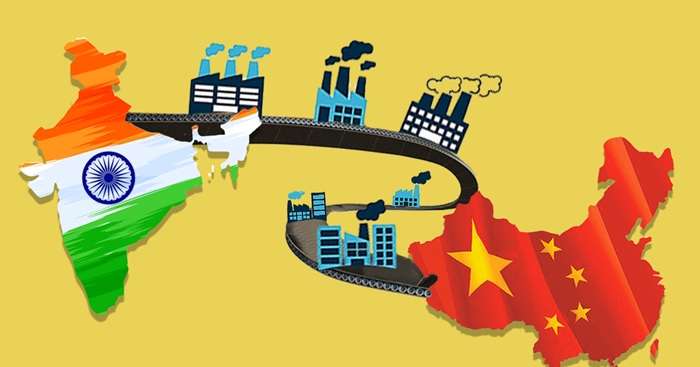
The government plans to launch the second edition of the PLI (Production Incentives Linked) scheme for the textile industry, mainly in the garment and apparel segment. PLI 2.0 will promote khadi along with man-made fibers and technical textiles with a budgetary allocation of Rs 4,000 crore. The Ministry of Textiles aims to complete approval and cabinet process for the scheme by August-September, and implement the scheme by October.
Designed to make India a garment hub, the new PLI scheme urges 64 garment companies to complete investment process under the old scheme in the next two years Sandeep Jain, Director, TradeSwift says, the government gives special importance to this sector, as textile has been the biggest employer in India.
EuroCham Vietnam signs MoU with VIFW to strengthen sector business
The European Chamber of Commerce in Vietnam (EuroCham Vietnam) has signed an Memorandum of Understanding with the Aquafina Vietnam International Fashion Week (VIFW). Reports say, the MoU will give EuroCham and its affiliated national chambers an opportunity to support the development of European companies both regionally and in Vietnam, and assist Vietnamese companies planning to expand into the European market.
The MoU will also identify and promote the benefits of the EVFTA for both groups; it will expand Vietnam’s fashion and culture across the world and create new business opportunities for Vietnamese designers and fashion brands. Alain Cany, Chairman, EuroCham Vietnam, believes, EuroCham would help VIFW connect and bring European businesses to Vietnam for mutual development and a sustainable relationship. Le Thi Quynh Trang, Chairperson, VIFW and President, Council of ASEAN Fashion Designers says, this ensures a new development journey for local and international businesses.
Nguyen Thi Tuyet Mai, Deputy General Secretary, Vietnam Textile and Apparel Association (VITAS) opines, the MoU would promote sustainable development of Vietnam’s fashion and textile industries. Organized by Harper’s Bazaar Vietnam and VIFW, the seminar was a sideline event of the Aquafina Vietnam International Fashion Week Spring-Summer 2022 held until May 29.
Pakistan apparel textile sector warns against discontinuation of special power tariffs
Pakistan’s apparel textile sector has warned the federal government against discontinuing the special power tariff to five export-oriented sectors saying, this would prove disastrous for the economy. It also urged the government to inform the IMF that the concessional facilities are not a ‘subsidy. It should be communicated to the IMF that the special energy tariffs and other facility to export industry have been wrongly interpreted as ‘subsidy’, says Muhammad Jawed Bilwani, Chairman, Pakistan Apparel Forum
The government needs to understand that the special energy tariffs provided to the five export sectors are on par with those given to industries in the regional countries to ensure the country’s products could compete globally. Similarly, the DLTL (the Duty Drawback on Local Taxes and Levies) is a policy measure to spare export goods from taxes, he adds. The government should continue the concessional tariff for export industries beyond June 30, 2022 in ‘the national interest, Bilwani says. He urges the government to act wisely and do not any decision that would negatively impact exports.
He believes, continuation of concessional power tariff slab will help local industries perform better.
Finalize extension of cotton import duty waiver: Piyush Goyal, Textile Minister
In a meeting with the newly constituted Textile Advisory Group, Piyush Goyal, Minister for Textiles and Commerce & Industry directed concerned authorities to finalize the decision to extend import duty waiver on cotton till December 31.Je also addressed issues relating to augmenting present supplies of cotton and strengthening productivity. He called for importing from destinations where stocks are available.
Suresh Kotak, Chairman, Textile Advisory Group emphasized on the need to ensure seed availability for sowing especially new early maturing varieties and revamp the seed system to enhance productivity of Indian cotton from present stagnation. As per estimates of Committee on Cotton Production and Consumption, current carry over/closing stock is 41.27 lakh bales, which is about 12.66 per cent stock to use ratio and equivalent to stock for 45 days consumption. The cotton-based textile industry is facing a shortage of cotton leading to rise in prices from Rs 44,500 per candy in February 2021 to Rs 90,000 per candy in March 2022.
The steep increase in cotton prices is severely impacting the potential growth of the cotton textile value chain. The Central Board of Indirect Taxes and Customs (CBIC) had notified the exemption from Customs duty and Agriculture Infrastructure development Cess for import of cotton.
Custom T-shirt printing market to grow at 9.7 per cent CAGR till 2032: Study

Valued at $3,579.1 million, the global custom T-shirt printing market is estimated to grow to $9,009.3 million by 2032, says a Future Market Insights study. They estimate, the market will contribute over 2 to 3 per cent to the global apparel market. From 2022 to 2032, the custom T-shirt printing market is expected to surge by over 9.7 per cent CAGR. Most of this growth will be driven by increasing demand for customized modern T-shirts and their use as a modern branding strategy. Rising disposable income coupled with a growing preference for personalized clothing is encouraging customers to spend on customized clothing.
Boosting brand visibility and luring customers
Demand for customized T-shirts with slogans and logos moving north. The global custom T-shirt printing market is expected to surpass 508,487 units by the end of 2032. Major companies across the world including start-ups use custom T-shirts to boost brand visibility and lure potential customers. These T-shirts also act as an effective branding tool for companies. The high-quality materials used to make these T-shirts helps brands extend their shelf-life and visibility for longer period.
US contributes 78.9% to global sales
One of the most lucrative markets for custom T-shirts is the US contributing 78.9 per cent to global sales in 2021. Demand was driven by leading football clubs and teams who custom-designed their T-shirts and jerseys with personal logos and designs. The market is expected to continue growing with government spending on sports-related activities increasing in coming years.
One of the fastest growing markets, Germany accounted for 26.9 per cent of the European custom T-shirt printing market. The market is expected to continue growing on account of rapid development and investment in printing technologies.
T-shirts with movie slogans, logs rise in popularity
Presence of market leaders such as Spreadshirt among others is also expected to boost growth. Custom T-shirts with movie slogans and logos are gaining immense popularity resulting in increased collaborations between key players and leaders of the entertainment industry.
Offering high print quality, the screen printing segment revenue share increased to over 52.1 per cent in 2021. Cost-effective printing techniques enables mass printing on synthetic fabrics like viscose, polyester, silk, and other similar materials.
Graphic design segment to dominate market
The largest share is being held by the graphic design segment with a market share of over 56.9 per cent in 2021. Growth in this segment is being aided by the growing popularity of custom T-shirts with pre-printed graphics. Increasing demand for graphic T-shirts is expected to boost the global men’s custom T-shirt printing market through 2021. On the other hand, growing gender fluidity and acceptance of different sexualities will help the global unisex custom T-shirt printing market to grow at 12.5 per cent CAGR from 2022 to 2032.
Discounts, easy access will help online segment
Emerging as the fastest growing segment, the online segment will grow at 13.1 per cent CAGR from 2022 to 2032. Growth will be driven by higher internet use, large discounts and ease of access.
Leading players in the custom T-shirt printing market are launching new products and expanding their business. For instance, Printful launched commercial and merchandize use graphic printing techniques in collaboration with Vexels in 2021. Similarly, in January 2019, Printful opened its second fulfillment center in Europe for better customer service and meet faster shipping demands.
China’s cotton yarn exports decline in April 2022
China’s cotton yarn exports declined to 10.3kt/yr in April 2022, compared to 15.7kt in April 2021, 7.9kt in Apr 2020 and 26.8kt in Apr 2019. As per a CCF Group report, exports were dominated by cotton yarn of combed 30.4-46.6S and combed 54.8-66S varieties. In April 2022, the exports of uncombed 8.2-25S increased a lot.
The export volume of uncombed 8.2-25S increased by 18 per cent while that of , combed 8.2-25S increased by 27 per cent and uncombed 25-30.4S surged by 48 per cent. Export volumes of combed 35-30.4S declined by 43 per cent while those of combed 54.8-66S declined by 42 per cent.
Vietnam emerged top importer with 25 per cent global share; followed by Bangladesh and Pakistan. Export volumes to Italy, Cambodia and Thailand increased but still remained small.
PT MAS Arya Indonesia becomes first fully renewable energy-powered unit
South Asia’s largest apparel and textile manufacturer, MAS Holdings has signed up for Science-Based Targets initiative (SBTi) to reduce its absolute scope 1 and 2 greenhouse gas (GHG) emissions by 25.2 per cent by 2025 from 2019 levels. The Intergovernmental Panel on Climate Change (IPCC) has launched a new report to emphasise on the need to address the climate crisis issue in the fashion industry on an urgent basis.
As per a McKinsey & Company report, the fashion industry is responsible for 4 per cent of global carbon emissions. .The industry has taken several steps to address this issue including supporting the Science-Based Targets initiative (SBTi) to promote and adopt science-based climate targets. However, to address the concerns of increasingly environment-conscious consumers, brands need to collaborate with manufacturers sharing their vision of a sustainable fashion industry.
PT MAS Arya Indonesia (MAS Arya), with two production facilities located in Central Java, Indonesia, has become the first manufacturing unit of MAS to be powered entirely through renewable electricity. The facilities entered into long-term agreements with PT PLN (Persero), the state-owned electricity supply and distribution entity in Indonesia, to purchase renewable electricity. Having signed up with PLN for a 15-year commitment, MAS Arya is the first firm in Indonesia’s Semarang Region to join the program.
Sri Lanka needs new reforms to accelerate sector growth: JAAF
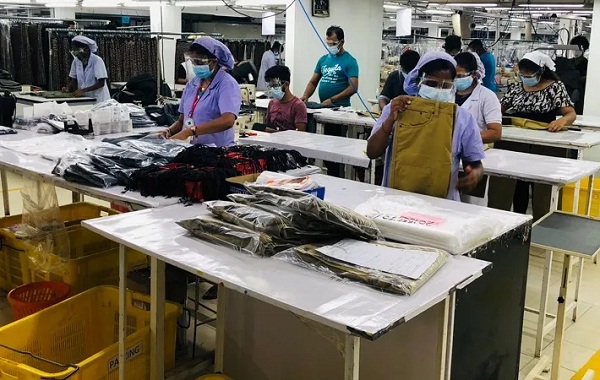
Sri Lanka’s textile and apparel sector may face serious consequences if policy makers fail to introduce new reforms to accelerate its growth, warns the Joint Apparel Association Forum (JAAF). Sri Lanka’s textile and garment exports increased 10.8 per cent in the first quarter of 2021 to $1.5 billion, reveals a Central Bank report. However, export earnings declined 0.6 per cent to $464 million from $ 467 million compared to the same period a year ago.
Data from Export Development Board pegs Sri Lanka apparels and textiles exports’ growth at 22.12 per cent Y-o-Y to $445.79 million in April. The sector is currently under serious threat owing to the gross economic mismanagement. Demand for apparels in the country is low, leading to a 20 per cent fall in export orders, says a Daily FT report. To stabilize growth, Sri Lanka needs to support garment manufacturers, both big and small. It needs to introduce sustainable, decisive solutions for their development urgently.
Yohan Lawrence, Secretary General, JAAF says, Sri Lanka needs to reinstate buyers’ confidence by being resilient to upcoming global economic crisis. The Sri Lankan industry is known for reliability, quality and sophisticated technical capabilities. It complements these qualities with a visionary approach to innovation, sustainability and circularity in fashion, he adds.
Stabilize energy supply and reform political culture
To ensure operational continuity, Sri Lanka’s apparel sector needs to stabilize energy supply by adopting renewable energy technologies, especially solar energy. This will help Sri Lanka ease some of the worst disruptions in production, explains Lawrence.
JAAF has also sought the abolition of the 20th Amendment to the Constitution to drive reformation of Sri Lanka’s political atmosphere. Its faulty political culture is considered to be at the root of its economic woes. To stabilize its economic growth, Sri Lanka needs to prioritize the welfare of its common citizens, Lawrence states. Refuting claims of shortages in raw material supplies and launch of new products, Lawrence says, the factories have an uninterrupted access to raw materials, ensuring smooth operations at the ports.
Ensure uninterrupted fuel supply
The permission to buy fuel directly from the Ceylon Petroleum Corporation (CEYPETCO) and Lanka IOC in dollars since April will help exporters avoid undue disruptions from power cuts and curfews, opines Lawrence. With bulk deliveries of diesel to apparel manufacturers resuming, exporters will be receiving uninterrupted fuel from specific fuel stations. This will help the industry continue day-to-day operations amidst ongoing fuel shortages, adds Lawrence.
Contributing 6 per cent to the country’s GDP, the Sri Lankan apparel sector accounts for 40 per cent of exports. The sector provides direct employment to 350,000 workers and indirect jobs to additional 700,000 workers. It aims to transform Sri Lanka into a global apparel hub and increase annual export earnings to $ 8 billion by 2025.