FW
Kraig Biocraft Laboratories files two new patents for recombinant spider silk
Kraig Biocraft Laboratories, the developer of spider silk-based fibre headquartered in Ann Arbor, Michigan, has filed two new patents concerning recombinant spider silk.
As per an Innovation in Textiles report, both these patents are built on underlying knock-in/knock-out gene-editing technologies that the company first made public in 2020. They expand on nearly pure spider silk genetic engineering systems allowing for larger, more complex, and more diverse protein production systems.
Covering the in situ auto assembly of large and complex proteins, the first of the two patents allows for the creation of silks that incorporate multiple sets of mechanical and chemical properties that cannot be created by conventional gene editing means.
Kraig developed this new system to address the limits on size and complexity of protein synthesis available from the world’s leading recombinant gene manufacturers.
The second patent moves developments in gene editing beyond the traditional heavy chain fibroin component of silk. This new research and development avenue opens the doors for the co-production of complementary proteins. This evolution in research delivers on the company’s vision for its transgenic silkworms as host platforms for tailored cosmetic and pharmacological proteins.
The company has filed both of these patent applications under the World Intellectual Property Organization (WIPO) Patent Cooperation Treaty (PCT) process, as well as filing utility patents in the USA. The broad nature of the patents will allow the company to protect its technologies across the globe.
High tariffs harming exports to EU, UK: Textile Ministry
Darshana Jardosh, Minister of State for Textiles, said, high tariffs are causing setback to the Indian textile and garment exporters to the European Union (EU) and the UK.
According to Jardosh, India’s textile and garment exports in 2020 totaled $29.61 billion, while shipments of Bangladesh, Vietnam and Cambodia for that year totaled $37.95 billion, $37.10 billion and $7.77 billion*, respectively.
As per a Textile Value Chain report, such high tariffs are affecting exports, unlike Bangladesh and Cambodia that have zero tariffs in mentioned destinations
Jardosh also said that, due to the COVID-19 pandemic and the nationwide lockdown imposed by various State Governments, production activities at all companies under the National Textile and Garment Group (NTC) have been suspended since 25 March 2020, thus affecting all stakeholders from farmers to traders and exporter in the value chain.
During this period, the employees are regularly paid by the NTC according to their status from the cash reserve. However, the second wave of COVID-19 once again resulted in the closure of all operations of NTC companies in April 2021 and now NTC has resumed operations at some companies in July 2021 depending on available materials.
Hanesbrands’ Q2FY21 sales surge by 13%
The Q2FY21 sales of US-based global marketer of branded everyday basic apparel HanesBrands surged by 13 per cent sales to $1.7 billion as compared to the sales of $1.5 billion in same period of previous fiscal. However, net income for the quarter slipped to $128.6 million (Q2 FY20: $161.2 million).
The company’s gross profit for Q2 FY21 totaled to $681.6 million while operating profit rose to $217.4 million. The company’s income from operations surged to $147.8 million from $136.5 million in the corresponding quarter previous fiscal.
Segmentally, sales of innerwear dropped by 29 per cent to $780.6 million from $1.0 billion due to the overlap of last year’s $614 million of PPE sales. However, active wear sales advanced 140.0 per cent to $404.2 million from $168.4 million. Furthermore, HanesBrands' international sales jumped 90.6 per cent to $478.9 million with strong growth in Australia, Americas, Europe and Asia Pacific driven by strong consumer demand and the overlap of last year’s COVID-related shutdowns.
For the complete fiscal 2021, the company has raised its forecast and now expects net sales from continuing operations of approximately $6.85 billion, which is $550 million above its prior range of $6.2 billion to $6.3 billion.
Frasers Group to invest in physical and digital elevation strategy
UK-based fashion retailer Frasers Group plans to invest in its physical and digital elevation strategy, though it believes there could be more restrictions this winter.
Revenues of, the group slumped by 8.4 per cent from £3.9 billion in pandemic-hit 2020 to £3.6 billion in the year that ended 25 April 2021.
As per Apparel Resources, the Group’s sports retail revenue too fell by 10.7 per cent to £1.9 billion during the period.
The fall has been attributed to frequent store closures. However, the Group added that the fall was offset by growth in its e-commerce business as well as pent-up demand.
Frasers Group’s Premium Lifestyle category saw its yearly revenue rise by 1.9 per cent – all thanks to new store openings and e-commerce growth.
The European retail revenue for the Group, however, dipped by a worrying 11.8 per cent, but that was expected considering several lockdown-induced store closures all through the year.
Notably, Group’s EBITDA fell by 2.6 per cent to £536.5 million. Frasers Group was earlier known as Sports Direct International, before changing its name in 2019 following the acquisition of House of Frasers.
Joor to launch 13 global fashion events
Digital wholesale platform Joor will undertake 13 global fashion events, starting with the Copenhagen International Fashion Fair (CIFF) on 9 August 2021.
As per Apparel Resources, some of the major events to be expected include the London Fashion Week, Premium + Seek, Rakuten Fashion Week Tokyo, Liberty + LA Men’s Market and iHKiB Istanbul Fashion.
Brazil Footwear, Showroom Canada, Tokyo Fashion Awards, Cabana, Jetro Project Japan and Ontimeshow Shanghai are other industry events to be launched.
JOOR will actively facilitate on-site order taking, and broaden the event’s timeframe and geographic reach to buyers from around the world. Marketplace events such JOOR Showcase will also be hosted, featuring more than 400 menswear and womenswear apparel, accessories and footwear brands.
Destination Italy, an exclusive showroom for Italian heritage brands such as Sergio Rossi, MSGM and Red Valentino, will also be included. These curated marketplaces will be available throughout the year for the buyers to access them.
An initiative has also been undertaken to promote brands of sustainable making, allowing JOOR to collaborate with CIFF. Complimentary access to JOOR is being provided to 12 sustainable brands, which will be highlighted on the digital event.
Launched in 2020, JOOR Passport is the most popular global platform to organise virtual trade shows and market week events around the world.
The platform has curated fashion’s largest global marketplace by hosting 40 global events, attracting more than 2,62,000 visitors from 149 countries.
Forever 21 plans third return to China
After exiting from China 2019, American fast fashion brand Forever 21 plans to once again return to the country. The brand’s business in the country will be handled by Lasonic Limited Xusheng Co and its subsidiary, Xusheng Electrical (Shenzhen) Co.
The brand currently operates on some e-retail platforms in China such as Vipshop and Pinduoduo, The Company plans to open new stores across China as well as roll out its products on e-commerce channels in the country.
This will be Forever 21’s third return to China after a brief stint in 2008 and another in 2011, which ended with the brand exiting the country in 2019.
The brand also made a comeback to the UK and other European nations through localised online stores in June last year. It had filed for bankruptcy in September 2019 and was acquired by Authentic Brands Group (ABG), a global brand development, marketing and entertainment company, in Feb 2020.
Textile industry needs to adopt a circular economy in mainstream
 Characterized by overproduction and over consumption of low-cost clothes, the global textile industry is a major source of environmental pollution. The industry is currently worth $1.4 billion and employs over 300 million people, especially in developing countries like Bangladesh, Brazil, China, India, Pakistan and Turkey. To reduce its environmental impact and increase efficiency, the industry needs to adopt a more circular economy and connect the downstream segment with the upstream. It needs to use more renewable materials, make durable clothes and encourage recycling by converting used garments into new ones.
Circularity to make upcyling more mainstream
The industry can make supply chains more resilient by developing reverse logistics capacities. This would help reduce 33 per cent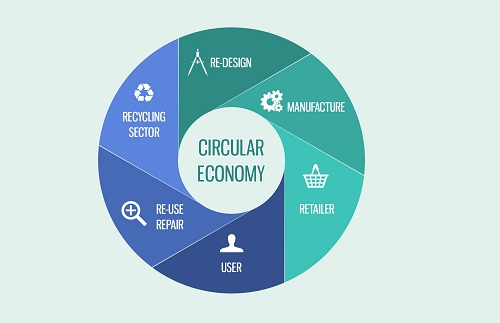 of carbon dioxide emissions and connect production and disposal ends of the value chain. It would also reduce air, land and soil pollution caused by processes, says a recent UNCTAD study as a part of the SMEP program.
There is growing demand for more attention to used clothes in the industry. The UNCTAD report says, existing collection systems for used clothes are outdated and create an illusion of circularity. Upcycling could make circularity more mainstream and improve management.
Smarter transportation for job creation
Another important social concern for the circular textiles industry is loss of jobs. Sectors like the cotton and polyester are likely to face a decline in employment levels due to increased automation and decreasing investments. However, as per a recent ILO research, the industry will benefit in the long term as it will create 18 million new jobs by 2030. A 2020 OECD study also predicts, employment levels will rise 2 per cent in this decade. The industry needs to adopt smarter ways to transport textiles back to reprocessing sites. It needs to avoid engaging people into low-value-added occupations of manual material separation.
Recycling textiles abroad can prove more expensive for companies as import rates for used textiles are higher than other secondary materials such as scrap plastics. On the other hand, there are minimal fees for disposal of used garments in the domestic market. The EU has launched a new initiative to change VAT rules for recycling used garments.
Delivering profitable circular solutions
It is difficult to change the current linear process of sourcing, retail and disposal of textiles and garments as COVID-19 has created several logistical challenges, says the UNCTAD research. Textile companies need to focus on new technologies, business models and customer acquisition. They need to acquire new markets for small-scale circular operations. They also need to focus on delivering profitable circular solutions. Convince buyers about the benefits of buying responsibly produced textiles.
Vietnam benefits from new generation trade agreements
Vietnam’s Ministry of Industry and Trade (MoIT) believes, joining new-generation agreements like the European Union-Vietnam Free Trade Agreements (EVFTA) and the Comprehensive and Progress Agreement for Trans-Pacific Partnership (CPTPP) has brought great economic benefits to the nation.
Last year, Vietnam exported goods worth $40 billion and $38.7 billion to the European and CPTPP member countries respectively. Trade between Vietnam and EU member countries declined by 1.8 per cent to $55.4 billion as compared to that of 2019.
As per Vietnam Plus, the biggest importers of Vietnamese goods among European countries are: Belgium ($2.3 billion), Germany ($6.6 billion), the Netherlands ($6.9 billion), France (nearly $3.3 billion) and Italy ($3.1 billion. According to the MoIT, some of the items exported include footwear, plastic products, rice, textiles and garment and farm produce.
Vietnam's export turnover to CPTPP members also rose in 2020 compared to the previous year Total trade between Vietnam and other CPTPP member countries increased by 1.9 per cent to reach $79 billion last year,. Vietnam exported goods worth $38.7 billion to these countries and spent $40.3 billion on imports, resulting in a trade deficit of 1.6 billion USD last year.
The country enjoyed a trade surplus with some countries namely Canada and Mexico with a year-on-year rise of 11.8 percent and 12.1 percent, respectively.
Key products for exports to the CPTPP member countries are aquatic products, textile and garments, footwear, pepper, and wooden products.
E-com make up 48.5 % of UK’s textile, clothing, footwear sales in H12021
As per eMarketer data from Insider Intelligence, e-commerce continued to drive UK textile, clothing, and footwear sales in the first half of 2021 and will make up 48.5 per cent of the category's sales by the end of the year. The category's retail ecommerce sales in the UK will approach $20 billion in 2021. The proportion of textile, clothing and footwear sales in UK’s total e-commerce sales is likely to decline from 12.2 per cent in 2019 to 10.4 per cent in 2025. The proportion of ecommerce sales in the UK in this category increased to 37.6 per cent in 2020 from 23.3 per cent in 2019.
Retail sales in the category are likely to decline by 3.9 per cent in 2021 after plummeting by 23.5 per cent in 2020. During the pandemic-induced lockdowns in 2020, many UK-based shoppers confined to their homes saw little need to shop for apparel, and even now, as restrictions ease, apparel will still not be a consumer focus.
Impact of livestock’s contribution to global warming overrated: AWI
Angus Ireland, Program Manager-Fiber Advocacy and Eco-credentials, Australian Wool Innovation (AWI) believe, the impact of livestock’s contribution to global warming is being overstated. As per a report by the Farmers’ Weekly, it had been previously reported that livestock contributed 18 per cent of human-produced greenhouse gas emissions around the world.
UN’s Intergovernmental Panel on Climate Change had earlier calculated that methane gas generated from the digestion of pasture remained in the atmosphere for 100 or more years, continuing to have a harmful effect for that length of time. However, a recent research by the LEAP project reassessed methane’s contribution to global warming and proved that it was relatively short-lived in the atmosphere. Ireland said, the UN had recognized the new findings, and had formed a technical advisory group that reported to the LEAP project.
Ireland says, this new information was also proving useful for AWI’s current attempts to counter the EU’s efforts to mandate that clothing and textile products carry labels displaying their environmental credentials. The EU was targeting the textile industry in order to achieve climate neutrality and a true circular economy, he said.