FW

Latest survey by Oliver Wyman says over 75 per cent of Chinese consumers reduced their spending on apparels and on footwear by 45 per cent in the first quarter. This could lead to a 15 per cent contraction in 2020. However, consumer spending is likely to return its 2019 level in the second half of the year.
The survey also noted a marked difference between the buying behavior of higher and lower income groups. More than 60 per cent respondents from the lower income groups preferred buying essentials only. On the other hand, the respondents from the high-income group said they would trade up and go for both value and quality, with 54 per cent of them saying they would still look to buy products offering higher quality and functionality.
However, the importance of goods that offered value for money was common to both groups. More than 70 per cent of lower-income respondents and 56 per cent of high-income respondents said they preferred items offering value for money. The firm also predicts online channels to take up to half of the entire market in 2020, surging from 34 per cent in 2019. Although shoppers with high-incomes traditionally preferred to shop for apparel and footwear in stores, 64 per cent of them now reported spending more online.
Apparel manufacturers within the 14 investment promotion zones including Katunayake, Biyagama, Meerigama, Pallekelle, etc, in Sri Lanka will request President Gotabaya Rajapaksa soon to declare a National Policy Framework for the apparel industry in the backdrop of the COVID-19 which has affected their operations.
However, as a prelude to the meeting, these manufacturers met Minister of Industrial Exports, Investment Promotion, Tourism and Aviation Prasanna Ranatunga to deliberate matters related to exemption of the EPF and the ETF for a period of three months in the light of the cancellation of export orders by their buyers and the insurmountable losses that these employers have gone through in the last few months on account of COVID 19.
The minister had requested all 14 zonal directors to bring with them written submissions on all respective zones on how many factories within the individual zones were closed, if any have been closed at all, and how many of them have been reopened, how many factories have adopted their prescribed health precautions.
These 14 zones have 286 factories within them which employ 187,000 employees. These factories have closed on March 19 and reopened on May 11. Around 50 per cent of these factories manufacture apparel for export.
India ITME Society, the organiser of India International Textile Machinery Exhibition (ITME) 2020, has postponed the fair to December 08, 2021 at IEML, Greater Noida.
The new pre-event dates would be December 3-7, 2021, and dismantling dates would be December 14-15, 2021.
The venue of the event is being shifted to IEML, Greater Noida as no large events and container movements are permitted by municipal authorities and traffic police department until the completion of the massive metro construction work in Mumbai.
However, the organisers would be making special arrangements for shuttle buses from Delhi airport, railway station and metro station to the venue. All details shall be available nearer to the event on the website.
 Recognized for big names like Calvin Klein and Coach, the American fashion industry also comprises numerous small and independent labels that are currently on the verge of collapse due to havoc wreaked by COVID19 on sales. Consumer demand in the country, which relies heavily on wholesale channels for sales, has dwindled. This has led to a virtual standstill for department stores cancelling their pre-Fall orders and also cutting off cash flow to brands.
Social media aids customer reach
Independent specialty stores across the US are trying to reach customers through social media platforms like Instagram to increase online sales. However, even these channels have been unable the fill the sales gap for these stores. Independent retailer McMullen is hosting Instagram Live sessions with designers to discuss latest collections.
Brands that operate own stores also have to pay rent, and without any government assistance, many small brands are likely to go bankrupt. Another challenge they face during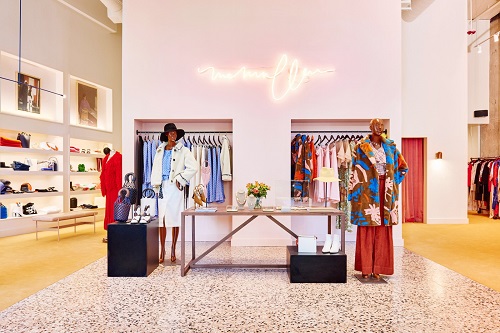 such times is paying employees. Just like a restaurant, the corporate offices of these brands house their shop-floor managers and sales assistants, many of whom are not paid when these small brands shut their doors.
In such a situation, these small, independent brands if they have an e-commerce operation they can sell or they can apply for loans. Another option open to these brands is to start selling places where they never seriously considered before like Amazon which consumers have flocked to order essential items.
Government loan to sustain business
But what these brands actually need is government assistance either in the form of capital or free rent. According to New York Times financial columnist Andrew Ross Sorkin, the government should offer a no-interest “bridge loan” to every business and self-employed worker to sustain them until the outbreak is over and people should be safely allowed to return to work. However, these companies should continue to employ at least 90 per cent of their work force at the same wage that they did before the crisis.
Though this seems like a utopian arrangement, it is currently the most ideal solution. As even though situations change, fundamental human behavior doesn’t. As soon as the pandemic ends, people will continue with their purchasing behavior. Hence, the government should support industries like fashion that enhance this consumer behavior.
According to a recent Bloomsberg survey, the US consumer confidence stabilised in May, indicating Americans are optimistic that the economic drubbing from the coronavirus pandemic will be short-lived.
The Conference Board’s index rose by 0.9 point to 86.6. The median estimate in a Bloomberg survey of economists had called for a reading of 87. The group’s subindex of expectations, based on consumers’ short-term outlook for income, business and labor market conditions, rose for a second month to 96.9. Attitudes about the present situation dropped by 1.9 points to 71.1, the lowest since 2013, as the proportion rating business conditions as bad rose to the highest since 1983.
The data add to signs that the worst of the fallout from the coronavirus is over, though there is still some way to go until the economy is back on track. While states are letting businesses reopen, confidence will be highly dependent on how well the coronavirus is contained and whether there’s a second wave of infections. Economists expect a significant pick-up in activity in the third quarter, but a return to normal is still nowhere in sight as tens of millions of Americans are out of work, schools remain closed and with no vaccine or significant treatment yet available for Covid-19.
The consumer confidence survey is one of the latest signs that while the US may be recovering from the initial shock of the pandemic, the pain is far from over. Americans are still losing jobs by the millions and reopenings have gone more slowly in some areas of the country.
The South Gujarat Textile Processors Association (SGTPA) has called for abolition of the practice of supplying grey cloth or unfinished fabric from power loom units to textile markets to stop the spread of the novel coronavirus. Instead, the association urged textile traders to make arrangements for direct delivery of unfinished fabrics to textile mills.
SGTPA president Jitendra Vakharia recently informed that around 40 textile mills will be operational after May 25 and retail stores and wholesale cloth mairkets in most states have started operations, the demand may be generated in the next fortnight, if no further lockdown is announced by the government.
The smooth operation of the man-made fibre (MMF) textile chain in and around Surat has been disturbed with about 95 per cent of the textile markets in the red zone yet to restart operation.
Faced with the mass exodus of migrant labourers and subdued demand of fabrics, the MMF industry has started with 30,000 power loom machines, which is 20 per cent of the installed capacity of 6.50 lakh machines.
According to the Pandesara weavers association, less than 10 lakh metres of fabric is weaved every day now against the installed capacity of 4 crore metres. The production will continue till yarn stocks last, he added.
The power loom units have reportedly resumed operation to safeguard their yarn stock, which was gathering dust in the units for the last 60 days.
Viscose yarn was lying in the godowns for almost two months and the stock has to be utilised before monsoon season before fungus growth.
Thousands of garment workers across Pakistan are battling against forced layoffs and months of unpaid salaries, as the deepening economic crisis caused by COVID-19 hits workers’ ability to support their families in the world’s fifth most populous country. The textile and apparel industry is
Nearly 9 per cent of Pakistan’s GDP – and almost 70 per cent of the country’s exports – comes from the industry. The pandemic has wreaked havoc on textile exports, which are mostly sent to the US, China, the UK and Germany.
Factory production has slowed dramatically across the country, with global fashion brands reducing or eliminating orders. This has precipitated a devastating crisis for Pakistani suppliers, who are passing the impact along to those least able to weather it: labourers living on meagre wages, campaigners say. In Lahore, hundreds of garment workers were reported to have organised a strike last week against the non-payment of salaries at multiple factories and activists claim factory owners are treating workers as expendable commodities.
Last year, Human Rights Watch censured Pakistan’s garment factories for rampant labour violations, including failing to pay the minimum wage, forcing hours of unpaid overtime, and neglecting to provide medical leave or adequate breaks to workers.
The ITM (International Textile Machinery) Exhibition, which is organized every two years, took a step forward by opening the Denim Technologies Special Section this year.
Denim, with its comfort and practicality, is one of the indispensable products of wardrobes and receives demands from all segments including youngsters and older people with the uprising trend of sportswear in recent years. Denim that is considered as one of the timeless products of the fashion world, effectuates a considerable economy from manufacturing to retail on this day. The success of the textile companies in Turkey in production and marketing and their proximity to European countries is considered as a geographical advantage. The fact that the ITM exhibitions are organized in Istanbul connecting the east and the west backs up this advantage.
Because of reaching the occupancy limit in all halls of the ITM 2020 Exhibition, the “Denim Technologies Special Section”, which was established for the first time as an additional hall, is making itself ready to welcome denim, fabric and ready-made garment manufacturers. It offers a great occasion for the visitors that the manufacturers will be exhibiting the latest technological innovations in denim production in this specialized hall from the machinery related to the sector to the dyes used in the production.
The Fashion Design Council of India has accepted all applications from its fashion designer members for its COVID-19 Support Fund and has now opened round two of the funding initiative to non-member designers.
The FDCI also announced that it would acknowledge the contributors to the fund at a later date as funds are still coming in.
The FDCI has been running ‘FDCInsights’ as a multi-media initiative to share stories, information, and tips from designers, stylists, and other fashion industry names during lockdown. The ‘digital discourse’ series has garnered 10 lakh views, the FDCI said.
The organisation’s next initiative is ‘FDCI Wall of Frame’ as an Instagram-based contest for fashion photographers. The contest, which closes on June 1, aims to recognise up-and-coming fashion photography talent in India and give new names a platform.
Six European apparel giants have stepped in to rally support and obtain financial aid for tens of thousands of Myanmar workers who lost their jobs in the economic fallout caused by the global Coronavirus pandemic. These include Swedish H&M (Hennes & Mauritz) Group, Spanish Inditex known for their brand Zara, Britain’s Next, Belgian-German-Dutch C&A, Denmark's Bestseller and Germany's Tachibo.
These brands have urged the stakeholders of Myanmar’s garment and footwear industry to make rapid and coordinated joint approach and action to help their workers. They have signed an agreement with suppliers and trade unions to protect the garment industry and workers in Myanmar from the impact of the COVID-19 pandemic.
This agreement with the Industrial Workers Federation of Myanmar (IWFM) and the IndustriALL Global Union aims to keep the doors of the industry open to the world and its workers protected during and after the pandemic.
Among other things, the apparel brands expressed their commitment to secure financial aid for workers and ensure that their working environment complies with health and safety rules to protect workers from novel Coronavirus transmission. The clothing companies also expressed support for workers' rights in participation in union activities and tripartite dialogue to settle issues.