FW
GFA unveils new campaign to drive sustainability awareness
As per Pulse of the Fashion Industry 2019, by 2030 global apparel and footwear industry will grow by 81 per cent, exerting an unprecedented strain on planetary resources. If the pace of progress in sustainability does not increase, the harmful consequences of fashion will become even more challenging to overcome.
To deal with this issue, Global Fashion Agenda (GFA), the world's foremost leadership forum for sustainability in fashion, has unveiled a new campaign that brings together leading voices from across the fashion industry to drive awareness and inspire action on sustainability.
The campaign includes prominent leaders such as Arizona Muse, model, ambassador and consultant; Katharine Hamnett, CBE, designer and activist; Marie-Claire Daveu, Chief Sustainability Officer and Head of International Institutional Affairs, Kering; Anna Gedda, Head of Sustainability, H&M Group; Samuel Ross, founder and designer, A-Cold-Wall*; Julia Ormond, actress and founder, ASSET; Connie Nielsen, actor and activist; Tim Blanks, Editor-at-Large, The Business of Fashion; Wilson Oryema, artist, writer, activist and model, etc.
Munich Fabric Start to organise Bluezone in September 2019
Munich Fabric Start will organise Bluezone- the world’s most important denim fair on September 03-04, 2019 in Munich. The fair will present the latest developments in denim, finishes, washes and ready-made solutions under the All-related collab Project zone in Halls 6 and 7, supplemented by vintage and timeless segments.
The All-related Collab Project zone will also define future collaborations. It will combine creativity, cooperation, transparency and responsibility. International designers, fabric suppliers, additional manufacturers and producers have split up into eight teams for this event in order to realise their vision of a sustainable denim silhouette.
Australia partners ILO to support Bangladesh RMG industry
Australia has partnered International Labor Organisation to improve working conditions, empower women and boost the competitiveness of Bangladesh’s readymade garment industry. The partnership has been strengthened by the re-commitment of funds for Better Work Bangladesh as part of Australia’s ongoing partnership with ILO. Australia has been supporting BWB since 2016 and today the program reaches 485,708 workers in 210 factories who work with 22 international brands.
Australia is committed to fund this program until June 2020 as a demonstration of support for industrial safety, labor law governance and women’s economic empowerment in Bangladesh. Australia’s ongoing support for the Better Work Bangladesh program drives important changes in workplace safety in the garment industry. Better Work has made measurable impacts on the lives of millions of workers and their families. It aims to unite multiple stakeholders; promoting decent work for all and helping the garment industry in Bangladesh thrive.
Reliance makes clothes from bottles
Reliance Industries is converting used plastic bottles into clothes. The conglomerate which has its roots in the polyester business aims at making sustainable clothing affordable and accessible. The company is already processing two billion used PET bottles every year and plans to scale it up to six billion in two years. Reliance already has an umbrella brand, R|Elan, for eco-friendly fiber made from used plastic. The manufacturing process is aimed at reducing carbon footprint at every stage by using biofuels and pre-dyed fibers, which eliminate the water and chemical discharge from wet dyeing. The strategy is to manufacture co-branded apparels and Reliance has already partnered with Arrow, Wrangler, Raymond, Lee, among other international brands.
Consumers in developed countries are embracing ethical or sustainable fashion, and are even ready to pay a premium for it. The Indian buyer, though, is still very price conscious. So as a strategy Reliance is selling the sustainable fiber on the basis of attributes that it will provide to the clothing made from it at a price competitive to non-sustainable products with the same attributes. Global brands are making everything from swimwear to winter wear to backpacks with recycled material. India can catch up soon if it looks at its waste as a resource.
WTO ranks Vietnam first in export growth
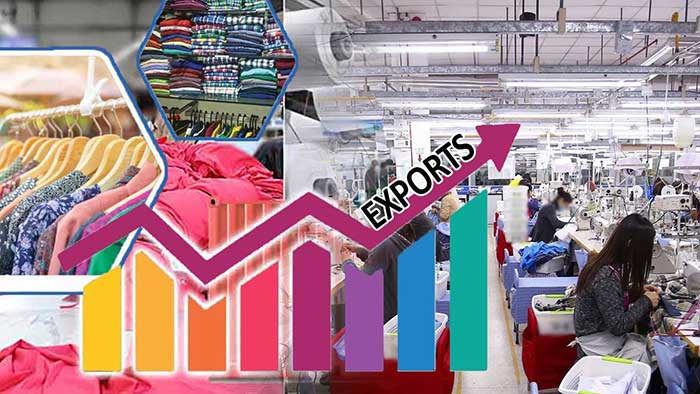
The World Trade Organisation’s index ranks Vietnam first in export growth among emerging economies. Vietnam has 14.6 per cent growth while Bangladesh is in second place with 9.8 per cent growth. The figure is 5.7 per cent for China and 5.3 per cent for India. Mexico has a 4.5 per cent export growth, UAE 3.7 per cent, Turkey 2.4 per cent, Brazil 1.9 per cent and South Africa 1.5 per cent.
Vietnam has moved faster in producing goods which are being relocated from China and has the advantages of a shorter lead to Bangladesh’s exports of apparel and clothing. Readymade garments are still the main driving factor for Bangladesh’s export growth with its increased stake in the global market. Due to the ongoing tariff war, a significant volume of trade has relocated from China to other countries but Bangladesh has been unable to capture a significant portion of it despite being an attractive sourcing destination. One reason could be poor delivery capacity. Another is the appreciation of the currency against the dollar, which has eaten up Bangladesh apparel makers’ competitive edge in global markets.
The value of Vietnam’s yarn exports to China has decreased by 2.5 per cent. The reason is the depreciation of the Chinese currency against the dollar. Vietnam imports cotton from the US to make yarn products for export to China. If the yuan continues to fall, Vietnam’s yarn producers will continue to face difficulties.
Esprit to stop sourcing from Myanmar amidst military violations
Apparel brand Esprit will no longer source from Tatmadaw – firms run by or affiliated with Myanmar’s military as they have fuelled “brutal operations against ethnic groups. This was decided by the brand after a recent report from the U.N. Independent International Fact-Finding Mission on Myanmar uncovered that revenues from the military’s affiliated businesses have been used to enhance its ability to carry out gross violations of human rights with impunity.
The Fact-Finding Mission (FFM) has highlighted in recent years, earnings from Tatmadaw – firms run by or affiliated with Myanmar’s military – have fuelled “brutal operations against ethnic groups”, said to constitute serious crimes under international law. Since 2016, the country’s military has forced the deportation of more than 700,000 Rohingya Muslims to Bangladesh; whilst 14 foreign companies have been outed as having supplied the military with fighter jets, armoured combat vehicles, warships and missile launchers during this period.
Having called on the UN Security Council and Member States to impose sanctions against companies run by the country’s military; fashion brands, including Esprit, H&M and Bestseller, have now made vocal their intentions to reevaluate where they’re sourcing from, as to stop any association.
In light of its findings, FFM made a series of recommendations which it hoped will erode the economic base of the military, undercut its obstruction of the reform process, impair its ability to carry out military operations without oversight and thus reduce violations of human rights and international humanitarian law, and serve as a form of accountability in the short-term.
Primark to train Indian cotton farmers on eco-friendly farming
Primark is training 1,60,000 cotton farmers in India, Pakistan and China in environmentally-friendly farming methods. This includes efficient irrigation, planting in rows with trenches to maximise drainage, and introducing organic pesticides and fertilisers such as cow dung, when possible, to reduce the use of chemical options. But Primark has not entirely done away with the use of fertilisers and pesticides on crops, since farmers have to deal with pests. Completely organic farming means a much lower yield.
Primark is currently using sustainable cotton in women’s pajamas, a range of denim, towels and bedding, and will be rolled out to menswear and T-shirts next. The retailer is stepping up its efforts to source 100 per cent sustainable cotton and, if successful, this should support hundreds of thousands of farmers, especially women, significantly improve their lives and that of their families. Some farmers in India have increased their incomes by 200 per cent since enrolling in the program. The retailer ultimately plans to use 100 per cent sustainable cotton in all its product categories. Meanwhile, Primark is trying out recycling units at its flagship where customers can return clothes by the brand as well as other companies. The retailer hopes to have a five-fold increase in the number of farmers enrolled in the program.
Pakistan textile exports up three per cent till July
Exports of textile articles from Pakistan grew 3.16 per cent in July 2019 as compared to July 2018. Carpets and other textile floor coverings export was up 8.79 per cent while apparel and clothing accessories (knitted or crocheted) export went up 6.57 per cent. Exports of articles of apparel or clothing accessories (not knitted or crocheted) increased 11.08 per cent. Made-up textile articles export went up 3.85 per cent while that of manmade filaments grew 22.89 per cent. Exports of manmade staple fibers increased 8.08 per cent. Exports of other vegetable textile fibers (paper yarn etc) increased by 145.28 per cent.
On the other hand, silk exports declined 44 per cent and wool, fine or coarse animal hair, horse hair yarn decreased 80 per cent. Cotton exports dipped 2.99 per cent. Exports of wadding, felt and non-woven, special yarn, twine also decreased by 97.11 per cent.
Globally competitive Pakistani exporters remain few and far between. The economy still centers around production of cotton, a commodity, while manufacturers have been slow to embrace automation. But those that have gained a global foothold may benefit from the country's depreciating currency -- the rupee has lost a third of its value in the last two years, which makes Pakistan exports cheaper.
Bangladesh seeks higher leather earnings
Bangladesh has offered the leather sector various incentives to boost exports earnings. More investment will be attracted from home and abroad for the country’s second highest export earning sector. Investors in the leather sector who adopt green technology in factories will be provided with low-cost loans. Cash incentives will be given if they set up environment-friendly industries.
Presently, Bangladesh has around 165 footwear and leather factories and they could bring in bigger export receipts were they compliant and using modern technologies. There are about 60 companies in Bangladesh which export footwear and leather goods. The destinations are mainly Japan, Europe and the US to some extent. Bangladesh produces 400 million sq ft of finished leather annually. But the country can use only 30 per cent of its finished leather. The remaining 70 per cent is exported, mostly to China. Bangladesh can earn three times more from exports of leather goods if all the finished leather produced locally is utilised. Finished leather exports fetch less than a third of a footwear item.
The country has raw leather but has to import almost all the other raw materials. By law, imports have to be done in phases and so it takes time to produce the finished goods and export.
Scientists develop cost effective method for fabricating smart textiles
Australian scientists have developed a cost-efficient and scaleable method for rapidly fabricating textiles that are embedded with energy storage devices. In just three minutes, the method can produce a smart textile patch that’s waterproof, stretchable and readily integrated with energy harvesting technologies. The technology enables graphene supercapacitors -- powerful and long-lasting energy storage devices that are easily combined with solar or other sources of power -- to be laser printed directly onto textiles.
Current approaches to smart textile energy storage, like stitching batteries into garments or using e-fibers, can be cumbersome and heavy, and can also have capacity issues. These electronic components can also suffer short-circuits and mechanical failure when they come into contact with sweat or with moisture from the environment. The graphene-based supercapacitor is not only fully washable, it can store the energy needed to power an intelligent garment -- and it can be made in minutes at large scale. The technology can enable real-time storage of renewable energies for e-textiles.
The growing smart fabrics industry has diverse applications in wearable devices, health care and defense sectors -- from monitoring vital signs of patients, to tracking the location and health status of soldiers in the field, and monitoring pilots or drivers for fatigue.