FW
Spain’s Jeanologia works on five zero finishes
Jeanologia has introduced two new collections, 5.Zero indigo & vintage and 5.Zero all blacks. The five zero finishes are: zero discharge, zero manual scrapping, zero potassium permanganate spray, zero stone washing and zero bleach.
The collection 5.Zero indigo & vintage is inspired by the vintage of the ’80s, ’90s and 2000s and shows how, through the use of Jeanologia’s laser, it is possible to create wear and other effects from the era, saving water and considerably reducing the use of chemicals and energy. The collection 5.Zero all blacks shows the benefits of the eco-technology for developing finishes on black denim. Combining the use of laser and G2 ozone technology the white effect in the used area is enhanced, avoiding the use of potassium permanganate spray.
These technological solutions aim at making the industry fully sustainable, maintaining quality, product look and the rationalization of production methods. The company, based in Spain, feels it’s possible to achieve this with the combined use of its technologies like laser, ozone and e-Flow, along with the right fabric selection, and the light sensitive fabric tool.
Since 1993, Jeanologi’s mission has been to improve garment finishing through its technological knowhow.
Garmon launches new textile dyes
Garmon Chemicals has launched OVO, a new line of textile dyes. These offer significant advantages both in terms of sustainability and saving of resources when compared to reactive dyes.
The line includes 22 direct dyes that inhibit extraordinary color effects. These dyes have excellent dischargeability, with the ability to achieve superior results without any aesthetic compromises. Furthermore, these dyes are used in the cationised dyeing processes on garments, where surface deposition of the color on fabric is required.
The new project uses only five process steps instead of eight. This leads to lower quantity and higher performance of both dyes and auxiliaries, and also allows for much easier corrections of final shades.
Garmon Chemicals, founded in 1982, is a customer-centric R&D powerhouse that is geared towards innovation with the goal of guiding change in the garment industry. The effort that the company dedicates to product innovation and constant research for eco-centric solutions is supported by the unmatched Garmon expertise in anticipating its customers’ needs.
Along with the new line of dyes, Garmon has also launched its enhanced Stretch Care Collection that includes Elam Sense and Fortres Flex. Elam Sense is the softener for high-quality finishes on super and hyper stretch fabrics, completely aminoethyl-ethanolamine free. Fortres Flex is a dispersing agent that performs at its best even at low temperatures.
EU apparel imports up ten per cent in July
The European Union’s apparel imports rose 10.70 per cent in July this year. From January to July ’18, the EU’s imports of apparels upped marginally by 0.06 per cent. In this period the value of China’s apparel exports to the EU fell by 6.78 per cent. Unit prices this year too plunged by 1.60 per cent. The continued fall indicates China is no longer a favorite place for European buyers to place orders. But China remains the EU’s largest apparel sourcing destination, with Bangladesh taking second place.
Bangladesh’s apparel exports to the EU grew 3.92 per cent year on year. Turkey somehow remained stable despite the worst ever economic crisis it is facing and managed to tap a 2.90 per cent growth in its apparel shipments to the EU. Turkey’s unit prices remained the highest among all top apparel exporters to the EU.
India’s value of apparel exports to the EU fell 3.02 per cent. India's readymade garment sector will continue to enjoy 20 per cent duty preference on exports for the next three years to EU markets. Vietnam saw a 2.44 per cent growth till July ’18.
The EU itself has a vibrant textile and clothing industry, covering a wide range of activities like transferring raw fiber into yarns and then yarns into fabric and then finally using the fabric to produce a wide range of finished products such as wool, bed-linen, geo-textiles, clothing, and synthetic yarns.
Century Textiles’ net profit up threefold in Q2
For the second quarter Century Textiles & Industries’ net profit jumped nearly threefold. Net sales were up 8.83 per cent during the quarter under review as against the corresponding period last fiscal.
Profit before interest, depreciation and tax jumped 40 per cent. Total expenses rose 8.35 per cent. Revenue from the textile segment surged 37.83 per cent. Revenue from cement was up 16.84 per cent. Revenue from pulp and paper was up 28.04 per cent.
The company’s debt stood at around Rs 4,200 crores as at September 30, 2018, and after the demerger of the cement division, it will be reduced by Rs 3000 crores, putting it in a strong position to deliver robust growth going forward.
Mumbai-based Century Textiles and Industries is active in textiles, viscose filament yarns, cement, and pulp and paper. In the textile business, Century has two revenue streams: cotton fabric and denim units. The company has a vertically integrated plant at Bharuch for manufacturing cotton fabrics.
Century’s cotton division is one of the oldest players in India and manufactures a wide range of premium textiles and supplies to many international players, including Royale Linen, Ralph Lauren, DKNY, Belk and US Polo. Minority shareholders gave a thumping support to the company’s decision to sell its cement assets.
Circular bedding solutions from Reliance
GHCL has launched Cirkularity, a new brand of bedding. The brand platform is inspired by Rekoop, the first bedding solution to use Applied DNA’s Certain T platform and Reliance’s Recron GreenGold fiber for source verification and traceability of recycled polyester across the supply chain.
Rekoop uses Certain T platform to trace and authenticate post-consumer recycled polyester plastic in its bed sheets and pillow cases throughout the entire supply chain. This technology provides forensic proof that goes beyond a paper document. It guarantees brand authenticity, a growing concern for manufacturers as counterfeiting continues to escalate.
As a part of the integrated supply chain for Rekoop, Reliance is also partnering with Applied DNA Sciences in the use of the molecular-based solution for recycled PET to produce certified fiber for home textiles, apparel, footwear and other applications.
GHCL, operating its home textiles facility in Gujarat, incorporated the Certain T verified rPET fiber into its production process, from spinning to weaving to finished processed fabric.
Textile manufacturing is changing from linear to circular paradigms to ensure transparency, authenticity and sustainability. Reliance plans to work closely with Applied DNA Sciences and GHCL to forge new paths to bring the required changes to drive the circular concept in the industry.
Buyers tight fisted with Bangladesh
Bangladesh’s exporters do not get fair and reasonable prices for their products. Reasons include lack of negotiation skills. Negotiation skills at both the entrepreneur level and government level and relationships with buyers are seen as important for reaping fair prices for export products. Exporters get lower prices for readymade garment products compared to Cambodian and Vietnamese exporters from global buyers. Buyers do not want to pay higher prices, although the cost of production will go up further with wage hike, port congestion and higher transportation cost.
Domestic competitiveness, cost of doing business, workplace safety, diversification of products and markets, skilled labor force, attracting foreign direct investment and technological advancement and automation in the production process are key to maintaining momentum in export growth.
Readymade garment workers in Bangladesh log in 60 hours a week. In Cambodia they work 47 hours a week. Also 54 per cent of workers in Bangladesh are paid below the minimum wage. The country’s entrepreneurs are being urged to provide a living wage to enhance productivity and meet the nutritional needs of workers. Another issue is that of lead time. This would be a matter of concern for RMG exports in future as the country might lose the cost advantage in coming days.
Abuses rife at Bangladesh tanneries
Labor and human rights and environmental practices are being violated in Bangladesh’s leather sector. Workers labor in tanneries in hazardous environments and many of them are underage despite the fact that Bangladesh prohibits work by anyone under 18 at a tannery. They are exposed to heavy metals like chromium, cadmium, lead and arsenic, as well as biocides, acids, bases and dyes, and usually have little protective gear to safeguard themselves from exposure to these hazardous chemicals. Workers are often soaked in chemicals and frequently breathe in hazardous fumes.
Tannery workers often suffer fever, eye inflammation, skin diseases and cancer as they work with toxic chemicals and rarely have any safety training or protection. They work long hours with toxic chemicals for poverty wages, making shoes and clothes for western brands. Accidents regularly occur. Machine operators get trapped. Workers cleaning underground waste tanks suffocate from toxic fumes or drown in toxic sludge at the tannery premises. Deaths often occur due to hydrogen sulphide inhalation.
Due to the absence of a fully functional waste management infrastructure, the tanneries dump thousands of cubic meters of untreated waste into rivers and fill the water with toxic chemicals. The central effluent treatment plant is yet to be fully functional and there is no effective system yet in existence to remove salt from effluent.
Prosperity Textile aims to touch 100 million yards per annum mark next year
"A global leader in denim fabric Prosperity Textile has introduced multi fiber types. These are different fibers like cotton, Tencel, polyester rayon, etc, blended together to improve performance and the features. The company, founded in 1999 in China, will also start operating its Vietnam unit from next month. The unit has one roller dyeing for the denim. “We have around 120 looms and one full set for finishing. So our first phase capacity is 1.2 million yards per month,” explains Andy Zhong, Managing Director. The second phase of production will start in 2019 and by 2020 the aim is to reach five million yards. In China the capacity of Prosperity Textile for denim is about 80 million yards per year. “And by next year we will be close to about 100 million yards a year. Finally it will be more than 120 million. That’s the total capacity because we have 80 million in China, about 40-50 million in Vietnam.”
 A global leader in denim fabric Prosperity Textile has introduced multi fiber types. These are different fibers like cotton, Tencel, polyester rayon, etc, blended together to improve performance and the features. The company, founded in 1999 in China, will also start operating its Vietnam unit from next month. The unit has one roller dyeing for the denim. “We have around 120 looms and one full set for finishing. So our first phase capacity is 1.2 million yards per month,” explains Andy Zhong, Managing Director. The second phase of production will start in 2019 and by 2020 the aim is to reach five million yards. In China the capacity of Prosperity Textile for denim is about 80 million yards per year. “And by next year we will be close to about 100 million yards a year. Finally it will be more than 120 million. That’s the total capacity because we have 80 million in China, about 40-50 million in Vietnam.”
Multiple blends within single fabrics
Prosperity Textile offers multiple blends within single fabrics. “Some fabrics have three to five blends,” Andy says. “You can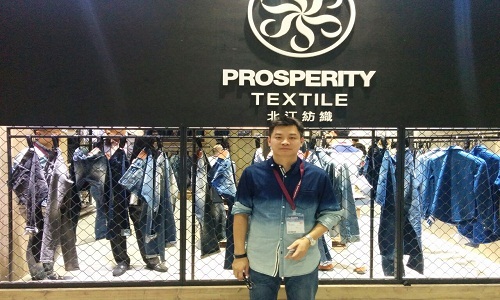 see more colors like the indigo for winter. Every shade of this color has a different dyeing process, with different dyeing stuff, material etc. The dark blue shade is in demand as it is easily washable and easy to maintain,” he adds.
The company’s products are exported worldwide. “Our major markets are: Bangladesh and Vietnam followed by Cambodia, Indonesia and other Asian countries,” Andy informs. “We sell around 50 to 60 per cent to China and export around 20 per cent to Bangladesh. Exports to Vietnam, Cambodia and Indonesia is about 5 per cent each,” he adds.
Business under pressure from rising prices
Talking about business Andy says, “Business this year is challenging. Demand is good but costs of material, dyeing ingredients, chemicals etc, have increased.” The reason for price increase is rising costs in China. “Also, there was a lot of focus on compliance during the first half of the year though it did not affect us; it affected others like the chemical supply chain etc, price of dye stuff increased 30 to 40 per cent during the first half of the year. And supplies were tight,” he adds. Prosperity Textile believes in fast delivery and therefore, keeps fresh inventory in large numbers. “We want to maintain prices of raw material, which puts a lot of pressure on us. But after the first six months, things have become easier now. Normally, second half of the year has a larger market share than the first half. This year, we have seen a modest increase compared to last year,” he adds.
Growing demand for denim
Andy points out, in the last few years, demand for denim has increased exponentially. “Brands and retailers have increased their denim portfolio, which makes us more confident of growth in the next few years,” he states. “Pressure from the other segments provides a lot of useful information, as we get better reference about denim requirements. In the past few years, denim has seen a lot of changes,” he adds.
Elaborating on upcoming denim trends, Andy says, “About 70 to 80 per cent of the denim fabric today is stretch. It is the current market trend. So, we work on four ways stretch or a comfort stretch. We also use sustainable materials, like sustainable cotton, sustainable recycled cotton, polyester etc. Ideally, this would offer more comfort and style,” he concludes.
Interfilere Shanghai 2018: The meeting point of all global players in the lingerie and swimwear industry
Visitor flow remained steady and strong as 2017at Interfilere Shanghai, while the quality, as endorsed by the suppliers, was once again ensured at its premium level where all the attendees had been validated as industry professionals. In the 14 edition of Interfilere Shanghai held from September 27-28, 2018, 75 per cent of the visitors are from China and 25 per cent goes to the rest of the world which Japan, Korea, USA, Indonesia and Spain registered increases in number. nspired by the movie Black Panther, the Prototype Fashion Show presented a selection of finished products around the theme Tribal Tech, articulating to the visitors the technology, motifs and substantial elements engraved in each showpiece.
 Visitor flow remained steady and strong as 2017at Interfilere Shanghai, while the quality, as endorsed by the suppliers, was once again ensured at its premium level where all the attendees had been validated as industry professionals. In the 14 edition of Interfilere Shanghai held from September 27-28, 2018, 75 per cent of the visitors are from China and 25 per cent goes to the rest of the world which Japan, Korea, USA, Indonesia and Spain registered increases in number.
Delivering values to the audience
Inspired by the movie Black Panther, the Prototype Fashion Show presented a selection of finished products around the theme Tribal Tech, articulating to the visitors the technology, motifs and substantial elements engraved in each showpiece.
Interfiliere Shanghai in collaboration with Taobao iFashion presented the GenZ Fashion Show on Sept 26, featuring 5 iFashion lingerie and loungewear brands - Miss Curiosity, Ubras, Miss Kiss, PJM and Six Rabbit. By connecting digital world with real life experience, the fashion show facilitated the communication between brands and Gen Z consumers, supported brands in delivering their strong identities and values to the audiences.
Optimising the resources
With inspirations from the world as a global village, and handpicked spectacular pieces of craftsmanship from the exhibitors, the Trend Forum encouraged the audience to be creative and indulge in a healthy life environment where a balance of comfort & aesthetics, culture & wellness could be reached.
The Innovation Forum curated by the French Knitwear and Lingerie Federation provided the visitors with a thought-provoking experience to rethink the textile clothing industry from a sustainability perspective, with reduce, reuse and recycle as pillars. The exhibits enlightened the industry players to optimise the environmental impact whilst maintaining the product performance through various eco-approaches.
Awarding the experts
With the belief that young talents will significantly contribute to the future of our industry, Interfiliere Shanghai launched the very first edition of Young Label Awards dedicated to new industry forces, with the wish to assist them in going a step further by linking with industry experts.
The 5th Interfeel’Awards , which recognized professionals of the intimates, swimwear and sportswear industry, rewarded the know-how and collections of 6 Interfiliere Shanghai exhibitors.
A thought-provoking experience
Specialists from Concepts Paris, WGSN, Carlin Creative Trend Bureau and Daxue respectively shared their insights on the upcoming body fashion trends and helped the audiences to navigate towards new markets. On the other hand, experts from Redress and Support Ltd dived deep into the intersection of fashion and sustainability, motivating the audiences to undress wastes issues and explore circularity for fabrics and product design.
Eurovet signed a partnership agreement with Jinjiang Swimwear Industry Association (JJSIA) during a press conference. Marie Laure BELLON, CEO of Eurovet Group stated the vision of the collaboration: “Interfiliere Shanghai 2018 is only a start, the first stone of our cooperation, and today we are signing with the Association an agreement, that will be the framework of a more global cooperation between us. She also emphasised: “With China being the largest market in the world, swimwear will experience exponential growth in the coming years, and associations such as JJSIA will play an important role in this industry.”
WWF, business group seek to green textile industry
World Wide Fund for Nature and the Việt Nam Textile and Apparel Association launched a project to make the textile industry more environment-friendly in Hà Nội The project is a part of the “Driving impact reduction through the textiles value chain” project sponsored by HSBC to support the green textile industry in China, Bangladesh, India, and Việt Nam.
The project will be implemented from 2018 to 2020 with a vision to transform the textile-apparel sector in Việt Nam. This will be achieved by engaging the industry and influencing environmental governance in order to bring social, economic and conservation benefits to the country. The main focus of the project is to improve water and energy sustainability in the sector, thus reducing its impacts on the environment.
It will also work with textile–apparel manufacturers to encourage them to be more active river stewards, practise sustainable energy planning and discuss collective actions for long-term sustainable investments and development in the sector. One important target of the project is to influence Vietnamese textile investors to implement more sustainable practices.
Key stakeholders in the project include international brands with suppliers in Việt Nam, factories around the country, in particular in the Mekong and Đồng Nai deltas in areas around HCM City, financial institutions, development partners, and other relevant stakeholders.