FW
Gap may hike prices as a fallout of tariff war
Gap might increase prices due to tariffs on Chinese goods. While most of its products are from Vietnam, about 22 per cent still come from China. As the retailer plans to continue moving away from China and expand sourcing to other nations, but there are certain items — like sweaters — where China has a strong advantage. And this will ultimately be a tax on the consumer.
The trade dispute is just one of the challenges facing Gap. The company has struggled with declining mall traffic, operational missteps and disappointing growth. The Gap brand, in particular, has fallen short, and the company is increasingly relying on its Athleta and Old Navy chains for growth. The company’s success with its Athleta brand inspired its new men’s brand, Hill City, which fuses sportswear with everyday apparel.
Over the next five years, Gap plans to ramp up its acquisitions, using Athleta as a model. Gap will eye other companies with a similar profile that don’t have a lot of stores and could benefit from Gap’s platform. The company will also seek to boost e-commerce, hoping online sales make up as much as 60 per cent of sales by 2023. The company may have the same amount of stores by then, but they’ll be smaller and with more technology enhancements.
Sportswear brand Under Armour to slash 400 more jobs
Sportswear maker Under Armour will slash around 400 jobs, or 3 per cent of its global workforce, in order to cut costs in its struggle to compete with Nike and Germany’s Adidas in North America. This is the second round of job cuts for the Baltimore-based company, which cut 277 jobs last year as part of a 2017 restructuring plan. The company had about 15,800 employees at the end of last year, and the workforce cuts are expected to be completed by March 2019. Under Armour expects to incur between $200 to $220 million in expenses for the latest rejig, which would be the final update to its 2018 restructuring program, slightly higher than an earlier estimate. Under Armour now expects annual adjusted earnings of 16 to 19 cents per share, compared with a previous estimate of 14 to 19 cents. Under Armour's sales in North America have risen only once in the past four quarters as it faced up to new sales pushes by its bigger rivals, and it expanded its cost-cutting programme in February.
Vietnam: Textile industry to witness transition period in 2019, say experts
Experts at the Hà Nội Textile & Garment Industry – Fabric & Garment Accessories Expo in Vietnam said, the textile and garment industry is likely to go through a transition period in 2019; requiring breakthroughs to shift its position in the global value chain. A representative from the Ministry of Industry and Trade also reiterated that 2019 would continue to be a challenging year for the textile and garment industry. The sector needed to shift towards a new position in the global value chain, from Cut-Make-Trim (CTM) to Original Equipment Manufacturing (OEM)/Full Package/Free on Board (FOB) and Original Design Manufacturing (ODM) and Original Brand Manufacturing (OBM) to generate higher added value.
Experts also said that the Industry 4.0 would have significant impacts on the industry, forcing producers to invest more in equipment and staff. However, they warned that Việt Nam’s textile and garment sector would face fiercer competition from Bangladesh, Cambodia, Laos, Sri Lanka and Myanmar, adding that it was important to enhance competitiveness to be able to grasp opportunities.
TCA meeting in Lubbock discusses issues facing cotton supply chain
About 220 people representing all segments of cotton supply chain such as producers, warehouse operators, merchants and shipping agencies met in Lubbock recently for a meeting organised by Texas Cotton Association (TCA).
The purpose of the annual meeting was to provide a forum and setting for each segment of the cotton industry to meet and communicate any anticipated problem associated with flowing Texas cotton to market. Kandice Poteet, Executive Vice President of Texas Cotton Association, in a recent meeting with China National Textile and Apparel Council, held in Dallas, indicated demand for US cotton in China would increase by million bales over previous years, which is highly significant while there are trade disputes between the two countries.
Tariffs occupied center stage in the discussions. Although China’s image as the number one importer of US cotton has eroded in the past two years, it still imports good quantity and hence the situation needs attention. As textile processing is shifting away from China, focusing on the needs of emerging markets in Southeast Asia such as the flow to these markets must be carefully considered by the United States’ cotton industry.
India: SIMA CD&RA gets new office bearers
The SIMA Cotton Develoment and Research Association has made several new appointments. R Elango, Managing Director of Sangeeth Textiles, Coimbatore has been unanimously elected chairman for the year 2018-19. He is also the board member of ITF (Indian Texpreneurs Federation and Yarn Committee Member in TEXPROCIL. Similarly, R Ravichandran, Director, Veejay Yarns & Fabrics was elected as the deputy chairman of the association and G Venkatramachandran, Managing Director of Laven Technoblend was elected as vice-chairman.
A registered non-profit organisation, SIMA CD&RA was established in 1974 by the textile mills of Southern States of Tamil Nadu, Andhra Pradesh, Karnataka and Pondicherry. It aims to promote the development of cotton farming for enhancing cotton production, productivity and fibre quality so that the raw cotton may be made available at reasonable price to the textile mills. It supplements the efforts of the state and Central governments and other agencies in promoting the increased production of quality cotton to meet the demands of the textile industry.
Tariffs threaten US-China apparel and textiles sector
The US is hoping to use tariffs to bring about a deal with China that would, among other things, address long-standing concerns related to forced technology transfer and intellectual property rights. Initially, tariffs were on high-tech goods and equipment while avoiding consumer items. The idea was to concentrate pain on China without exposing US consumers. But the latest list contains a wide variety of consumer products.
Diaper bags, baseball caps, fabric, and metal snaps are all on the front lines of the trade war. Those items, and many other fashion articles and accessories, will be subject to an additional 25 per cent tariff when imported from China. They join about $200 billion worth of products — including special chemicals, boats, wood flooring, furniture, bicycles, medical and surgical equipment, sports gear, snow blowers, art, and more — that are also in danger of additional tariffs. Apparel, footwear, and other home textiles have so far escaped being targeted.
The US tariff approach has triggered retaliation from China, and other countries, which have proposed import taxes on a wide range of American-made products. While much of this retaliation has been targeting US agriculture, a surprisingly high number of US-made textile and fashion items have also been included.
L-Gam looking at acquiring majority stake in sportswear brand Woolrich
Woolrich and L-Gam Advisors Sarl, a Luxembourg-based investment company are partnering Princely Family of Liechtenstein, for the acquisition by L-Gam of a majority of Woolrich’s shares. The agreement marks a further step in the globalization process of Woolrich. Following the merger of Woolrich Europe with the American parent company in 2016, the group in 2017 entered into a minority financial partnership and an industrial agreement with the Japanese outdoor giant Goldwin.
The agreement with L-Gam, a long-term oriented investment company, aims to give further impetus to Woolrich’s international expansion plan in Europe, North America, Japan and an entry into China by 2019.Woolrich is the Italian-American company behind the historical sportswear brand Woolrich.
Goldwin is a Japanese technical leader in outdoor apparel. It is a top-notch industrial partner in this field as it holds the rights for the use of brands like The North Face in Japan and Korea. It produces and sells highly functional sportswear brands including Helly Hansen, Danskin and Ellesse.
The aim of this operation is to make the Woolrich brand further expand globally, as it starts to offer a new outdoor and more sports-oriented collection. Woolrich will develop a first capsule collection of about 20 items to be delivered by fall/winter 2018-19.
US cotton demand to move north despite trade disputes
Demand for US cotton in China is expected to increase by one million bales over previous years. This is highly significant since there are trade disputes between the two countries. The flow of cotton from the United States to markets several thousand miles away is complex, and any trade dispute surely affects the flow. Though trade wars come and go, an extended trade war can affect the supply chain.
China’s lead as the number one importer of US cotton has eroded in the past two years, but it still imports a significant quantity. Meanwhile US cotton faces other issues. This year’s US cotton is expected to be better than the 2017 crop. The staple length is good and micronaire is returning to normal ranges. But textile processing is shifting away from China to emerging markets in Southeast Asia. The US cotton industry has to consider the flow of cotton to these markets. Providing contamination-free, good quality cotton based on a reasonable delivery schedule is important for the United States to have premium markets.
The US cotton industry has worked hard for many years to build the reputation of being contamination free. The whole industry, from producers to ginners, has to do everything possible to keep plastic out of cotton harvesting and processing.
Shima Seiki to participate in upcoming PH value 2018 AW in Shanghai
Leading computerised knitting machine manufacturer Shima Seiki, alongwith its Hong Kong subsidiary Shima Seiki (Hong Kong), will participate in the autumn edition of the China International Knitting Fair (PH Value 2018 AW) exhibition in Shanghai, China this month. The exhibition will be held from September 27 to 29, 2018 at the National Exhibition and Convention Center in Shanghai.
This is the first time Shima Seiki will be participating in the PH Value 2018 AW. As a trade promotion and business-to-business platform for the Chinese knitting industry, PH Value offers an opportunity for Shima Seiki to reach out to apparel manufacturers, retailers, merchandisers as well as ecommerce businesses in the Chinese fashion value chain. It will display APEX3 design system.
At the core of the company’s Total Fashion System concept, APEX3 provides support throughout the production supply chain, integrating production into one smooth and efficient workflow from yarn development, product planning and design to production and even sales promotion.
Applied DNA Sciences unveils tagged thread
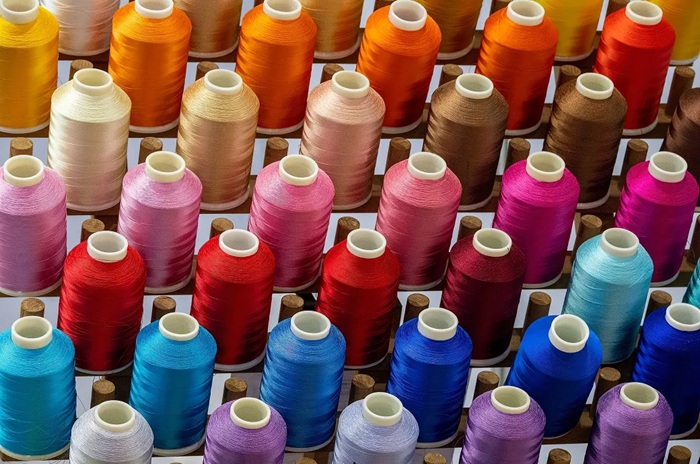
Applied DNA Sciences in partnership with American & Efird has unveiled a DNA-tagged thread that includes a DNA marker. This can test authenticity by adding a small amount of activator fluid to a swab that has been brushed on the product to collect a sample.
This is a biochemistry-based innovation in apparel authentication and can decrease the threat of counterfeit products in different industries. American & Efird is a thread manufacturer. With its array of thread products, A&E’s broad client base includes customers who use threads for industrial sewing, embroidery, consumer products and technical textiles. Among its clientele, A&E counts major fashion brands that rely largely on a reputation for quality and unique approaches to apparel manufacturing. This customer base includes makers of luxury apparel and accessories, a segment extremely vulnerable to counterfeiting.
Applied DNA Sciences provides DNA tagging as a type of verification to ensure authenticity of an array of products—from military electronics to Pima cotton. Through investing in anti-counterfeiting science at the beginning of the supply chain, manufacturers will not only deter counterfeiters but increase retailer confidence when selling to consumers.
The garment is brushed with a swab that becomes fluorescent under a black light after activator fluid is applied. By swabbing the fabric, testers at the end of the supply chain can verify a genuine article without damaging the product.