


FW
Yarn Expo Spring edition sees enhanced participation by 15 per cent
"Yarn Expo continued its growth story as the industry’s most comprehensive and effective business platform with its Spring edition which concluded recently. It saw a large increase in buyers, as well as another year of growth in exhibitor numbers. Strong demand was evident in synthetic, fancy and specialty yarns as well as chemical fibres, while exhibitors in the more traditional cotton product group also fared well. In total, 435 exhibitors from 10 countries and regions took part, attracting 25,966 trade buyers from 88 countries & regions."

Once again, Yarn Expo proved itself as the ideal trade fair for the industry to benefit from changing demands and product trends, especially in the Chinese and wider Asian markets,” Wendy Wen, Senior GM, Messe Frankfurt (HK) explained. “The fair has evolved in recent editions to have a much bigger focus on synthetic, fancy & specialty yarns and chemical fibres, and based on the exhibitor feedback during the fair, there was an increase in buyers sourcing these products this year. What’s more, local buyers were showing strong interest in the offerings from Southeast Asian countries such as Indonesia and Thailand, while Vietnamese cotton exhibitors reported increased orders from China due to the favourable trade policies between these countries.”
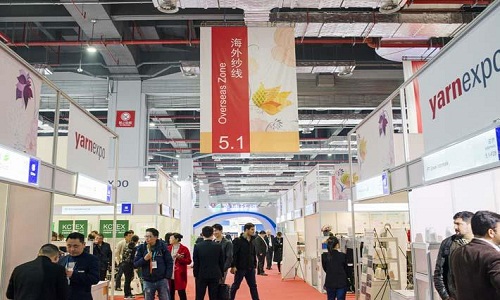
As one of the industry’s leading players, Birla Jingwei Fibres plays a big role at Yarn Expo, with their Birla Planet pavilion proving to be highly successful. Sachin Malik, Sr-VP explained, “Yarn Expo is an important platform for Birla, to be visible to our value chain, to connect with our customers, and our own clients’ customers. We value Yarn Expo as a long-term partner for showcasing our products and connecting with the value chain. Each edition we connect with more and more buyers, and more customers in the industry recognise the importance of this fair. It has developed into a premium event in the global textile industry calendar. Usually this edition is quieter than the autumn fair, but the results this year saw the spring edition reach the same level. Our booth was always packed with buyers, and we also received more high-quality and international buyers. Our pavilion members are also very satisfied with the buyers and their results this time.”
Exhibitors upbeat about show
Satisfied with their participation, most exhibitors were happy with the show’s turnout. Anupam Agrawal, Director – spun yarn business, PT. Indo-Rama Synthetics Tbk said, “Yarn Expo is an ideal platform to meet not only Chinese but also global buyers. The fair attracts so many good-quality buyers, and compared to other fairs attracts more of our target buyers. The results in this edition have been good. After four years of doing business in China, we have found many Chinese customers who are willing to pay for quality. The demand in the China market for high-quality products is growing, in particular because of the shortage of spinning capacity which is made up for by imports. We have seen more serious and meaningful buyers that have strong desire for further cooperation this time, and I think the potential of this market will continue to grow.”
Joo Son, International Sales Team, HJLite, Korea observed, “Our booth was so crowded throughout the fair. We had more than 300 buyers visit us, and I guess approximately 30 per cent of them will turn into business after the fair. Our target buyers are fabric and garment manufacturers, and we found a lot of good quality ones here. A wide range of worldwide buyers from different market sectors sourced at our booth, especially big-brand sportswear manufacturers and sourcing offices. We have had visitors from China, Europe and many other countries. We are very satisfied with our first Yarn Expo experience, and we expect a very good outcome after the show.” N Sarawgi, Representative of Madhusudan Rayons, added, “Yarn Expo is really helpful in that it has a diverse buyer profile and attracts buyers from around the world. We managed to talk to customers from Pakistan, India and Colombia, as well as potential Chinese buyers who are very interested in our products. The buyers have been genuine with specific sourcing needs, and some of them have already placed orders.”
Buyers a satisfied lot Visitors too were happy with the products & services basket showcased. Wang Gaofeng, DGM, Jiaxing Jinqie Fashion, China, stated, “We can find all ranges of cotton yarn, fancy yarn and chemical fibres at Yarn Expo. Most of the famous brands are here, and they bring the latest technologies and products, including debut products. Yarn Expo always catches the latest trends in the industry and presents them at the fair. This year the quantity and quality of fancy yarn exhibitors has increased, so I’ve found some products to source already.” Linggar Jati Halim, director, PT. Kartika Sinar Mulia, Indonesia, averred, “We mainly came to source fancy yarn this time, and we found many new options. This international show greatly expands our sourcing options. Many of our existing suppliers, including from Indonesia, exhibit at this fair so that’s why we source here. We are satisfied with the exhibitor quality and intend to place orders afterwards. There have been a number of new technologies presented here that left a deep impression on us.”
Climate may wreck garment industry
Climate changes may be affecting the readymade garment sector in Bangladesh. Diseases spike during extreme weather events. In garment factories, the humidity, combined with heat and fabric dust emitted by the sewing machines, makes breathing difficult. These conditions exhaust workers’ energy and focus, affecting their efficiency and productivity, which in turn also may be affecting the performance of the readymade garment sector.
From May to September, monsoon in Bangladesh brings tropical rains, muddy roads and a kind of shocking humidity that makes clothes stick to the skin. In addition to causing extreme temperatures, the monsoon’s heavy rains fill streets and seep into buildings, turning factories and residential areas into breeding grounds for mosquitoes and water-borne diseases.
Rising temperatures and more frequent flooding events are likely to increase with climate change, and in Bangladesh, this will affect the lives of the four million people working in the garment industry. These employees are disproportionately women. The industry is the largest employer of female workers in Bangladesh. By holding back the industry, climate change could undermine the progressive women’s social and economic achievements that Bangladesh has experienced over the last 30 years. The projections of increasing extreme weather events due to climate change pose a significant future risk for the garment industry.
Coats hires Keith DuPont as President, Performance Material
Keith DuPont has been appointed new President, Performance Materials at Coats. The Performance Materials business includes hi-tech end uses such as automotive, composites, fiber optics, flame retardant and engineered performance fabrics and knits.
Du Pont will be responsible for delivering the overall strategy for Performance Materials, including operational and commercial activities, meeting sales and organic growth targets as well as developing talent. He has over 25 years’ experience of manufacturing and commercial leadership across the metals, plastics and chemical sectors.
He also held several strategic sales and marketing roles at SABIC, a global leader in specialty plastics, focused on identifying and developing new product innovations for the automotive, electronics and specialty materials markets. He is a mechanical engineer. He has the required skills, expertise and mindset to accelerate profitable sales growth in Performance Materials.
Coats is the world’s leading industrial thread manufacturer and a major player in the Americas textile crafts market. At home in some 60 countries, Coats employs 19,000 people across six continents. In 2017 Coats’ revenue grew by four per cent, driven by apparel and footwear (up five per cent) and Performance Materials (up 12 per cent). Adjusted operating profit was up 11 per cent. Group operating margin was up 11.5 per cent.
India’s cotton industry needs revival
The Indian cotton textile industry has been losing its sheen on various fronts. From weaving and processing to rising labor costs, inconsistent fiber policy, delay in signing free trade agreements, have all pushed the cotton textile industry to a tight spot.
The garment sector in the textile value chain is at its lowest ebb, losing out to low cost countries such as Vietnam and Bangladesh, as they enjoy least developed countries status. The spinning sector has established a benchmark, but scaling is required in post-spinning operations, particularly in weaving, processing, knitting and garmenting. There is a need to scale up garmenting. Lack of access to capital and the size of operations have put them in a disadvantageous position.
The knitwear cluster has had to conform with various compliances such as ZLD and social compliance, which, in turn, have resulted in a 10 to 15 per cent rise in production cost, making the operations unviable. Price risk management is important for the cotton sector. The market size is huge, at Rs 65,000 crores, but in 2017-18 the risk cover was only to the extent of Rs 9,000 crores. There is a need for the industry to utilise the MCX platform more aggressively.
Germany hosts 34th Bermen Cotton Conference
The 34th International Cotton Conference Bremen was held in Germany from March 21 to 23, 2018. More than 500 participants from almost 40 countries exchanged views on the latest trends in the natural raw material.
This year, the conference developed into a whole week of diverse events around the entire cotton supply chain. With the focus on Africa, the emerging continent, which also has a special significance for cotton, became the center of attention. The keynote session gave participants an overview, with an informative analysis of the current cotton situation. The marketing of cotton and changing consumer habits in a globalised and digitalised world were the subject of lectures. There was a look at the raw material from a stock market perspective.
Digitalisation is also a cross-cutting issue that runs through the entire supply chain of the cotton industry. One session emphasised the importance of digitalisation for the industry. This enables new approaches in cotton cultivation and textile processing and also influences consumer behavior and thus the necessary changes in the textile industry. The focus is on the status quo of the implementation as well as the opportunities and risks of digitally controlled, vertically integrated procurement and sales processes and the associated challenges at retail level.
CFTA sees 44 African nations signing the pact
Forty-four African countries have signed an agreement establishing a free trade area, seen as vital to the continent's economic development says the head of the African Union. Moussa Faki Mahamat, Chairperson, AU Commission says the agreement establishing CFTA (African Continental Free Trade Area) was signed by 44 countries. The creation of a free trade area billed as the world’s largest - comes after two years of negotiations, and is one of the AU's flagship projects for greater African integration.
However, other economic powerhouses South Africa, Kenya, Morocco, Egypt, Ethiopia and Algeria known for strict protectionist policies restricting imports and exports. The agreement will still have to be ratified at a national level, and is only due to come into force in 180 days.
The full list of countries which did not sign the agreement is not yet available, however, Nigeria is a notable absentee after President Muhammadu Buhari pulled out of the launch in Rwanda saying he needed more time for consultations at home. Nigeria, one of Africa's largest markets, hesitated after objections from business leaders and unions a sign that getting the deal through scores of national parliaments may face several hurdles.
Albert Muchanga, the AU Commissioner for Trade and Industry says that some countries have reservations and have not finalised their national consultations. But it shall have another summit in Mauritania in July where countries with reservations sign is expected.
India hopes EU responds positively to FTA
India will revive the free trade negotiations with the European Union (EU). As many as 16 rounds of negotiations took place between the two sides for the proposed FTA from 2007 to 2013 before formal talks were stuck.
Differences have persisted on the broad contours of the proposed FTA, including the EU’s insistence that India cut import duties on auto parts and wine and strengthen its intellectual property rights regime and the Indian demand for more liberalisation in services and greater flexibility on data privacy. India also feels the flexibility shown by it in further opening up to foreign investments in more than a dozen sectors should be considered positively by the EU.
The EU — including the UK — made up for 17.6 per cent of India’s goods exports in the first ten months of the current financial year. Garments were India’s biggest export segment, followed by engineering goods and gems and jewelry. Similarly, the country imports capital goods and gems and precious stones worth billions of dollars from the EU.
Access to the EU market is crucial for a number of Indian sectors, especially textiles and garments and information technology. Similarly, India is a lucrative market for European auto and pharma companies.
Jayashree expects its Ebidta fall
Jayashree Textiles is staring at a sharp fall in profits in the current fiscal. One reason is the dumping of Chinese products in the Indian market. Pre-GST, Chinese players had effected a 23 per cent price drop, which made the company's products uncompetitive in the domestic market. Post-GST, Chinese imports get a 15 per cent offset in the value chain which takes the effective drop in selling price to 38 per cent.
The manufacturer of linen yarn and fabric as well as merino wool is expecting a steep fall in Ebidta margins between 2015-16 and 2017-18, particularly after the implementation of GST.
Jayashree Textiles, part of the Aditya Birla Group, is India’s top linen manufacturing company. It sells in over 50 countries and is the only integrated linen factory in the country with state-of-the-art facilities equipped with the latest spinning, weaving and finishing systems from Switzerland and Italy. Jayashree runs the Linen Club brand of stores, which sell the company's apparel and yarn. Linen Club is on an expansion mode across the country. There are 180 Linen Club stores in the country. The plan is to add 30 to 35 stores each year. All the stores are run on a franchisee basis.
Trade war may benefit Vietnam
The US-China trade war of slapping tariffs on each other’s imports, on the surface, the disruption could be seen as a disaster for other countries in Asia. A blow to Chinese exports could ripple through the supply chains that stretch across the region, robbing other economies of growth opportunities and jobs.
At the same time, a US-China trade war will spill over into another ongoing economic battle -- the one between China and its low-wage competitors in global export markets. For many emerging economies, the long-term benefits might well outweigh the short-term damage.
China, the world’s largest exporter, has long been the destination of choice for US and European companies looking to outsource and offshore manufacturing, especially of labor-intensive consumer goods such as clothing, footwear and electronics. As factory wages in China have risen to the highest in emerging Asia, however, other developing countries with lower costs have begun to steal away investment and jobs, helping to promote industrialization and boost growth at home. Apparel and electronics manufacturers, for instance, have already started diversifying production to rivals such as Vietnam and India.
Vietnam has been enjoying an export boom, led by sectors traditionally dominated by China, including clothes and mobile phones.
US consumers prefer Egyptian cotton
Egyptian cotton is the preferred option for towels and bedding among American consumers. This is among the findings of a survey commissioned by the Cotton Egypt Association (CEA). When consumers were asked to arrange a list of cotton brands in order of perceived quality, 89 per cent placed Egyptian cotton as one of their top two choices. Pima made the top two in 45 per cent of selections, followed by Turkish cotton, Supima and Sea Island Cotton.
CEA takes measures to root out dishonest manufacturers and counterfeit goods from the supply chain. Egyptian cotton is the most recognized cotton brand in the United States. Egyptian cotton is also the name most people associate with quality and the cotton fiber they say they are prepared to pay a premium for. While 86 per cent of those questioned couldn’t name a brand of cotton, among those who could, 95 per cent cited Egyptian cotton, with the remaining five per cent naming Pima.
For 52 per cent consumers, texture is the most important consideration when buying a cotton product and only two per cent consider products being manufactured in the USA as an important factor, when asked to rate the importance of listed qualities.











