FW
U.S. clothing manufacturers seen deserting China for greener pastures
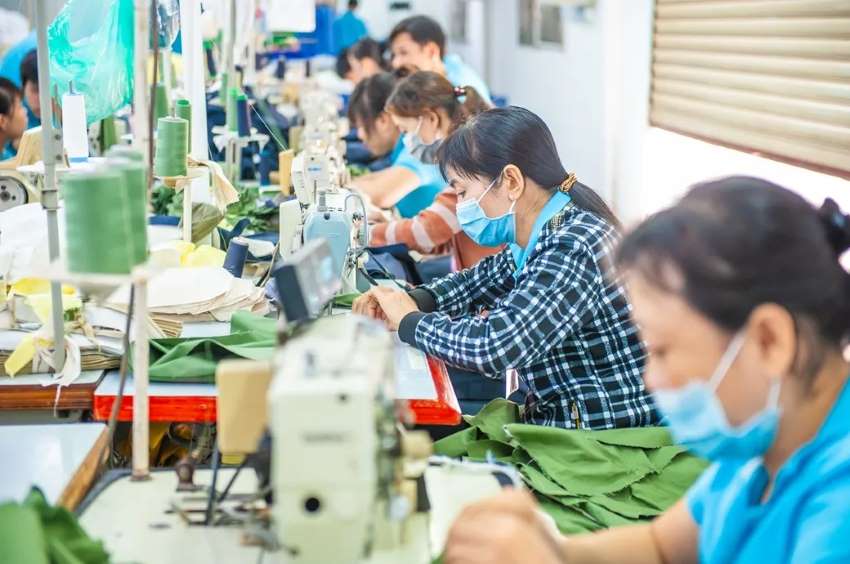
As manufacturers moved to lower-wage countries such as Vietnam, India and Bangladesh to do more of their production, the US imported fewer clothes from China this year than last year. Still, China accounted for 35 per cent of the apparel imported into the US for the 12-month period that ended on October 31. In last few years, China has accounted for as much as 40 per cent of all clothing brought into the country.
The U.S. Commerce Dept. reported that apparel goods coming in from China were down nearly 7 per cent in the one-year period to $28.35 billion. As salaries are rising in Chinese factories, U.S. clothing companies were seen moving production to countries that had lower wages. The most favored country for apparel making after China is now Vietnam that has grown steadily over the years with more apparel factories coming online.
Apparel imports to the US from Vietnam grew 3.7 per cent in the one-year period ending October 31 totaling $10.75 billion. This accounted for 13 per cent of all apparel imported into the United States.
Bangladesh is also growing in importance when it comes to apparel manufacturing. Big retailers such as H&M and Zara have consistently headed to this extremely low-wage country to have goods produced in big factories.
For the one-year period ending in October, Bangladesh exported $5.3 billion worth of clothing to the United States, making up about 6.5 percent of total apparel imports. That was about the same as the previous year. India only exported $3.65 billion worth of apparel to the United States, but when factoring in fabric and other textiles, the total jumped to $7.2 billion in goods.
Zara to pay unpaid Turkey workers at last
Zara will launch a fund for workers in Turkey. These 140 workers were at a factory that closed down without warning. They will be reimbursed for unpaid wages, severance pay and unused vacation time. The popular fast fashion retailer faced criticism when shoppers at an outlet noticed tags attached to garments. These tags were put by unpaid workers, who spelt out their plight in messages.
The total for the 140 workers left with three months of unpaid wages amounts to only 0.01 per cent of Zara’s annual sales. Homegrown brand Zara leads the fashion industry in Spain. Zara is the flagship brand of the Inditex Group. Inditex, which has a market capitalization of 113 billion dollars, is one of the world's largest fashion retailers. It owns 7,405 stores and employs 1,62,450 people. The company has helped to reshape the fashion industry with its ability to quickly produce and turnaround cheaper fashion items.
Some of the world’s biggest brands source garments from Turkey. Among them are Primark, Inditex and H&M. It can be difficult for brands to know exactly what their suppliers are doing. Factories may subcontract work without a brand’s knowledge to meet tight deadlines and Turkey’s proximity to Europe makes it convenient for fulfilling last-minute orders.
Sri Lanka conference discusses to use transparency to improve working conditions
A conference titled ‘Cotton2Cloth: Transparency in the Apparel Industry’ was held in Negombo, Sri Lanka from December 5 to 8. The event brought together 57 participants from 12 countries with participants looking at how to use transparency to improve working conditions in the apparel industry. The need for greater transparency in apparel supply chains was the subject of a meeting which brought together representatives from apparel manufacturers, brands and retailers as well as government NGOs and textile industry workers.
Leslie Johnston, executive director of the C&A Foundation said that transparency is a core pillar of C&A Foundation's work. RGE Foundation believes that it can bring about accountability and transform the fashion industry into a force for good. C& A Foundation co-hosted the Sri Lanka-based event along with Humanity United, Open Society Foundations and Transparentem. The meeting was held under Chatham House Rule. However, there were some interesting observations about how a lack of transparency in supply chains is not conducive to sustainability.
Needs of Wool industry must not be overlooked
According to British Wool Marketing Board chairman Ian Buchanan, the needs of the wool industry must be fully accounted for in the upcoming Brexit negotiations. He cautioned against a change in trading conditions that would impact on the export of wool.
He confirmed that the recent weakening of Sterling in the world’s money markets, the so-called Brexit effect, is helping to maintain UK wool prices at the present time. He admitted that prices paid at the most recent wool board auctions had softened to an extent.
Buchanan said that enhancing efficiency levels throughout the board’s entire operation is a key a priority moving forward. This will impact positively on the way the UK manages the grading centres and the range of services provided to farmers.
He however admitted that the UK government’s plan to commence a major house building programme should be good news for the wool industry. But the Britishers need to educate the upcoming generation of new home owners about the quality of woollen carpets. Buchanan also confirmed that 2016 had been a challenging year from a wool production perspective.
National seminar on Recent Advances in Textile Finishing held in Mumbai
ICAR- CIRCOT, Mumbai in collaboration with Indian Fibre Society (IFS) organised a National Seminar on Recent Advances in Textile Finishing on December 17at the Jubilee Hall of ICAR-CIRCOT where Dr. Kavita Gupta, IAS, Textile Commissioner of India was the chief guest. The seminar was attended by more than 100 delegates from research organizations, academia, industry, policy makers and media.
Dr. P.G. Patil, Director, ICAR- CIRCOT delivered the welcome address which was followed by lighting of the lamp by the dignitaries. Dr. Sujata Saxena, principal scientist and seminar convener informed the audience about the seminar. Three publications viz. ICAR- CIRCOT- An Overview, Book of Papers and the Souvenir of the seminar were released by the chief guest on this occasion.
In her address, Gupta elaborated on the present status of Indian Textile industry and the importance of value addition to textiles through finishing and emphasised upon being competitive in international as well as domestic market. She mentioned about the present huge gap between India and China in world textile trade and reminded the audience of our past prime position in textiles and the need to make efforts for regaining it.
In all, there were three technical sessions in the seminar viz. An Overview of Textile Finishing chaired by Dr. G.S. Nadiger, Textile & Management Consultant, Functional Finishing of Textiles chaired by Dr. S. Sreenivasan, former Director, CIRCOT and Application of Plant materials for Textile Finishing chaired by Dr. N. Bhattacharyya eminent textile chemist. There were five oral presentations in each of the sessions. A poster session was also organised. The seminar ended with a vote of thanks by R.M. Gurjar, Secretary, IFS.
Mini garment factories flourish in Syedpur dist. of Bangladesh
The number of 'mini garment industries' has been maintaining a steady rise in Syedpur upazila of Bangladesh under the country's northern Nilphamari district. At present, there are more than 200 such industries, almost all of which are located in and around Syedpur municipality area.
Most of the small-scale and home-grown industrial units, dubbed as mini garment industries, comprise five to 25 traditional sewing machines. Insiders and local businessmen say roughly 5,000 employees work in different shifts in these units predominantly aiming to export their products to West Bengal of India, Bhutan, and Nepal.
Sources say that the production cost of these mini factories is relatively low as they preferably use stock-lot and waste cut pieces of cloth usually collected from the large ready-made garments (RMG) industries in Dhaka, Gazipur and Chittagong. This is used to make shirts, T-shirts, jackets, trousers and allied items.
However, the sources inform that this year these mini industries exported garment items worth Tk 3.6 billion to Siliguri and Jalpaiguri of West Bangal in India along with destinations in Nepal and Bhutan. The export figure is reported to be increasing every year as the mini industries exported to the tune of Tk 2.7 billion during the corresponding period of last year.
Although these tiny units are contributing substantially to the country's export basket, they still remain deprived of the country's statutory body Export Promotion Bureau's (EPB) membership. On this, local chamber leaders and traders lamented that they were seeking the EPB membership for so long.
Lenzing sheds stake in EQUI-Fibres
The Lenzing Group, a global supplier of high-quality, botanic cellulose fibres to the global textile and nonwovens industry, has reduced its equity stake in EQUI-Fibres Beteiligungsgesellschaft mbH, Kelheim from 45 to 20 per cent. EQUI-Fibres is the parent company of Kelheim Fibres GmbH that manufactures viscose fibres at its plant in Kelheim, Germany.
EQUI-Fibres reported a total revenue of €162 million in 2015. The transaction represents the next logical step in the Lenzing Group’s implementation of its sCore TEN strategy. The buyer is a company represented by its managing directors Peter Untersperger and Gerald Schmidsberger. Untersperger is a known name and very familiar with both EQUI-Fibres and the fibre industry.
On the basis of this transaction, the financial result of the Lenzing Group for the current financial year is expected to increase by about €10-15 million. The payment of the stipulated purchase price is to take place starting in 2017.
Invisible force behind RMG unrest in Bangladesh: Tofail
The latest disturbances in the readymade garment (RMG) sector in Bangladesh are alarming as many countries are feeling bitter over Bangladesh's gradual progress in the sector. Though the government is not able to find out as to who is behind this unrest, Commerce minister Tofail Ahmed feels that there is an invisible force behind all this. He was speaking at a 'Meet the Reporters' programme that was organised by Dhaka Reporters Unity (DRU).
The minister said local garment sector has been making brisk progress and to halt this progress, an invisible force has created the unrest. He said the RMG sector has suffered a lot due to various incidents like Rana Plaza collapse, Tazreen Fire and Holey Artisan terror attack. Now the untoward incidents at Ashulia happened all of a sudden.
Ahmed also said the RMG workers' wages were hiked several times. But the workers at Ashulia came to the streets without any discussion. On this, leaders of the Bangladesh Garment Manufacturers and Exporters Association (BGMEA) said that they would not concede anything this time.
Govt. removes RMGs from Packaged Commodities Act
In what is being described as a landmark step and a game changer for India’s domestic garment industry, the ministry of consumer affairs, food and public distribution has sidelined the readymade garments from the purview of the Legal Metrology (Packaged Commodities) Act 2011. This will increase the ease of doing business and help in growth of retail business.
As per the Legal Metrology Act 2011, there were no clear labelling guidelines for loose garments which made it difficult for garment retailers to demarcate the labelling procedure between pre-packaged and loose garments. This would cause unnecessary inconvenience during inspections at apparel retail showrooms.
The Act mandates packaged commodities to incorporate name, descriptions, size, the full address and customer care number of the manufacturer. In practice, this created problems for clothing businesses. For example, the Act mandates garments size to be measured in centimetres in India. However, clothing sizes are measured globally in S (small), L (large), M (medium), XL (extra large), XXL etc. This created a problem for domestic manufacturers. Similarly, the Act mandates that the length be mentioned as ‘cms’ and labelit as ‘cm’ may hold the director of the company liable with possible imprisonment and fine.
Hence, the garment industry has been petitioning the government to rectify or modify the Act. Their argument was that mere putting garments in a plastic cover do not make them a pre-packaged commodity, as the idea was to protect the fabric from dust. The issue was, however, taken up by textiles minister Smriti Irani with the consumer affairs minister Ram Vilas Paswan, according to the Clothing Manufacturers’ Association of India (CMAI).
The removal of garments from the requirements of pre-packaged commodities will unburden more than 90 per cent of the industry as the rules will apply to packs of two-three shirts, handkerchiefs and innerwear as well. Garments, especially in loose form, would no longer be required to declare the name of manufacturers, year of manufacturing and expiry, etc.
Gerber Technology names Helen Koo for its FashionTech Professional award
World leader in integrated software and automation solutions for the apparel and industrial markets, Gerber Technology has named Helen Koo, assistant professor, Department of Design at University of California, Davis as the recipient of Gerber Technology’s FashionTech Professional award. Koo was selected because of the creative and practical projects designed by her students yielding breakthrough innovations in wearable technology.
Moreover, she has been recognized for founding the Fashion Design and Technology Lab at the University of California, Davis. Earlier, she conducted multidisciplinary funded research projects on developing functional gear for sports, protective products and clothing for extreme environments, and smart clothing with sensors for healthcare. Her recent works focus on developing wearable technology for people with chronic diseases and disabilities.
Gerber’s FashionTech Professional Award is a contest for FashionTech instructors, faculty and professionals from colleges and universities that are members of ITAA. The recipient of the award receives a subscription of Gerber software and training valued at $20,000 and includes industry-leading products such as AccuMark® and YuniquePLM as well as training through Gerber University.