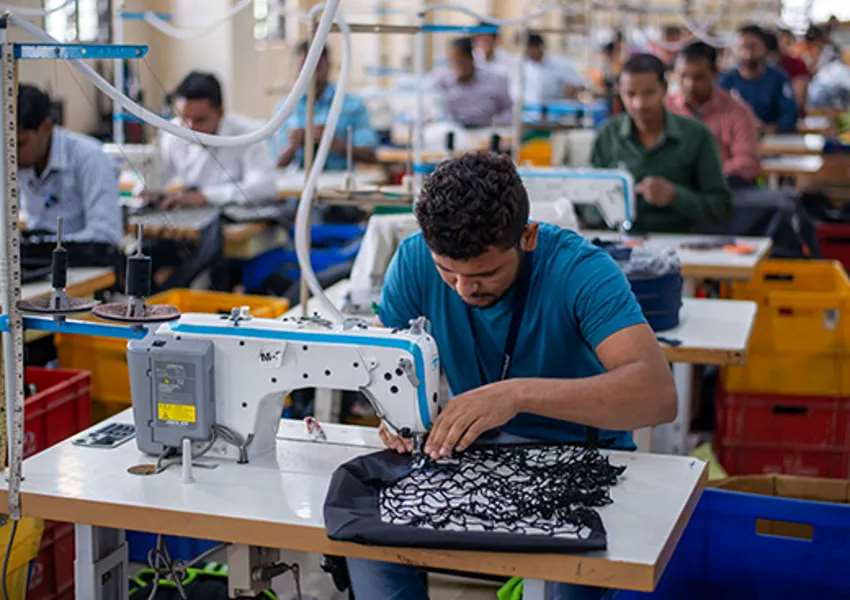
Safety standards at readymade garment industries in Bangladesh have improved. Factory owners have achieved 44 per cent repair work so far. Bangladesh had made remarkable progress in allowing unionism in factories. However, factory owners have to bring about a change in their mindset so that trade unions can function effectively for realising the demands of the workers.
Currently 92 per cent of factories pay the minimum wage to workers. Although safety conditions in member factories of the Bangladesh Garment Manufacturers and Exporters Association (BGMEA) and the Bangladesh Knitwear Manufacturers and Exporters Association (BKMEA), two major trade bodies in the apparel sector, have improved a lot, conditions have not improved in 700 sub-contracting factories.
So the government and garment owners have to work to improve safety conditions in the sub-contracting factories, most of which are not members of the two garment trade bodies. International retailers and brands, which source garment items from Bangladeshi factories, had committed to pay more for garment items but have not done so. Rather, the prices of Bangladeshi garment items have decreased by 41 per cent over the last 15 years.
After the Rana Plaza disaster, compensation was indeed paid to victims, but whether it’s adequate is a matter for doubt. Also those responsible for the disaster have yet to be dealt with.

- 1
- 2
- 3
- 4
- 5
- 6
- 7
- 8
- 9
- 10
Intertextile Shenzhen 2026: Pioneering the Future of Textile Innovation
As Shenzhen cements its status as China’s premier hub for manufacturing, artificial intelligence, and startup cultivation, Intertextile Shenzhen Apparel Fabrics... Read more
The Devil Wears Prada 2 reflects fashion’s power shift, where consumers replace …
" " The release of The Devil Wears Prada 2 has sparked a debate far bigger than a Hollywood sequel. What... Read more
The 30-minute problem reshaping the $63 bn leggings market
The global leggings makers are racing to solve one of the apparel industry’s most expensive hidden problems: discomfort that appears... Read more
Why the resale explosion is failing to slow apparel production
The global apparel industry is confronting an uncomfortable paradox. The explosive rise of the resale economy, once viewed as a... Read more
Can India’s textile sector convert FTAs into global dominance?
What began as a cautious China Plus One sourcing strategy for global apparel trade, has now evolved into a full-scale... Read more
No More Easy Wins: Why global retailers are losing ground in China
China’s retail sector has entered a new phase, one defined not by aspiration, but by scrutiny. The long-standing advantage enjoyed... Read more
Resale overtakes fast fashion as vinted climbs UK Retail rankings
For the first time in decades, the British fashion market is witnessing a major change as resale platform Vinted secures... Read more
Shein Buys Everlane: Why sustainable fashion brands are losing the scale war
The acquisition of Shein by premium basics label Everlane marks a defining moment in the global apparel industry. What initially... Read more
Status, Rewired: Health, AI and experience are displacing heritage luxury
The global luxury industry is not facing a demand fall it is confronting a redefinition of value. As bellwethers like... Read more
Secondhand apparel enters asset era as global resale market targets $393 bn by 2…
Clothing is increasingly being treated not as a depreciating consumer good but as a tradable financial-like asset. As per ThredUp... Read more