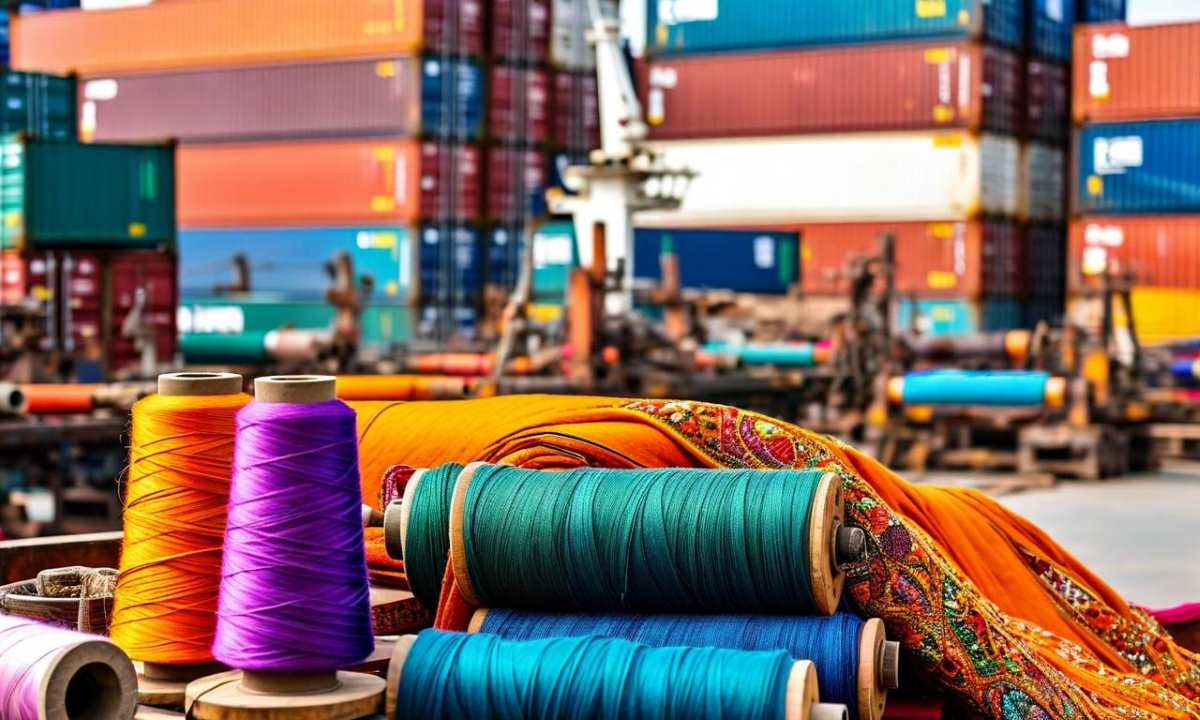
Brazil’s emergence as the world’s largest cotton exporter is no longer simply an agricultural success story. It has given a boost to the global spinning industry. The country closed the 2025/26 marketing year with a record 3.374 million tonnes of lint exports, up 19 per cent from 2.836 million tonnes a year earlier, generating $5.3 billion in export earnings. More importantly, the destination pattern shows that Brazilian cotton is being absorbed by the world’s principal spinning hubs.
China took 770,523 tonnes, Bangladesh 584,756 tonnes, Turkey 441,054 tonnes, Pakistan 414,340 tonnes, Vietnam 393,206 tonnes and India 353,820 tonnes. Together, these six markets accounted for 87 per cent of Brazil’s exports.
Table: Brazil’s cotton exports
|
Market destination |
Annual volume (tonnes) 2025/26 |
Market share (%) |
July 2026 exports (tonnes) |
July 2026 share (%) |
|
China |
770,523 |
23% |
5,133 |
3% |
|
Bangladesh |
584,756 |
17% |
30,053 |
19% |
|
Turkey |
441,054 |
13% |
26,609 |
17% |
|
Pakistan |
414,340 |
12% |
23,051 |
15% |
|
Vietnam |
393,206 |
12% |
26,565 |
17% |
|
India |
353,820 |
10% |
15,376 |
10% |
|
Indonesia |
204,182 |
6% |
12,950 |
8% |
|
Egypt |
76,758 |
2% |
4,834 |
3.10% |
|
Malaysia |
51,476 |
2% |
5,362 |
3% |
|
South Korea |
32,112 |
1% |
2,145 |
1.40% |
|
Others |
51,715 |
2% |
2,887 |
1.90% |
|
Total Export Volume |
3,373,922 |
100% |
154,965 |
100% |
The implication is significant: Brazil is not merely supplying cotton to traders; it is embedding itself deeper into the procurement strategies of competing textile-manufacturing countries.
India is the emerging swing market
The sharpest shift is visible in India. Brazilian shipments to the country have multiplied over 40 times in two years, reaching 353,820 tonnes. This is not simply a price arbitrage story. Indian spinning mills operate under pressure to maintain consistent quality, yarn specifications and delivery schedules even when domestic cotton arrivals fluctuate. Brazilian cotton offers an alternative pool of machine-harvested, HVI-tested fibre that can be incorporated into mill laydowns with greater predictability.
With Indian cotton consumption projected at a record 5.77 million tonnes in 2026/27, imported cotton can easily work as a risk-management instrument rather than an emergency substitute. That distinction matters. Once mills qualify an overseas origin for particular counts and customers, procurement relationships can become structural.
Brazil is correcting, not retreating
Brazil’s next crop indicates that exporters are not pursuing volume at any cost. Abrapa’s August estimate puts 2026 planted area at two million hectares, down 8 per cent from 2025, while lint production is forecast at 3.9 million tonnes, 8.2 per cent below the previous record. Yet productivity remains remarkably resilient.
Table: Brazilian crop indicator
|
Crop indicator |
2021 |
2022 |
2023 |
2024 |
2025 |
2026* (forecast) |
2026 vs. 2025 change |
|
Planted Area (Million Ha) |
1.37 |
1.6 |
1.66 |
1.99 |
2.17 |
2 |
-8.00% |
|
Seed Cotton Output (Million Tonnes) |
5.8 |
6.27 |
7.7 |
8.91 |
10.32 |
9.5 |
-7.90% |
|
Cotton Lint Output (Million Tonnes) |
2.36 |
2.55 |
3.17 |
3.7 |
4.25 |
3.9 |
-8.20% |
|
Seed Cotton Yield (Kg/Ha) |
4,230 |
3,920 |
4,628 |
4,584 |
4,753 |
4,758 |
+0.1% |
|
Cotton Lint Yield (Kg/Ha) |
1,721 |
1,596 |
1,907 |
1,904 |
1,958 |
1,954 |
-0.20% |
This is arguably the more important signal. Brazil is reducing acreage while preserving yields. The adjustment therefore resembles inventory and market management rather than a deterioration in agricultural competitiveness. With global Brazilian exports still projected at around 3.33 million tonnes in 2026/27, the country retains considerable export capacity.
Price is reinforcing the shift
Brazil’s advantage is also being supported by international price spreads. In early August, Brazilian Cepea/Esalq cotton stood at 82.1 cents a pound and nearby ICE New York at 83.2 cents. The Cotlook A Index was higher at 95 cents, while China’s cotton index was at 120.8 cents. India’s domestic spot price was 91.6 cents and Pakistan’s 80.1 cents.
Table: Global crop index
|
Benchmark index |
Latest value (Aug 12) |
Latest month (July) |
12-month average (Aug 25–Jul 26) |
|
Cepea/Esalq (Brazil Domestic) |
82.1 cents/lb |
80.4 cents/lb |
72.1 cents/lb |
|
ICE Futures NY (Nearby) |
83.2 cents/lb |
78.6 cents/lb |
68.7 cents/lb |
|
Cotlook A Index |
95.0 cents/lb |
88.9 cents/lb |
80.2 cents/lb |
|
China Cotton Index (CC) |
120.8 cents/lb |
118.4 cents/lb |
105.6 cents/lb |
|
Indian Spot Index |
91.6 cents/lb |
86.7 cents/lb |
79.9 cents/lb |
|
Pakistani Spot Index |
80.1 cents/lb |
79.0 cents/lb |
73.9 cents/lb |
These spreads create room for Brazilian cotton to remain commercially attractive even after freight and landing costs, particularly for mills purchasing large volumes. But price alone cannot explain the durability of the trend. Consistency, logistics and quality documentation increasingly influence fibre selection as much as the headline cotton price.
Traceability becomes a competitive weapon
The sustainability dimension could strengthen Brazil’s position further. During 2024/25, Brazil accounted for 3.32 million tonnes of Better Cotton-licensed fibre against a 4.25 million-tonne crop forecast, with 2.11 million tonnes recorded in verified commercial transactions.
Mass-balance transactions represented 85.6 per cent of that volume, while segregated supply accounted for 14.4 per cent. For exporters serving global apparel brands, this infrastructure is becoming commercially relevant as traceability requirements move closer to the farm level.
The experience of Bangladesh’s Apex Yarn Spinners is an expample. By replacing 30 per cent of its traditional Central Asian cotton with Brazilian middling cotton, the mill reportedly reduced comber nil waste by 2.5 per cent and improved yarn-strength uniformity in 30s and 40s counts. Such outcomes turn origin diversification into an operational proposition rather than merely a sourcing preference.
The new cotton geography
Brazil’s rise does not mean traditional suppliers will disappear. Nor does it imply that Asian mills will abandon domestic cotton. Instead, the global spinning system is moving towards a more diversified sourcing architecture in which Brazil provides scale, consistency and an increasingly credible sustainability proposition.
That is the significance of the Cotton Brazil initiative, backed by Abrapa, Anea and ApexBrasil. Its focus on Asian spinning markets reflects where the next battle for fibre demand will be fought. For India, the lesson is particularly important. Brazilian cotton can help mills manage domestic crop volatility, but growing dependence on imported fibre also exposes the industry to freight, currency and international price risks.
The larger picture, therefore, is not Brazil replacing another cotton powerhouse. It is the emergence of a new supply-chain anchor. The Cerrado has moved from being a peripheral cotton-growing region to becoming an increasingly consequential component of the global spinning economy. And as mills optimise for consistency, traceability and cost simultaneously, that influence is likely to deepen.