

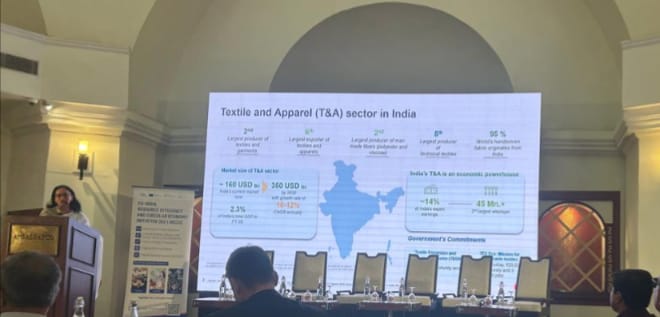
On the occasion of World Environment Day, industry leaders, policymakers, and international experts gathered in the capital yesterday for Circular Samvaad 2.0, a high-profile multi-stakeholder workshop focused on driving the Indian textile sector toward a circular and resource-efficient future.
The conference, titled "Circular Samvaad 2.0: Enhancing Circularity and Resource Efficiency in the Indian Textile Sector," was organized by GIZ India in close collaboration with the Ministry of Textiles and the Ministry of Environment, Forest and Climate Change (MoEFCC). The initiative operates under the broader EU-India Resource Efficiency and Circular Economy Initiative (EU-I RECEI), co-financed by the European Union and the German Federal Ministry for the Environment, Nature Conservation, Nuclear Safety and Consumer Protection (BMUV).
Driving the Narrative: Nature, art, and subcontinental identity
A key highlight of the event was an address by Dr. Rachna Arora of EU-I RECEI (GIZ India), who elegantly tied the technical necessity of sustainable manufacturing back to India's deeply rooted cultural history. She introduced a holistic perspective to the textile value chain, emphasizing that India's relationship with fabric has always been inherently connected to nature.
"I would like you to look at this sector of holistic living because, of course, the theme is actually nature and art," Dr. Rachna Arora stated during the session. "And I think the topic of textiles is very closely related to subcontinental art. We are just having a conversation in India and for all of us, the priority of course remains what we come out of art. The textile is something which is so close to our heart and we feel it everywhere. It is like a legacy we should make. The way the history of textiles is designed, it is about a holistic understanding of the creative. How close our textiles are, especially in India, it has been so close to nature."
Dr. Rachna Arora shared insights from ongoing field workshops, explaining that EU-I RECEI (GIZ India) has been gathering critical data over the past year to build ground-up solutions. She extended a warm welcome to the diverse audience, emphasizing that solving day-to-day industrial and environmental bottlenecks requires real-world data and multi-ministerial collaboration.
Moving Beyond Compliance: A national imperative
The Indian textile and apparel industry serves as a crucial cornerstone of the national economy, acting as a massive driver of employment and industrial growth. However, the sector faces mounting global scrutiny regarding resource usage and waste. With a staggering material intensity and rising volumes of both pre- and post-consumer textile waste, a shift away from the traditional linear "produce, use, and dispose" model is no longer optional.
Faced with impending trade changes—such as the upcoming ratification of the India-EU Free Trade Agreement and stringent European sustainability regulations, Indian manufacturers must transition to circular frameworks to maintain global market competitiveness.
To guide this transition, the event highlighted an ongoing National Study on Fostering Circular Economy in the Indian Textile Sector. This study actively looks to map the economic and employment potential of textile recycling, upcycling, and repair while aligning with emerging government frameworks like the Ministry of Textiles’ Textile Expansion and Employment (TEEM) Scheme and the Tex Eco Initiative.
A ‘Whole-of-Government’ and industry ecosystem
A defining theme of Circular Samvaad 2.0 was the recognition that the journey toward circularity is too complex for any single stakeholder to tackle alone. The event served as a collaborative bridge, uniting chambers of commerce, academic institutions, and a cross-section of ministries—including the Ministry of Housing and Urban Affairs, to align on data-driven policy recommendations.
By prioritizing responsible production, traceability, and resource efficiency, India is positioning its textile value chain not just to meet baseline environmental compliance, but to lead the global fashion market as a preferred hub for sustainable manufacturing.











