

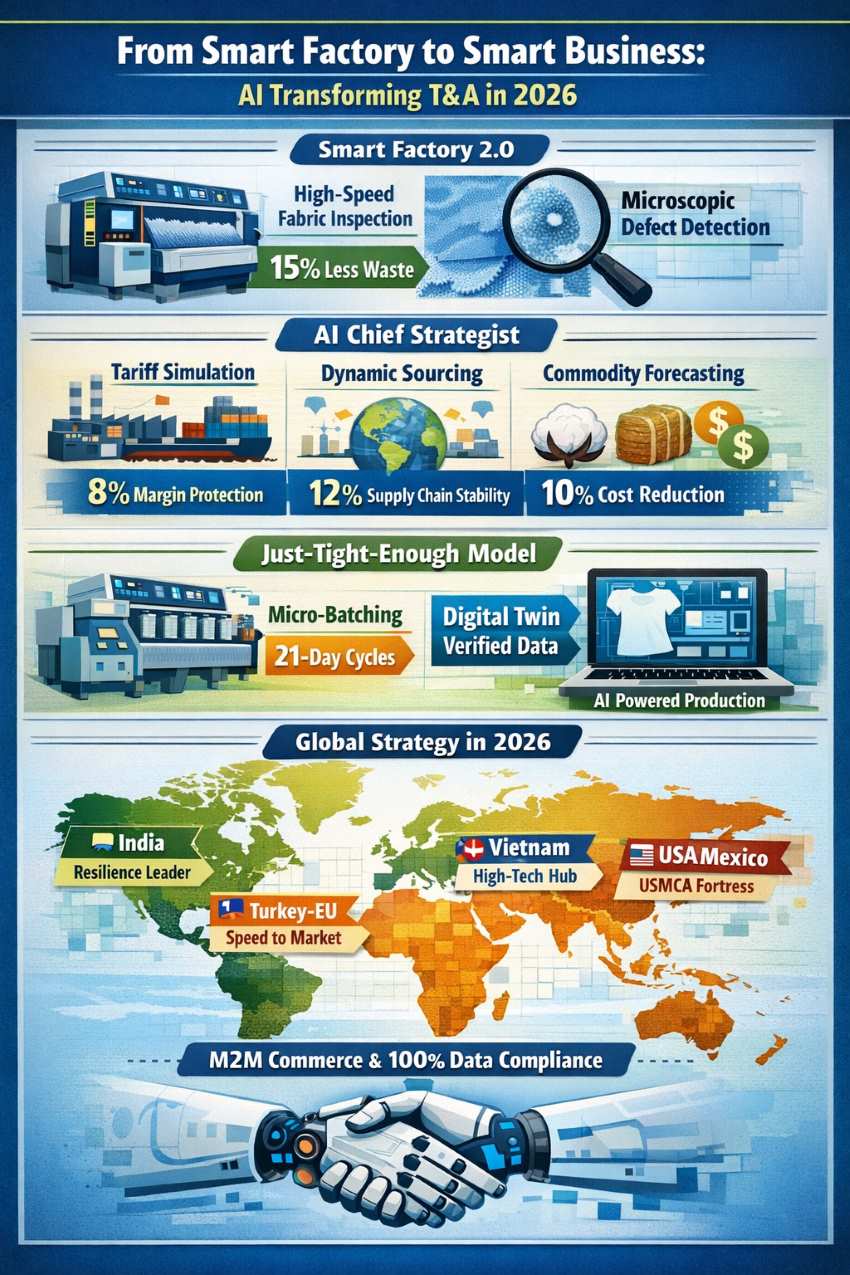
The next feature, we present as part of our year-end series, 'Wrap Up 2025, Outlook 2026', as the global textile and apparel (T&A) industry closes the books on 2025,a year defined by aggressive tariff adjustments and a race for supply chain transparency—the sector is crossing a decisive commercial threshold. If 2025 was the period of emergency transparency measures, 2026 is emerging as the year of operational and strategic autonomy. The industry has moved beyond an era where technology was a peripheral efficiency tool to one where it functions as the central floor manager, strategic business advisor, and lead procurement officer capable of navigating the most volatile geopolitical headwinds.
The 2026 market outlook confirms that Smart Factory 2.0 is no longer a pilot concept but a mandatory operational standard. In the production hubs of Tiruppur, India, and Ho Chi Minh City, Vietnam, factories have integrated high-velocity Computer Vision systems that scan fabric at speeds of 60 meters per minute. Catching microscopic fiber defects and seam misalignments with 90% precision, these units have driven a 15% reduction in fabric waste. This provides a critical financial buffer in a market where raw material costs continue to squeeze margins.
Strategic Command: The AI CEO as the defensive shield
In 2026, technology has moved "upstream" from the factory floor into the boardroom, evolving into a Global Chief Strategist that navigates complex risks. With the U.S. implementing steep unilateral tariffs—which reached a staggering 50% on certain Indian textile segments by late 2025—and the EU activating its Carbon Border Adjustment Mechanism (CBAM) on January 1, 2026, successful enterprises now use AI to run "Scenario Stress Tests." By simulating various tariff outcomes and shipping disruptions, these systems reallocate production across geographical lines in real-time to protect the bottom line.
For instance, when geopolitical tensions triggered supply shocks in 2025, smart platforms functioned as Business Model Advisors, immediately suggesting a shift toward the UK, Oman, and Australia to leverage newly ratified Free Trade Agreements (FTAs). This "Dynamic Sourcing" capability, powered by AI that tracks port congestion, raw material price indices (like the Global Cotton Index), and currency fluctuations—has reduced the impact of supply chain shocks by an estimated 12% across the sector.
|
Strategic Challenge |
AI "Chief Strategist" Intervention |
Measured Outcome (2025-26) |
|
Tariff Volatility |
Scenario Simulation & FTA Optimization |
8% Margin Protection via Regional Re-allocation |
|
Raw Material Spikes |
ML-Driven Commodity Price Forecasting |
10% Reduction in Procurement Costs |
|
Supply Chain Gaps |
Real-Time Logistical Digital Twins |
18% Improvement in Delivery Reliability |
|
Sustainability (DPP) |
Blockchain & IoT Provenance Tracking |
100% Compliance with EU CBAM Reporting |
The 2026 CEO Profile: Transitioning from creative oversight to data governance
The leadership requirements for global fashion houses have undergone a total overhaul. The traditional CEO profile has been replaced by the "Orchestrator CEO," who relies on AI for Business Model Innovation. Leadership performance is now measured by Model Accuracy and the strength of "AI Ethical Guardrails." A brand’s most liquid asset is its "Digital Twin", a verified data shadow of every garment that authenticates its origin, environmental footprint, and resale potential, acting as a permanent record of the brand's strategic integrity.
Operational Resilience: The "Just-Tight-Enough" production model
The industry is formalizing a shift away from "Just-in-Time" logistics toward a "Just-Tight-Enough" manifesto, advised by algorithms that value capital preservation over volume. The historical practice of over-ordering by 20% to mitigate supply chain volatility is now viewed as a critical drain on working capital. Instead, the sector is adopting "Micro-Batching." By utilizing predictive analytics to delay bulk production until consumer demand signals are verified, brands are scaling winning lines in 21-day cycles.
This "Platformization" of manufacturing has enabled a "Manufacturing-as-a-Service" (MaaS) model. Platforms like StyTrix (by Makalot) leverage decades of historical production data to reduce physical sampling waste by 70%. This allows brands to remain asset-light, launching collections without the burden of inventory risk.
Regional Trade Trajectories: 2026 strategic map
Manufacturers are specializing geographically to align with new trade corridors and regulatory zones, guided by AI that identifies the most "digitally compatible" partners.
|
Region |
Commercial Identity |
2026 Growth Driver |
Strategic Leverage |
|
India |
The Resilience Leader |
Man-Made Fibers (MMF) |
18 FTAs (UK, Australia) & PM MITRA Smart Parks. |
|
Vietnam |
The High-Tech Hub |
AI-Driven Production |
Transitioning to "Smart Factory 2.0" for luxury cycles. |
|
Turkey / EU |
The Speed Hub |
Circularity Infrastructure |
72-hour delivery to EU; advanced recycling tech. |
|
USA / Mexico |
The USMCA Fortress |
Vertical Integration |
Regional protection; 21-day lead times for US retail. |
Agentic Commerce: The shift to Machine-to-Machine transactions
The most significant change in the transactional space is the rise of Agentic Commerce. B2B procurement is moving toward Machine-to-Machine (M2M) interactions. At major retailers like Walmart or Zara, human procurement teams are being supported by AI Agents that communicate directly with factory ERP systems.
In this environment, "relationship-based" sourcing has been replaced by Data Integrity. If a supplier's digital interface cannot "talk" to a retailer's autonomous agent, which now triggers replenishment based on real-time sell-through, that supplier is effectively removed from the bidding pool. This has birthed a new legal reality: the first "Data Integrity" lawsuits were filed in late 2025 against suppliers who provided inaccurate carbon data to procurement agents, marking the start of a high-accountability era where AI acts as a Risk Mitigator.
Editor’s Conclusion: The disappearance of the ‘Middle Ground’
As we analyze the 2026 horizon, it is evident that the "middle ground" in the textile business has vanished. The market has bifurcated into two lanes: Ultra-Fast/Ultra-Low-Cost (volume-driven) and Ultra-Transparent/High-Value (margin-driven).
Geopolitical shocks are no longer considered anomalies; they are the baseline operating environment. To remain competitive, textile firms must function like technology companies where AI is the Chief Strategist. The successful leader of 2026 is not the one who spots the next color trend, but the one who builds a resilient, autonomous, and data-transparent ecosystem. The Smart Factory 2.0 is no longer just a facility for making garments; it is a refinery for the data that grants a brand its license to operate.










