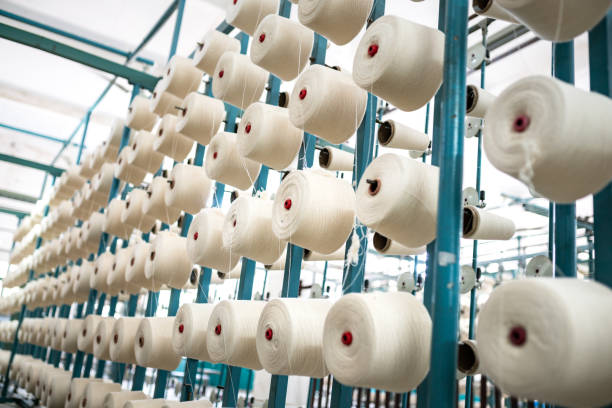
The global textile auxiliaries market is set to get a boost with a surge in consumption and production of textiles. Textile auxiliaries are used at various stages of textile processing like pre-treatment, printing, dying, and finishing. Textile auxiliaries increase the aesthetic appeal as well as the durability of textile products.
Textile auxiliaries are mainly used for architectural and construction purposes like concrete reinforcement, insulation, and faced foundation. The growth in infrastructure and urbanization on a rapid scale in Brazil, Russia, India, China, and South America is providing an advantageous factor for the development of textile auxiliaries in the global market.
Demand for healthcare products like sanitary napkins and baby diapers are also fuelling the growth of the textile auxiliaries market in the world. However, factors like high cost of natural textile auxiliaries may hamper growth in the long run. Natural textiles are more expensive as compared to synthetic and this is because of the high cost of raw materials and limited availability in terms of natural auxiliaries. Manufacturing and extraction of natural textile auxiliaries require trained workers with technical knowledge. Factors like these may affect the development of the textile auxiliaries market in the long run.

- 1
- 2
- 3
- 4
- 5
- 6
- 7
- 8
- 9
- 10
Crude correction gives polyester a fresh cost advantage
A sustained correction in crude oil and petrochemical benchmarks is reshaping the economics of synthetic yarns, widening the cost gap... Read more
Chinese apparel majors trade volume for margin in premiumisation push
China’s apparel and consumer goods market is moving beyond the traditional volume-at-any-cost model, with leading domestic brands betting on premium... Read more
India’s MMF push faces rising risk from China’s petrochemical dominance
India’s ambition to build a globally competitive synthetic textile industry is facing constraints as downstream capacity alone cannot solve: concentration... Read more
Shein’s Vietnam retreat exposes the limits of nearshoring
The global apparel industry has spent the past few years pursuing a straightforward strategy: reduce dependence on China by moving... Read more
Regional pavilions compete on fiber strengths and supply chain niches at Yarn Ex…
The trade floor at Yarn Expo Autumn 2026 in Shanghai, held between Aug 25-27, capitalizing on a sharp rebound in... Read more
Inside activewear's shift from stitched mesh to precision engineered textiles
The global functional apparel market, on track to touch $640 billion, is looking at a production shift as activewear manufacturers... Read more
Brazil’s cotton dominance puts Asian spinners on a new sourcing map
Brazil’s emergence as the world’s largest cotton exporter is no longer simply an agricultural success story. It has given a... Read more
Textile industry sees long-term growth but $100-bn export goal stays a stretch: …
India’s textile and apparel industry is entering a phase of optimism, but that confidence is tempered by a hard export... Read more
Apparel trade slumps as global textile mills move upstream
Global manufacturing is growing, but finished apparel is failing to capture that growth. United Nations Industrial Development Organization (UNIDO) data... Read more
Global apparel value chain converges in Shanghai as Intertextile Autumn 2026 ope…
The global apparel and textile community gathered in full force yesterday, August 25, 2026, as the Autumn Edition of Intertextile... Read more