India is formulating schemes for the development of silk industry. Seed production units will be strengthened to bring in quality standards in production network, besides increasing production capacity to cater to the increased silk production targets. Indian silk will be promoted through quality certification by Silk Mark not only in the domestic market but also in the export market. Emphasis will be given for use of silkworm by-products for poultry feed, cosmetic applications and value addition through product diversification into non-woven fabrics, silk denim, silk knits etc. Reeling and processing technologies in silk will be upgraded.
Living standards and economic conditions of the downtrodden, poor, backward and tribal families can be improved by encouraging them to take up various sericulture activities. Sericulture is an agro-based cottage industry having a huge employment and income generating potential in rural and semi-urban areas. It is estimated that the sericulture industry provides employment to 90 lakh persons. Of these, a sizeable number of workers belong to the economically weaker sections of society. Women constitute over 60 per cent of those employed in downstream activities of sericulture like mulberry garden management, leaf harvesting and silkworm rearing etc. Even the silk reeling industry including weaving is largely supported by them.
- 1
- 2
- 3
- 4
- 5
- 6
- 7
- 8
- 9
- 10
From London to Tokyo, premiumization redefines retail and office markets
Global real estate landscape has changed. Gone are the cautious narratives of recovery that defined the post-pandemic years. Today, flight... Read more
Compliance drives India’s $176 bn textile shift
India’s textile economy is no longer selling fabric alone; it is selling proof. As compliance rules harden across export markets,... Read more
The second life economy gets a boost as resale outgrows traditional apparel reta…
For decades, resale existed in the margins of the apparel economy, thrift stores, peer-to-peer marketplaces, and charity bins quietly absorbing... Read more
Rising polyester costs shake India’s textile manufacturing hubs
India’s synthetic textile industry is confronting a sudden and destabilizing price shock that is reverberating across its vast manufacturing ecosystem.... Read more
Cotton markets hold firm as tariffs, higher supply reshape global fiber economic…
In a year marked by tariff escalations, geopolitical brinkmanship and a recalibration of global trade flows, the international cotton market... Read more
Beyond Cotton How Kapok could redefine sustainable insulation in textiles
In the lush, humid heart of Southeast Asian rainforests stands a giant, a silent sentinel of the forest canopy. Growing... Read more
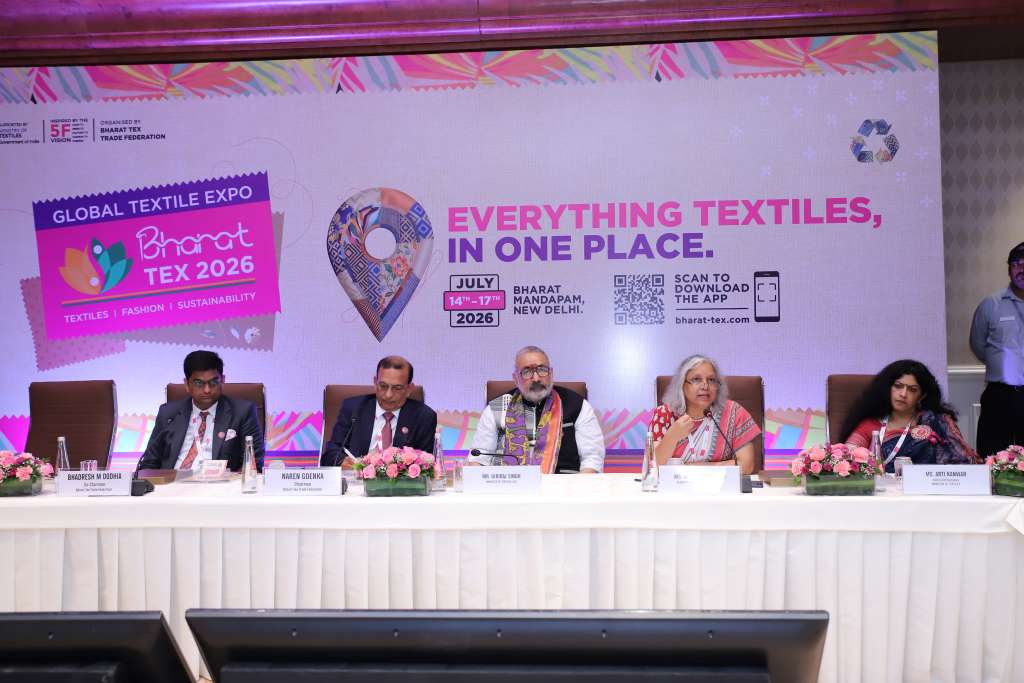
Bharat Tex 2026: Redefining the global textile value chain
Union Minister of Textiles, Giriraj Singh, has officially unveiled Bharat Tex 2026, signaling a significant leap in India’s influence over... Read more
Intertextile Shanghai Spring 2026: A hub for global textile innovation
The textile industry’s pulse is quickening as Intertextile Shanghai Apparel Fabrics – Spring Edition prepares to open its doors from... Read more
Moscow Fashion Week 2026: Blending sustainable innovation with timeless glamour
Scheduled to run from March 14-19, 2026 in Moscow, Russia, the Moscow Fashion Week (MFW) is cementing its status as... Read more
The Store as Stage: How fashion is crafting immersive consumer worlds
The North American fashion retail sector in 2026 is shedding its product-first identity and shifting towards a model that values... Read more