

As global brands push up efforts to diversify sourcing beyond traditional manufacturing hubs, India is repositioning its textile industry through an integrated growth strategy aimed at transforming the country into a full-spectrum sourcing destination. The push comes at a time when geopolitical disruptions, compliance-heavy retail sourcing norms, and rising demand for sustainable manufacturing are forcing global apparel companies to reassess long-term supplier relationships.
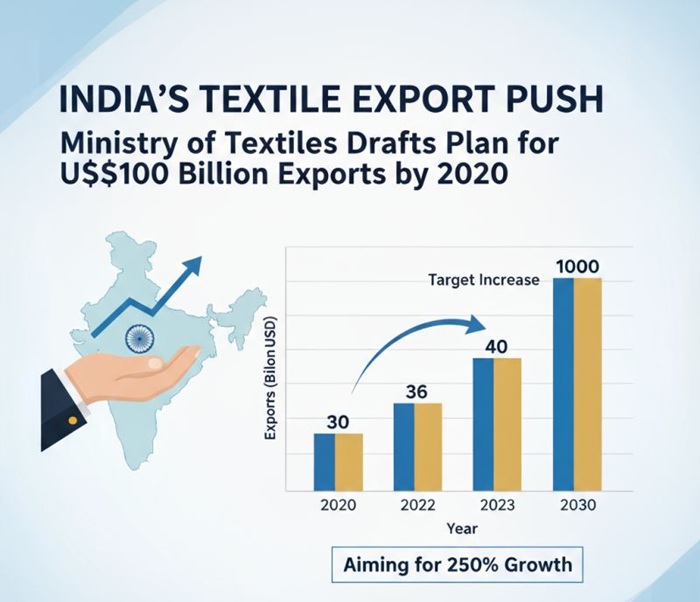
Addressing the TEXPROCIL Export Awards in Mumbai, Union finance minister Nirmala Sitharaman outlined the government’s vision of connecting the entire textile value chain: from farm and fibre to factory, fashion, and foreign markets. The objective is to scale India’s textile and apparel sector to Rs 24.17 lakh crore ($250 billion) while driving exports to Rs 9.67 lakh crore ($100 billion) by 2030 as part of the broader Viksit Bharat 2047 roadmap.
The strategy reflects a move away from fragmented, low-value textile manufacturing toward vertically integrated, globally compliant production ecosystems capable of handling large institutional sourcing contracts.
Manufacturing infrastructure the core competitive lever
India’s textile sector already has pole position within the domestic economy, contributing roughly 2.3 per cent to GDP while supporting nearly 6 crore livelihoods directly and indirectly. The industry also accounts for almost 12 per cent of India’s total export earnings.
Table: Overview of textile sector’s contribution to Indian economy
GDP contribution 2.3% of India's total Gross Domestic Product
Total National Export Earnings Accounts for nearly 12% of total outbound trade revenues
Socio-Economic Employment Base Supports close to 6 crore (60 million) livelihoods directly and indirectly
Aggregate Fiscal Year Exports (FY26) Rs 3.01 lakh crore ($33.5 billion) across all textile segments
Core Cotton Textile Consortium Exports Contributes approximately $11 billion to national outbound trade
To support future export growth, the government is pushing for investment in large-scale manufacturing clusters. The rollout of seven PM MITRA textile parks has already attracted investment commitments over Rs 27,000 crore. These integrated parks are designed to streamline operations across spinning, processing, weaving, and garment manufacturing while reducing logistics inefficiencies that historically weakened India’s competitiveness against rival sourcing nations.
The infrastructure push is being backed by policy incentives under the Amended Technology Upgradation Fund Scheme (ATUFS) and a broader fiscal framework introduced through recent Union Budgets. New initiatives including the Textile Expansion and Employment Scheme, National Fibre Scheme, Tex-Eco Initiative, and Samarth 2.0 are intended to modernize production capacity, improve labour productivity, and support sustainable manufacturing upgrades.
Industry stakeholders say these integrated manufacturing hubs are critical as global retailers shift toward vendor consolidation, preferring suppliers capable of delivering scale, compliance, and speed under one operational network.
ESG compliance in focus global retail sourcing
While cost competitiveness remains important, sourcing decisions among large western retailers are increasingly being shaped by environmental and governance metrics. Major fashion groups including H&M, Zara, and Marks & Spencer are tightening sourcing requirements around traceability, carbon disclosures, labour transparency, and recycled or organic material usage.
This is fundamentally altering how Indian exporters compete in global markets. Manufacturers that invest in automated cutting systems, energy-efficient production lines, water recycling infrastructure, and blockchain-enabled traceability are securing premium contracts and better margins. Conversely, exporters operating on legacy manufacturing systems are facing pricing pressure and declining order volumes.
To address capability gaps, the government has launched the Advanced Certificate Program in International Trade (ACPIT), designed to train exporters in handling ESG audits, non-tariff barriers, compliance documentation, and digital inventory systems. The shift indicates that future competitiveness in apparel exports will rely as much on technological and sustainability credentials as on traditional labour-cost advantages.
FTAs and incentives cushion global volatility
India’s textile ambitions are also unfolding against a volatile geopolitical backdrop. Recent disruptions across maritime trade corridors, including tensions affecting the Strait of Hormuz shipping route, have heightened concerns around freight costs, delivery delays, and raw material inflation.
To offset some of these pressures, the Directorate General of Foreign Trade has extended benefits under the RoDTEP scheme, restoring export tax rebates and helping manufacturers partially neutralize embedded domestic levies. At the same time, India is expanding its market access through a series of trade negotiations and free trade agreements with the European Union, the UK, the European Free Trade Association (EFTA), Oman, and New Zealand.
These agreements are expected to lower tariff barriers for Indian cotton, silk, yarn, and finished apparel products in major consumer markets. Experts say, preferential market access could significantly improve India’s position against competing sourcing destinations such as Bangladesh, Vietnam, and China, particularly in premium apparel categories.
Traceable cotton a premium export asset
One of the clearest examples of India’s shift toward value-added textile exports is the Kasturi Cotton initiative managed by The Cotton Textiles Export Promotion Council. The program combines farm-level DNA tagging with blockchain-based tracking systems to authenticate fibre origin, quality, and environmental credentials. Over 2,000 exporters are currently using Kasturi Cotton certification to service international buyers demanding stringent sustainability verification.
The initiative effectively converts cotton from a commodity input into a branded and traceable raw material asset. By improving transparency and reducing quality uncertainty, exporters are better positioned to protect margins from commodity price swings while strengthening relationships with large institutional buyers.
For India’s textile industry, the broader message is becoming clear: future export growth will depend not merely on manufacturing scale, but on the ability to integrate technology, sustainability, infrastructure, and trade access into a globally competitive sourcing ecosystem.











