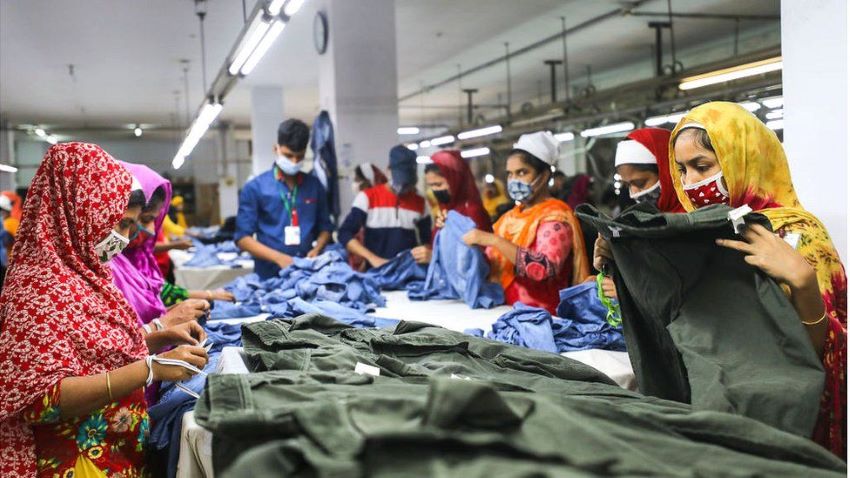
Indian textile units have asked for liquidity support and a one or two year moratorium. Other issues are pending claims under the various rebate schemes; release of TUFS subsidy; reducing the margin money for working capital from 25 to 10 per cent and the debt-equity ratio norm from 1:1.33 for the entire textile and clothing industry; extending the five per cent interest subvention for all textile and clothing export products; slotting recycled PSF under the five per cent GST rate; and enhanced EPF benefits.
The National Committee on Textiles & Clothing (NCTC) is meeting regularly to discuss various issues ranging from fiber to fashion to arrive at a common understanding of both short term and long term policy measures for domestic and international markets.
For the purpose of long term policy measures, NCTC will hire the services of a competent agency to undertake a study and recommend various policy measures to enable the entire textile and clothing value chain covering all types of fibers and products to remain globally competitive and achieve a sustained growth rate, both in the domestic and international markets. Among the measures proposed by NCTC are imposing adequate safeguards on the imports of fibers, yarns, fabrics, readymade garments and used cloths from China, Bangladesh and Indonesia; including the anti-dumping duty in the duty drawback calculation and enhancing the rates appropriately.
- 1
- 2
- 3
- 4
- 5
- 6
- 7
- 8
- 9
- 10
$120 Crude, Zero Margin: How India’s textile hubs are paying the price
For India’s textile clusters, the current West Asia crisis is no longer a distant geopolitical headline. In Surat’s polyester corridors... Read more
Luxury under pressure as stagflation and geopolitics redefine the winners’ circl…
The 2025 earnings for Europe’s listed luxury majors have delivered a verdict that has far more implications than the prevailing... Read more
Luxury resale goes global, sneakers, handbags, archival fashion redrawing border…
The luxury resale market in 2026 is no longer a monolithic global block. According to the RB Insights January 2026... Read more
China out but can India deliver? The realities of the global sourcing shift
With the US imposing a flat 15 per cent tariff on Chinese imports under Section 122 as of February 2026,... Read more
Luxury in Retreat: Why the aspirational consumer is gone for good
The global luxury industry is confronting an unprecedented situation. The active consumer base, which peaked at 400 million in 2022,... Read more
The Invisible Bleed: How a single chemical is slowing India’s apparel machine
The global fashion industry has spent the better part of the past two years obsessing over visible disruptions viz. volatile... Read more
The Closet Paradox: How ‘nothing to wear’ is driving global overconsumption
In an era of overflowing wardrobes and instant fashion gratification, a striking paradox has emerged: the more clothes we own,... Read more
US trade rulings and labor slowdown reshape 2026 cotton supply chains
The global cotton industry is entering a period of adjustment, shaped by legal rulings, trade policy recalibrations, and a softening... Read more
Zero-tariff paradigm drives strategic re-sourcing at Global Sourcing Expo 2026
Projected to reach a valuation of $30.3 billion this year, the Australian textile and apparel market is entering a period... Read more
Strategic manufacturing takes center stage at Gartex Texprocess Mumbai 2026
A $179 billion industrial cornerstone contributing 2 per cent to the national GDP, the Indian textile and apparel sector is... Read more