Kingpins was held in Amsterdam, October 19 to 20, 2022. The show provided a stage for mills, trims, technology companies and chemical suppliers to present their new concepts for spring/summer 2024.
While consumers are enthralled with jeans with an authentic stonewashed look, the industry is working overtime to give them what they want without reverting to the unhealthy dry finishing processes used in the 90s to achieve the effect.
Rudolf’s Dry Way is made without sand or other silica-containing compound. To add softness to the fabric, a new laundry aid that works in the dryer replaces traditional fabric softening. Dry Way allows for significant and measurable water and energy savings and is usable with any type of machinery. Technology company Tonello unveiled updates to its Laundry (R)Evolution that increases transparency, traceability and productivity. While much of Tonello’s focus has been on developing and enhancing its laser range, the company’s creative juices were also on display at the show. Garments featured a mix of static ozone and bleaching effects, colors derived from natural sources like persimmon, and layered effects, such as a jean that was mostly discharged of its indigo and then overdyed with natural dyes. The garments featured grades A to F on hangtags, determined by Metro, Tonello’s software that automatically measures the actual consumption of a laundry and summarizes the findings in environmental passports for each garment.
Zipper giant YKK presented the world’s first detachable button and rivet. The invention helps streamline the separation of metal trims from garments from recycling—a pain point for garment recycling centers—and brings metal trim-based fabric waste to zero.The buttons and rivets can be attached with standard machines and easily detached with a simple hand tool. They can also be finished with YKK’s Acro Plating technology, a range of non-toxic metal finishes produced using 65 percent less water, 60 percent less electricity and 90 percent less sludge generation compared to conventional processes.
Calik debuted B210, a multi-prong process that biodegrades its stretch and rigid fabrics within 210 days. B210 is a process that takes place across all stages of production, from yarn to dye, and is compatible with normal washing treatments and can be applied to non-denim fabrics as well.
Lycra Circular
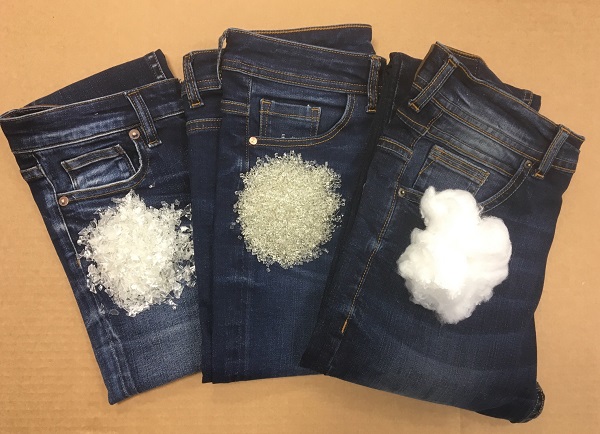
Lycra presented a range of circular products, including CoolmaxEcoMade and Thermolite EcoMade. Made from 100 percent textile waste, the fibers are achieved by collecting scraps of polyester waste, followed by a depolymerization and refining step that turns the waste into chips. The chips become fibers woven into new fabrics with the same performance benefits as virgin materials.Lycra also introduced a new visual tool to help demonstrate the benefits of Lycra Adaptiv fiber. The CGI video showcased how the patent-pending polymer’s unique chemistry adjusts to fit a wearer’s functional needs. When the wearer is at rest, the polymer adapts its holding force to deliver the right fit, shape, and control. But when the wearer is in motion, the polymer adapts its elasticity to provide improved comfort and a second-skin effect that enables the garment to stay in place. This breakthrough fiber enables brands and retailers to create jeans that adapt to fit different body shapes and genders while offering consumers a liberating wearing experience with its soft and easy stretch.