The global textile and apparel ecosystem is entering a decade marked by unprecedented capacity expansion and evolving sustainability imperatives. Industrial projections indicate that polyester fiber, a core material in modern fashion will see global production climb from 75.13 million tons in 2025 to 103.67 million tons by 2035. Valued at $135.10 billion in 2025, the market is on course to more than double, reaching $274.58 billion within a decade. For multinational retailers and apparel brands, this means both a logistical lifeline and a challenge, as companies must navigate the twin pressures of low-cost sourcing and intensifying circularity mandates.
Polyester reigns supreme in global apparel volumes
Polyester continues to dominate the retail rack, forming the backbone of the modern fashion industry. Accounting for 52 per cent of global textile and apparel volumes, the fiber’s versatility and cost-efficiency have cemented its role across mass-market and premium segments alike.
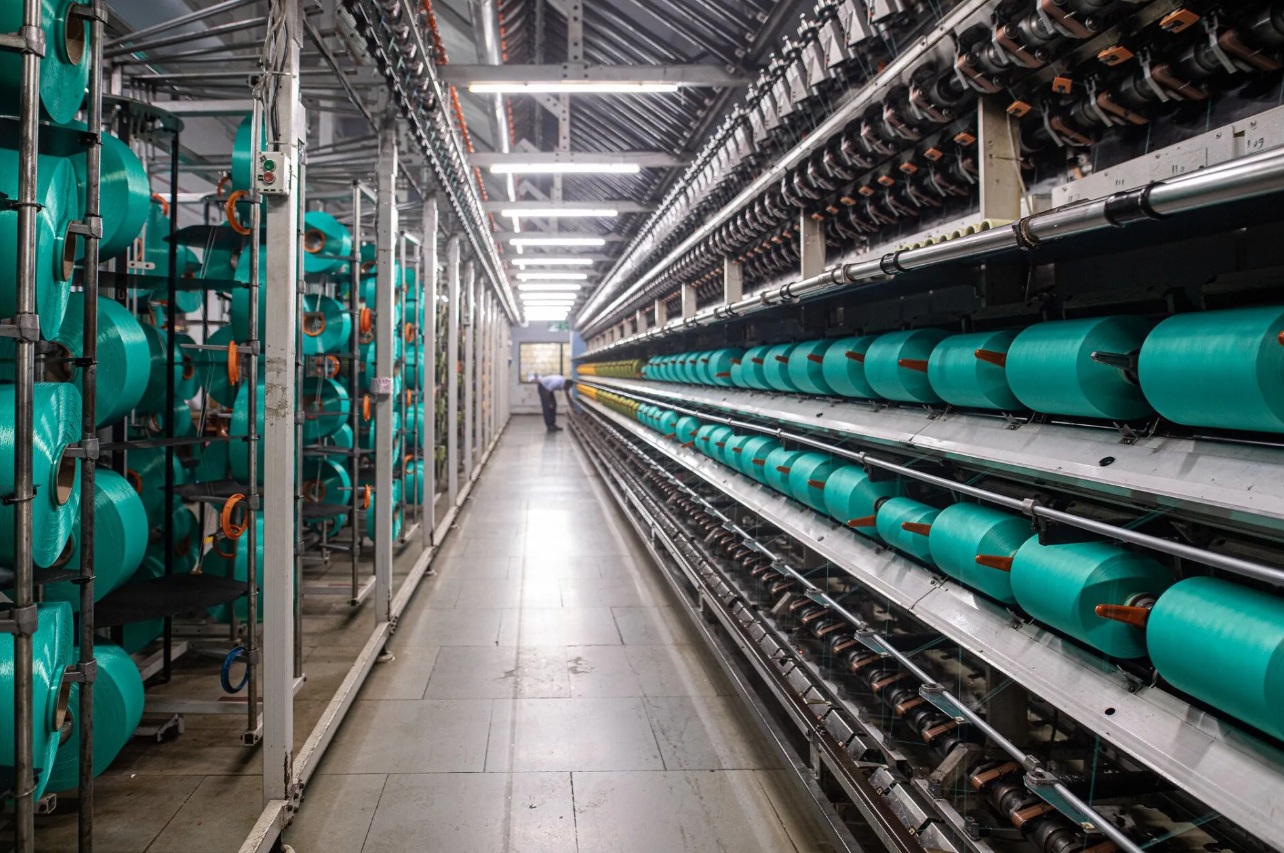
Within this, Polyester Filament Yarn (PFY) is particularly critical, comprising 60 per cent of total polyester volume in 2025. PFY underpins the explosive growth of athleisure and performance apparel, where high-tenacity, moisture-wicking, and shape-retaining properties are increasingly demanded by consumers. Retailers are responding to these preferences by positioning PFY-based garments as investment pieces, products that justify higher price points through durability and functional performance, aligning with the broader shift toward quality over quantity in global consumption patterns.
The rPET bottleneck and the emergence of green premiums
While virgin polyester continues to dominate 78 per cent of global supply in 2025 remains fossil-based recycled polyester (rPET) is emerging as the fastest-growing segment in the fiber market. Over 150 global brands have pledged to integrate 40-100 per cent rPET into their supply chains by 2030, creating a surge in demand that outpaces the current supply of high-quality bottle-to-fiber recyclates.
This scarcity has led to new commercial dynamics. Brands are increasingly entering into long-term offtake agreements with producers to secure rPET volumes, and retail price structures are beginning to reflect the green premium associated with sustainably sourced fibers. The pressure is particularly acute in high-performance applications, where recycled fibers must meet stringent technical standards without compromising durability or aesthetic qualities.
Asia Pacific dominates as western markets specialize
Geography remains a defining factor in global polyester production. The Asia Pacific region continues to anchor supply chains with a 72 per cent volume share in 2025, a figure expected to rise above 75 per cent by 2035. China and India remain the primary hubs, with India now ranking as the third-largest exporter of polyester yarn globally. Indian exports are growing at a CAGR of 7.6 per cent, catering to markets as diverse as Brazil, Turkey, and Southeast Asia.
In contrast, North America is carving out a niche in high-value, technical applications, including automotive and medical textiles. Advanced grades like PCDT polyester are gaining traction due to their high-heat resistance and long-term durability, enabling brands to differentiate on functionality rather than volume.
Table: Global polyester market outlook 2026-35
|
Metric |
2025 (base year) |
2035 (forecast) |
CAGR (%) |
|
Market Value |
$135.10 bn |
$274.58 bn |
7.35% |
|
Market Volume |
75.13 mn tons |
103.67 mn tons |
3.27% |
|
rPET Volume Share |
12.50% |
Projected >25% |
High |
|
Top Region (APAC) |
72% Share |
75%+ Share |
4.50% |
The table reflects, the market is expected to more than double in revenue terms, with demand for both mass-market apparel and premium performance fabrics on the rise. Production growth reflects capacity expansions in Asia Pacific and rising adoption of specialty fibers. Recycled polyester adoption is increasing due to brand sustainability commitments, but supply remains constrained.
Reliance Industries benchmarking integration and circular strategy
Reliance Industries Limited (RIL) remains the global bellwether for polyester production. Operating fully integrated petrochemical hubs in India, RIL controls the value chain from paraxylene feedstock to branded fibers such as Recron. The company is aggressively scaling recycled polyester capacity, aligning with the global pivot toward circularity, and cementing India’s position as a top-three polyester exporter.
Financially, RIL’s strategy is tied to the projected $350 billion Indian textile market by 2030. Beyond apparel, the company is targeting specialty segments such as high-tenacity fibers for automotive, industrial, and technical textiles, leveraging its production scale and research capabilities to capture both mass-market and high-performance opportunities.
Implications for global retailers
The growing polyester market offers retailers both opportunity and challenge. On one hand, stable production hubs in Asia and integrated supply chains provide reliable access to volume and cost efficiency. On the other, the rapid shift toward recycled materials and high-performance fibers demands long-term planning, investment in supplier partnerships, and an agile response to pricing dynamics.
Brands that successfully navigate this duality balancing scale with sustainability stand to benefit from a decade of transformative growth in both revenue and consumer loyalty. For global fashion retailers, polyester is no longer just a commodity input; it is a strategic lever for competitive advantage.