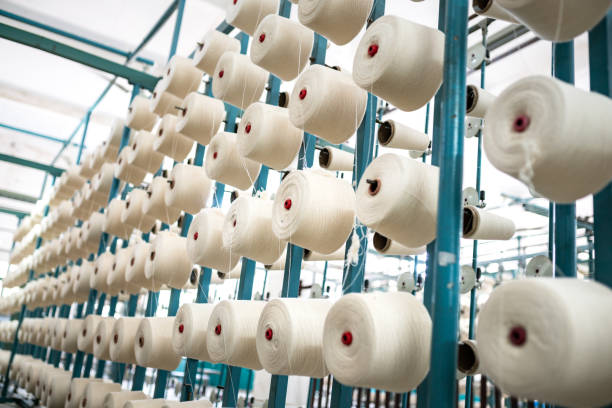
Leading global technology research and advisory company Technavio’s latest report on the global textile machinery market provides an analysis on the most important trends expected to impact the market outlook from 2016 - 2020. Technavio defines an emerging trend as a factor that has the potential to significantly impact the market and contribute to its growth or decline.
According to Technavio heavy industry research analysts, the top three emerging trends driving the global textile machinery market are: Automation in textile machinery, growing popularity of spinning machinery in India and overseas demand for Spanish machinery.
According to the report, automation plays a crucial role in improving the quality and cost-competitiveness of textiles. Automated textile machinery accelerates textile production and increases the flow rate of fabric, enabling lean manufacturing.
Technavio expects spinning capacity in India to develop, as the country has high cotton export demand. More than 10 -15 per cent capacity will likely be added in the next year. This creates a positive scenario for the domestic spinning machinery manufacturing industry.
The report says that the Spanish textile machinery manufacturers are gradually making a mark in the global market as they develop the latest technologies in areas such as braiding, technical fabric, spinning, finishing, dyeing, and printing. These manufacturers also manufacture customized machines and are also exporting over 80 per cent of their production.

- 1
- 2
- 3
- 4
- 5
- 6
- 7
- 8
- 9
- 10
Spykar accelerates offline expansion: plans 100 new stores across India
A titan of the Indian denim-first fashion scene, Spykar has officially unveiled an aggressive retail growth strategy. As consumer demand... Read more
The Inventory Illusion: Rethinking the Zara benchmark in a volatile retail era
For over a decade, the global fashion industry has treated the Zara playbook as the gold standard of inventory efficiency.... Read more
Retail Without Retail: How Walmart’s depot network is turning space into logisti…
Walmart is fundamentally rewriting the commercial real estate and retail logistics playbook with the rise of its ‘Walmart Depots’ a... Read more
Global textile regulation tightens, forcing realignment across fashion supply ch…
Global fashion and consumer goods supply chains are entering a decisive regulatory transition as Extended Producer Responsibility (EPR) frameworks for... Read more
Luxury’s new power axis, US dominance, China reset, Gulf surge
As the post-China luxury order takes shape, the US is emerging as the industry’s most dependable growth engine, while Japan,... Read more
India’s $9 Billion Landfill Blind Spot How trashed clothes hold the key to globa…
A massive economic windfall is sitting uncollected in India’s landfills, and the key to unlocking it lies in rethinking how... Read more
Red Sea crisis reshapes textile trade routes, challenges India’s export margins,…
Global apparel trade is now in a new operational phase where geopolitical stability and logistics reliability are as important as... Read more
EU’s textile waste rules enter enforcement phase, raising alarms across fashion …
Europe’s apparel and textile industry is approaching one of its most significant regulatory transitions in decades. As the European Union... Read more
Corporate fashion adopts reverse logistics to unlock the $367 bn resale market
Global fashion retailers are rapidly changing their business models around resale, repair, and textile recovery as the secondhand apparel market... Read more
Tariff Shock 2026: Forced-labor enforcement is repricing global fashion trade
Washington’s latest trade intervention signals a break in the global apparel sourcing patterns. The Office of the United States Trade... Read more