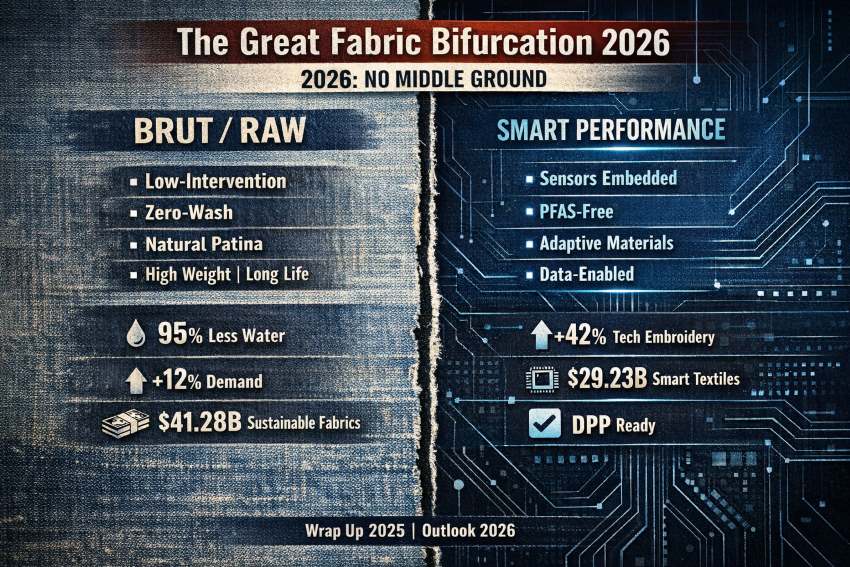
As part of our definitive annual series, "Wrap Up 2025, Outlook 2026," we examine how the textile and apparel sector has moved beyond a phase of simple recovery into a period of high-stakes material evolution. The final data from 2025 reveals an industry no longer satisfied with singular product identities. Instead, we are entering 2026 in a state of productive tension, a "Great Bifurcation" where the commercial appetite for raw, unadulterated "Brut" authenticity is matched only by a capital-intensive surge in high-tech, intelligent performance textiles. For the C-Suite, the strategic mandate of 2026 is clear: market leadership now requires a dual-track mastery of both artisanal heritage and technological developments.
The "Brut" revolution of late 2025 emerged as a direct commercial response to decades of chemical over-processing. In the denim sector, the move toward unwashed, untreated "Raw" or "Brut" fabrics has transitioned from high-end boutiques to global sourcing schedules. This aesthetic is the cornerstone of a broader movement toward Sustainable Fabrics, which have evolved from a niche preference to a $41.28 billion powerhouse. In 2026, the definition of sustainability has expanded to include "Low-Intervention" textiles—materials that emphasize their natural state through reduced scouring, bleaching, and finishing. Retailers in major import markets reported a 12% increase in demand for these rigid, high-weight textures as consumers favor garments that offer a personal patina and long-term durability. This is a high-margin sustainability play; by eliminating traditional stone-washing and chemical distressing, "Brut" production reduces factory water consumption by up to 95%.
Running parallel to this raw aesthetic is the rapid industrialization of bio-based and regenerated fibers. The global sustainable fabric market is projected to reach $134.7 billion by the end of 2026, driven by a 12% CAGR in organic and recycled segments. We are seeing a massive shift toward "Circular Feedstocks," where agricultural waste is transformed into high-performance cellulose. This is not merely an environmental choice but a regulatory necessity; as we head into 2026, the market value of recycled polyester is expected to hit $10 billion, reflecting its role as a primary substitute for virgin synthetics.
Simultaneously, the "Smart Performance" segment is capturing a larger share of global R&D budgets. Driven by a 42% surge in the technical embroidery market, where conductive threads are integrated directly into the fabric base, the 2026 outlook for intelligent textiles has moved from experimental labs to the mainstream supply chain. We are seeing the commercialization of "Opaque Rainproof" materials that utilize biomimicry to repel water without the use of restricted PFAS chemicals. Even in high-fashion categories, a 20% rise in demand for fine lace in the EU is being supported by the integration of high-tenacity, "invisible" synthetic fibers to ensure these delicate aesthetics meet the rigorous durability requirements of the upcoming 2026 circularity mandates.
2026 sectoral growth & performance forecast
The move into 2026 is defined by a massive reallocation of capital toward materials that satisfy the "Double Agenda" ; fabrics that deliver high-performance functionality while maintaining full compliance with the EU Digital Product Passport (DPP) registry, which becomes operational in mid-2026.
|
Fabric Segment |
2025 Market Value (Est) |
2026 Revenue Forecast |
Key Innovation Driver |
|
Sustainable Performance |
$37.26 Billion |
$41.28 Billion |
PFAS-free Hydrophobic Coatings |
|
Smart/Intelligent Textiles |
$22.08 Billion |
$29.23 Billion |
Integrated Biometric Sensors |
|
Brut/Raw Denim |
$4.80 Billion |
$5.40 Billion |
Zero-Wash Longevity Models |
|
Technical Embroidery |
$1.59 Billion |
$1.69 Billion |
Conductive Thread Connectivity |
|
Bio-Based Textiles |
$54.21 Billion |
$58.80 Billion |
Regenerated Agricultural Waste |
Regional Trajectories: The race for material superiority
As the global landscape shifts, 2026 is witnessing a clear division of labor among the world’s textile powerhouses, each leveraging specific technological or regulatory advantages to capture market share.
China: The infrastructure of Circularity
In 2026, China has successfully transitioned from a volume-based manufacturer to the global hub for advanced textile recycling. The market for recycled materials in China is projected to lead the Asia-Pacific region, with a 4.9% CAGR driving revenues toward $416 million by the end of the year. Massive joint ventures are now unlocking up to 100,000 tonnes of textile-to-textile recycled PET spinning capacity annually. By integrating IoT and Bluetooth Low Energy (BLE) into high-output performance lines, Chinese mills are securing their position as the primary suppliers for the "Intelligent Textile" boom, providing the scale necessary to move smart fabrics into the mid-market price bracket.
European Union: The regulatory standard-setter
The EU continues to act as the primary catalyst for the "Brut" movement through aggressive legislative frameworks. With the July 2026 ban on the destruction of unsold apparel, European buyers are prioritizing "Demand-Responsive" fabrics; materials that allow for late-stage digital printing or modification to prevent overproduction. The focus here is on the "Quality Premium," where the environmental footprint of every square meter is tracked. This has created a massive market for "Digital Product Passport" (DPP) ready textiles, where transparency is treated as a high-value product feature.
India & Vietnam: The efficiency powerhouses
India and Vietnam have moved aggressively into high-value Original Design Manufacturing (ODM). Vietnam’s textile exports are on track to reach $50 billion in 2026, fueled by a "dual transformation" of digitalization and greening. Vietnamese factories are increasingly utilizing AI-based vision systems for defect detection and automated packaging to offset rising labor costs. In India, a government-backed $1.6 billion investment in technical textiles has resulted in over 56% of new industry entrants focusing on "Clothtech" and "Protech" segments. By blending "Brut" textures with recycled stretch fibers, Indian manufacturers are capturing a growing share of the premium sustainable denim market.
North America: The innovation hub
North America remains the global leader in smart clothing demand, holding a 48.4% share of the wearable textile market. In 2026, the US consumer will be the primary driver for "Function + Fashion," with a specific focus on medical and fitness integration. This demand has pushed US-based manufacturers to focus on "Very Smart" textiles,fabrics that can recognize and adapt to environmental changes, transforming the garment from a passive product into an active participant in the user's healthcare and wellness ecosystem.
Regional economic & innovation outlook (2025-2026)
|
Region |
2025 Output (Est) |
2026 Export Forecast |
Strategic Competitive Advantage |
|
China |
$880 Billion |
$925 Billion |
Circular Economy Scale & IoT Integration |
|
European Union |
€162 Billion |
€170 Billion |
Regulatory Compliance & High-End Design |
|
India |
$152.4 Billion |
$164.8 Billion |
Technical Textiles & Organic Cotton Lead |
|
Vietnam |
$47.5 Billion |
$50.0 Billion |
Smart Factory Automation & ESG Hub |
|
North America |
$196.4 Billion |
$204.5 Billion |
Smart Textile Demand (48% Global Share) |
The C-Suite Outlook: Strategic resilience and the "Service" of surface
For the leadership tiers of 2026, the focus has shifted from managing commodities to managing sophisticated software delivery systems. The "Orchestrator CEO" of 2026 recognizes that the fabric surface is no longer a passive substrate but a functional service. Market winners are those who have abandoned the binary choice between sustainability and performance, instead using technology as the bridge to make circularity profitable. Leadership is now centered on data-first sourcing, where a roll of fabric is evaluated not just on its weight or hand-feel, but on its digital twin and its capacity for lifecycle tracking.
Editor’s Conclusion: The era of the intelligent loom
As we conclude our look at the transition from 2025 to 2026, the overarching theme is the end of the "middle ground." The textile industry has reached a point where value is created at the extremes—either through the raw, unrefined honesty of "Brut" materials or the hyper-engineered capabilities of smart fabrics. The loom of 2026 is digital, the thread is circular, and the business model is defined by transparency. In this new era, the most successful B2B partnerships will be those that can deliver a narrative as authentically raw as it is technologically advanced. The fabrics of 2026 are no longer just clothing; they are the most sophisticated interfaces on the planet.