

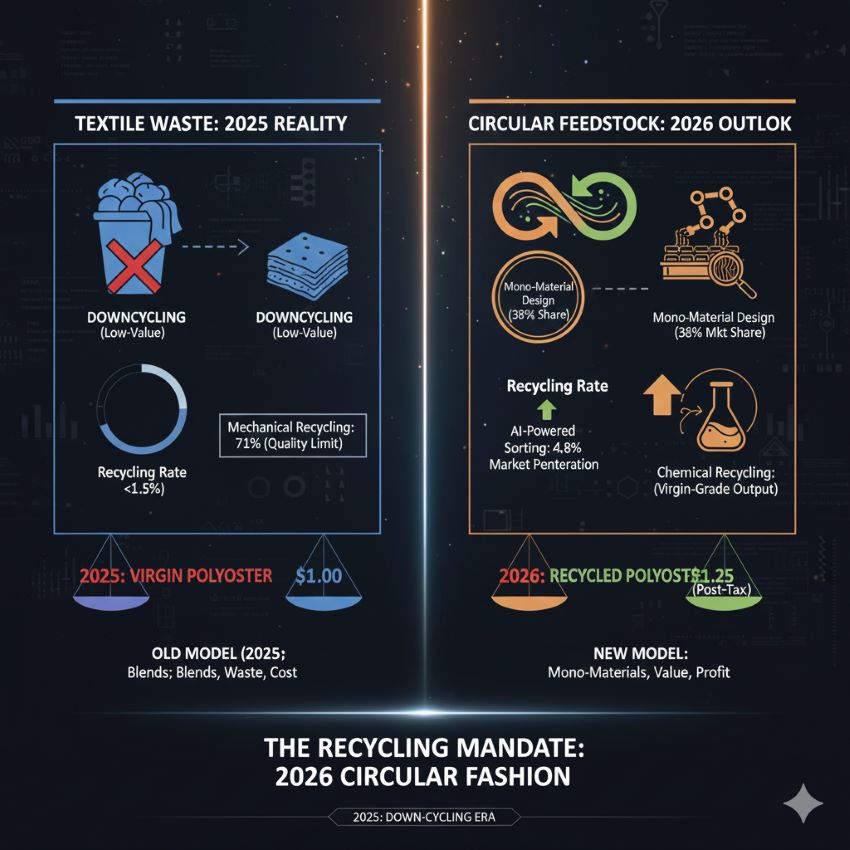
As we present this feature as part of our year-end series, 'Wrap Up 2025, Outlook 2026', and as the apparel industry closes the books in 2025, the strategic focus has moved beyond the simple substitution of virgin materials to a comprehensive industrialization of textile-to-textile recycling. For years, the sector relied on "downcycling", turning old garments into low-value insulation and "bottle-to-fiber" polyester recycling. However, 2026 marks the definitive arrival of the circular loop. Driven by tightening European regulations and a volatile market for raw materials, the industry is scaling technology that treats discarded clothing not as waste, but as a primary source of secondary raw materials.
2025 Review: The maturation of recycling infrastructure
The past year was a period of intense capital allocation toward automated sorting and chemical depolymerization. While mechanical recycling remained the dominant process in 2025,capturing over 70% of the market due to its cost-efficiency with cotton and wool, it hit a quality ceiling. Mechanical shredding shortens fiber length, often requiring a blend of virgin material to maintain yarn strength. This limitation spurred the commercial expansion of chemical recycling in 2025, a process that breaks synthetic fibers down to their molecular building blocks.
The commercial landscape also saw a significant shift in how waste is sourced. Although the textile-to-textile recycling rate remained below 1.5% for much of 2025, the transactional space for "pre-consumer" waste, factory off-cuts and yarn remnants, grew steadily. This industrial waste offers the consistent, clean chemical profile that chemical recyclers need to ensure virgin-grade output as they prepare for a high-growth 2026.
2026 Outlook: The strategic shift to ‘Mono-Materiality’
In 2026, the industry is moving toward a "Circularity-by-Design" architecture. The most significant commercial opportunity lies in the transition from complex fiber blends to Mono-Material Recyclable Stretch Yarns. Traditionally, adding stretch to a garment required blending polyester with elastane, a combination that is notoriously difficult to process in recycling facilities.
Entering 2026, the sector is scaling polyester-based mono-stretch solutions. These yarns achieve elasticity through mechanical texture or bi-component structures, allowing a garment to be 100% polyester from the shell to the stretch. This technical alignment is projected to see mono-material stretch yarns capture 38% of the market share in 2026, up from just 12% in 2025. This allows brands to bypass expensive manual sorting and move directly to high-yield chemical recovery.
Market data and commercial projections
The valuation of the textile recycling sector is no longer driven by sentiment but by the economic reality of the European Union’s and UK's "Eco-Modulated" fees.
Table 1: The Global fiber transition market dynamics (2025-2026)
|
Metric |
2025 Estimate |
2026 Outlook |
Key Growth Driver |
|
Recycled Fiber Market Size |
$26.12 Billion |
$28.03 Billion |
EU Waste Framework Mandates |
|
Mono-Material Stretch Yarn Share |
12% |
38% |
Circularity-by-Design Mandates |
|
Textile-to-Textile Recycling Rate |
<1.5% |
4.80% |
AI-Powered Sorting Infrastructure |
|
Virgin Polyester Price Premium |
Base ($1.00) |
$1.25 (Post-Tax) |
Extended Producer Responsibility (EPR) |
|
Global Yarn Market CAGR |
5.30% |
6.40% |
Sustainable/MMF Segments |
Table 2: Recycling process efficiency & commercial viability
|
Process Type |
Current Market Share |
Feedstock Suitability |
Output Quality |
2026 Trend |
|
Mechanical |
71% |
Natural Fibers (Cotton/Wool) |
Lower Staple Length |
Optimization for Blends |
|
Chemical |
18% |
Synthetics (PET/Nylon) |
Virgin-Grade |
Industrial Scale-up in Asia |
|
AI-Powered Sorting |
11% |
Mixed Post-Consumer |
High Purity Bales |
4.8% Market Penetration |
The Regulatory Horizon: EPR and the cost of non-compliance
The most aggressive driver for 2026 is the EU’s revised Waste Framework Directive. Starting this year, the destruction of unsold textiles is banned, and mandatory separate collection of textile waste is in full effect. For C-Suite leadership, this is a bottom-line issue. EPR schemes now include "eco-modulated" fees: a producer pays a significantly higher levy for a garment that is difficult to recycle (such as a multi-material blend) compared to one designed as a mono-material.
Business transactions are already reflecting this. Large-scale retailers are shifting their procurement contracts toward suppliers who can provide a "Digital Product Passport" (DPP). This transparency allows brands to prove the recyclability of their collections, effectively lowering their regulatory tax burden and securing their position in the European market.
C-Suite Strategic Leadership: Securing the circular supply chain
For leadership in 2026, the primary challenge is feedstock security. As chemical recycling plants, particularly the first true industrial-scale facilities in Asia, scale up, the demand for high-purity textile waste is outstripping supply. Leading manufacturers are no longer just buyers of yarn; they are becoming partners in waste collection.
Strategic moves in 2026 include:
● Vertical integration: Manufacturers are acquiring or partnering with sorting facilities to guarantee access to "recycling-ready" bales, supported by AI-powered infrastructure.
● Offtake agreements: Long-term contracts with chemical recycling pioneers to ensure a steady supply of recycled monomers that match virgin performance.
● Design standardization: R&D departments are being mandated to replace all nylon/elastane blends with mono-material alternatives to future-proof against rising disposal costs.
"The 2026 mandate is simple: if you don't own the waste stream, you don't own your future raw material," notes a leading industry analyst. "The commercial winners are those who have decoupled their growth from the volatility of virgin oil and cotton prices by building a proprietary recycling loop."
Editor’s Conclusion: From sustainability to industrial strategy
The 2026 outlook confirms that the era of "voluntary" sustainability is over. We have entered an era of industrial strategy where recycling is the primary tool for risk mitigation. The "Wrap Up" of 2025 showed that while the industry had the will to recycle, it lacked the design discipline to do so efficiently.
The rise of mono-materials and the expansion of chemical depolymerization solve the quality gap that previously held back the sector. As we move into 2026, the "green premium" is dissolving, replaced by a "recyclability discount" for those who design for the loop. The apparel industry is no longer just making clothes; it is managing a sophisticated material recovery system where every fiber is an asset to be recovered, repolymerized, and re-spun.










