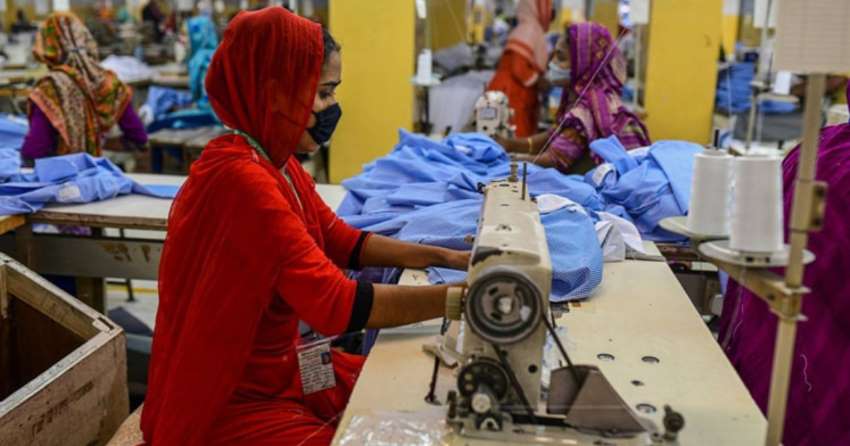
Buyers pay lower prices to apparel suppliers in Bangladesh than they do to some of the country’s competitors.
In fact they often pay prices that are below factory costs whereas Vietnam, Indonesia, Turkey and Mexico are given higher than the average rates.For instance, men’s woven cotton trousers made in Bangladesh are sold for $7.01 per piece in 2020, which is 9.20 per cent below the global average of $7.72.Vietnam receives $10.76 per piece while Sri Lankan and Indian exporters get $8 and $8.41, respectively, for the same product.
Similarly, men's cotton jeans made in Bangladesh are sold at $7.81 apiece, again 7.20 per cent down from the global average of $8.41. Vietnam receives $11.55 by selling a similar item.Only two products -- women's cotton trousers and men's cotton T-shirts – manufactured in Bangladesh brings home a price that is slightly higher than the global average.
Made-in-Bangladesh women’s cotton trousers are sold at $6.43 per piece up 23 per cent from the world average of $5.22.Turkey takes home the highest, at $15.84, a staggering 203 per cent higher than the global average.Men's cotton T-shirts fetch $1.47 per piece for Bangladesh, which is 23 per cent higher than the global average of $1. Peru nets $8.46, the highest among suppliers around the world.Woven cotton jackets bring $10.10 per piece, which is 0.70 per cent below the global average. Thailand receives $48.86 and Mexico gets $34.11.
A bra made in Bangladesh from manmade fiber is sold at $3.19 per unit, which is 18 per cent below the international average. Vietnam gets $6.06.
Possible reasons
One reason prices of garment items made in Bangladesh are priced lower than the average world price is that manufacturers in Bangladesh are still strong in basic garment items. For instance, 80 per cent of Bangladesh's garment items are still confined to five cotton-made items and it has the problem of over-capacity.So, a hidden unhealthy competition has also kept the prices of the items lower. Because of excess capacity in the denim segment, prices are falling.
Competitors’ strengths
Garment manufacturing has evolved from a simple manufacturing operation into a complex service industry.The actual cut and sewing operations are the simplest and least remunerated tasks.First-generation garment producers in Asian cities such as Hong Kong, Singapore and Seoul have transformed from simple product makers to multinationals and they operate globally and invest in engineering, advanced information technology and cutting-edge technology.Yet most small and medium-sized garment manufacturers in developing countries, and especially least-developed countries, have not adapted to this changing industry and they remain focused on simple cut and sewing operations, provide few services and produce commodity-type garments.