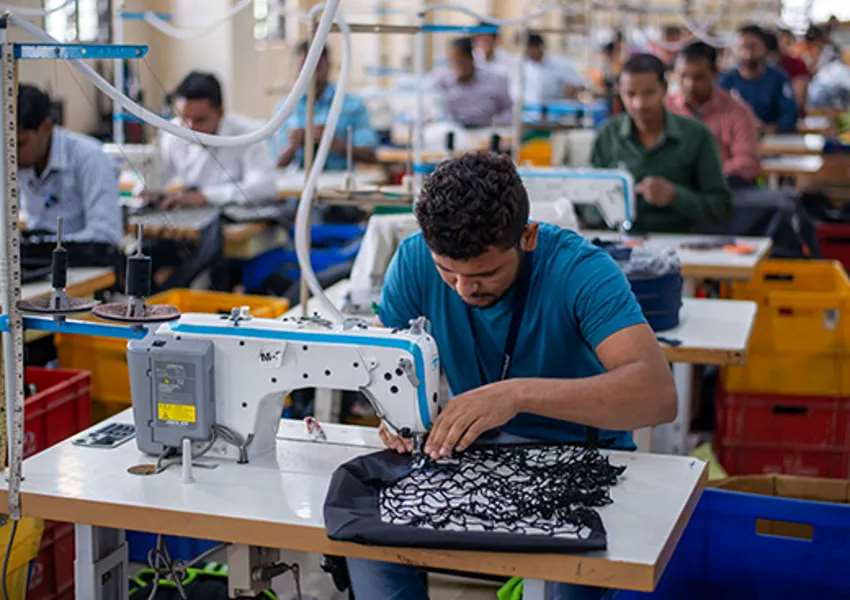
Bangladesh has launched the Center of Excellence for the Bangladesh Apparel Industry (CEBAI), aimed at improving the productivity of the country’s readymade garments industry through research and development. It will create skilled and semi-skilled workers through market-responsive training or through providing support for skill development endeavors.
The center will also regularly conduct research on the industry to keep it on the right track of development and act as a think tank for the apparel industry. CEBAI is the first such center established in the world. It would act as an important catalyst for the industry’s growth through research and skill development programs. It will provide all sorts of training and skill solutions, basic, regular and product based research, professional consultation and new market developments.
Swedish SIDA and retailer H&M are funding $1.5 million for the first three years of the project to be implemented by ILO. The skill delivery wing will be set up at Ashulia while the research and planning cell will be at Dhaka University and other activities would be conducted at private enterprises.
CEBAI aims to produce 6,000 skilled workers in two years. For meeting the growing global demand and export targets, Bangladesh will need 3.5 million skilled and semi-skilled workers by the next seven years.
- 1
- 2
- 3
- 4
- 5
- 6
- 7
- 8
- 9
- 10
Zombie inventory and shrinking margins inside China’s fashion returns meltdown
China’s digital fashion market, long celebrated as the world’s most sophisticated test bed for e-commerce innovation, is facing a destabilising... Read more
Circularity by Design: How EU rules are turning data into fashion’s new currency
The European fashion sector has entered a compressed transition window. Two regulatory confirmations: the revised EU Textile Labelling Regulation (effective... Read more
The Lyst Reset: Chanel and Dior rewrite luxury’s power index
The global luxury hierarchy has been quietly rewritten, and not by sales alone. In Q1 2026, Chanel rose to the... Read more
Inventory, not expansion, defines winners in global apparel
The 2025 fiscal year has crystallised that revenue growth and operational health are no longer moving in tandem. In an... Read more
From growth-at-all-costs to cash discipline, the new economics of DTC fashion
The global direct-to-consumer apparel market is entering a correction phase, as fashion brands across the US, Europe and the UK... Read more
Britain’s Forgotten Growth Engine: Why policy gaps are undermining fashion and t…
Britain’s fashion and textile industry, often framed through the lens of creativity and design, is emerging as a case study... Read more
Beyond price rallies structural reform can strengthen India’s cotton economy
India’s cotton economy is entering a decisive phase, where firmer prices and tighter arrivals in the 2026-27 season have given... Read more
Polyester volatility redraws India’s textile industry competitive map across Asi…
India’s synthetic textile industry has entered a phase of cost instability as polyester staple fibre (PSF) prices rise across domestic... Read more
The £7 Billion Question: Who pays for fashion’s ‘free rental’ habit?
The global fashion industry is facing an uncomfortable paradox: its most valuable customers may also be its most destructive. A... Read more
India, China Bangladesh face fresh headwinds as global apparel markets rebalance
Global apparel trade is entering a more uneven recovery phase, with demand growth persisting but losing uniform momentum across major... Read more