FW
Botanic fibers ideal for performance clothing
Climate resistance, odor control, UV protection, moisture management, and many additional benefits are available in today’s smart textiles that are engineered to work hard and look beautiful all day. Demand is growing for performance clothing that seamlessly crosses over from the gym to the street. Designers must rely on high-performance materials to contribute the majority of functional benefits that consumers require. Consumers want to know that the clothing they buy is made with consideration for the planet and that it does no harm during or at the end of its useful life.
To date, the vast majority of performance fabrics have been made from synthetic materials. While synthetics deliver outstanding technical benefits, consumers are starting to question some of the environmental aspects, including the raw material sources and potential microplastic pollution from use, care and disposal. Natural fibers like cotton, hemp, linen and wool are loved for their connection to the earth, but many of the performance features in demand today must be instilled into the fabrics with chemical treatments.
Botanic fibers like Tencel branded lyocell bridge the gap, combining high-performance benefits and natural origins along with an environmentally responsible profile from beginning to the end of its life cycle.
ASOS demands action on modern slavery from third-party brands
Leading global online fashion retailer, ASOS, is asking third-party brands to pledge to tackle modern slavery. The UK business has confirmed brands including Dr Martens, New Look and River Island have signed a pledge which includes mapping and assessing modern slavery risks, working with others to develop tools and resources to raise awareness of risks and training relevant employees about modern slavery risks within their businesses and supply chains.
ASOS has also released its annual Modern Slavery Statement in line with UK legislation. ASOS’ Modern Slavery Statement and the commitments contained within form a key component of ASOS’ Ethical Trade Strategy, which has been set up to help the brand tackle human rights impacts in its global supply chain and empower workers to realise and understand their fundamental rights. A key component of the strategy is an ambition to drive a systemic shift in the way ASOS Design and ASOS third-party brands approach ethical trade and sustainability.
Athleisure market to get a makeover with six new fabrics
"A new report titled, “Activewear Market by Product and Fabric: Global Opportunity Analysis and Industry Forecast, 2017-2024,” by Allied Market Research reveals, the global activewear market, currently valued at $351,164 million in 2017, is expected to reach $546,802 million by 2024."
 A new report titled, “Activewear Market by Product and Fabric: Global Opportunity Analysis and Industry Forecast, 2017-2024,” by Allied Market Research reveals, the global activewear market, currently valued at $351,164 million in 2017, is expected to reach $546,802 million by 2024.
Growth in demand has led to several innovations in the segment, especially in fabrics. Brands are using fabrics with innovative features such as moisture wicking properties and an ability to protect against UV radiation besides offering freedom of movement. Some of these innovative fabrics driving the athleisure market include:
Fabrics for inner lining
The first innovative fabric to be introduced includes the Knitted 3-Layer High Pile. This fabric can either be used as an inner lining or as a decorative accent on the outer face. The knitted 3-layer high pile keeps pile fibers firmly in place without spending extra time and effort on lamination. This simplifies the production process besides lightening the fabric, making it ideal for athleisure applications. This helps manufacturers save time and money, without sacrificing quality. Also, each of these layers can use a different material type — for example, a soft cotton lining and a UV protective fabric shell — optimizing function and comfort for outdoor sport enthusiasts.
Fabrics to add support
Sculpted spacer fabrics add the required padding and support to women sports bras, vests, and tank tops that are being  increasingly accepted not just for athletic activity, but also for daily wear. The spacer fabric technology helps manufacturers knit in correspondence to the natural size and shape of women’s bodies, enhancing comfort with form-fitting support. Rather than attaching padding after the sports bra is sewn, the sculpted spacer is sewn all at once, eliminating several steps of the production process.
Providing the required elasticity and compression
Quadro Stretch, the latest version of the 4-way stretch fabrics, provides variant elasticity and compression to prepare muscles before exercise and release tension during and after exercise. By changing the proportion of spandex, brands can adjust elasticity according to individual consumer demands.
Maintaining dryness and warmth
Spacer Jacquard fabrics provide all the functionalities to an athlete. They maintain dryness, warmth and protect them from various elements. Furthermore, these fabrics prevent impact-related injuries such as broken or fractured bones.
A lightweight fabric that cuts processing time
Swiss Fleece has a double-layer structure — soft-napped on the inside with jacquard pattern on the outside — that can be woven simultaneously, cutting the time and cost of processing, and keeping the fabric lightweight. It works best when worn over a moisture-wicking base layer material like merino wool, and under a waterproof and/or windproof shell. It is a highly breathable fabric.
Retaining color, pattern durability
Unlike printed fabrics, that peel off and fade over time, the intarsia fabrics retain their vibrant colors and patterns for much longer, since the design is knit into the fabric itself rather than just pasted on the top. As brands are looking for new ways to embed their logos into athletic gear — and designers remain on the lookout for techniques that can create a unique look — intarsia is likely to make a big impact in the 2019 athleisure market.
Intertextile Shanghai Apparel Fabrics spring edition gets a huge response from visitors, exhibitors
"A global apparel textile flagship event, Intertextile Shanghai Apparel Fabrics-Spring edition witnessed a 15 per cent increase in visitors this year. The event welcomed around 94,661 visitors from over 110 countries & regions. Held over six halls at the National Exhibition and Convention Centre in Shanghai, Intertextile Apparel Fabrics-Spring edition noted a 12 per cent increase in overseas exhibitors."
 A global apparel textile flagship event, Intertextile Shanghai Apparel Fabrics-Spring edition witnessed a 15 per cent increase in visitors this year. The event welcomed around 94,661 visitors from over 110 countries & regions. Held over six halls at the National Exhibition and Convention Centre in Shanghai, Intertextile Apparel Fabrics-Spring edition noted a 12 per cent increase in overseas exhibitors. The event was co-organised by Messe Frankfurt (HK); the Sub-Council of Textile Industry, CCPIT; and the China Textile Information Centre. The top 10 visitor countries & regions to the event this year included Hong Kong, Korea, Japan, India, the US, Taiwan, Russia, Italy, Vietnam and Spain.
Special pavilions, zones receives positive response
The Milano Unica Pavilion registered 20 per cent increase in visitors compared to the 2018 Spring edition. It also reported a satisfactory presence of buyers from China, Asia, South Korea, Japan, India, Russia and Saudi Arabia. Besides offering an access to the global textile market, the fair also provided an industry insight into the fringe programme, which included three panel discussions and 25 seminars.
Milano Unica booth also noted the presence of many established brands. Tessitura Monti from Italy was one of them 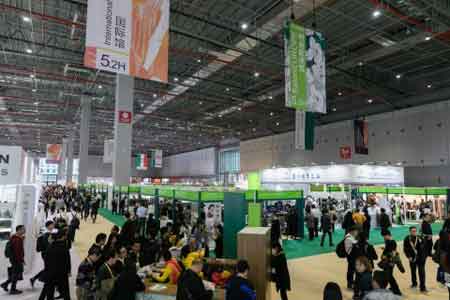 exhibiting at Intertextile for the last 20 years. “The event is an important bridge between Western and European products and the China market. It enables the Chinese buyers to source products that are not available in their local market. At the same time, it helps to expand our brand exposure in the Chinese market, says Nadia Schincardi, Export Manager of the company.
Known for offering high quality at affordable prices, Swiss company, Glarotex AG received overwhelming response to its booth in the SalonEurope Pavilion. “Though our target was Chinese buyers, even the European and Korean buyers visited our booth,” says Irina De Giorgi, Sales Manager, Ideas by Glarotex AG, Switzerland. The company plans to have a bigger booth in the next edition of the event.
Chinese exhibitor Beijing Vitality Textiles Co met around 150 good quality visitors at the Premium Wool Zone. “It’s already the most important trade show in menswear in China. It is a must-see global trade show,” observed Ning Zhang, President, Beijing Vitality Textiles Co (Stylbiella), China
The Verve for Design pavilion aimed at satisfy Chinese demand for original prints was a success as well. “This is a big event on the calendar for lots of our existing customers, so we can meet them here each year,” explained Jane Han Zhang, Creative Director, Fairbairn & Wolf Studio, UK / China a premium exhibitor at the Verve for Design pavilion
Thumbs up from buyers
Buyers at the Intertextile Shanghai Apparel Fabrics were impressed with the quality of the exhibitors and the high level of quality and certified fabrics here, at the event. “The event stocked sustainable alternative fabrics such as Tencel, Modal, organic cotton, BCI,” noted Marina Silveira, Senior Jersey Designer, hush, UK. “We always find new suppliers here besides our existing ones. It’s very easy to source here as the suppliers are flexible even for small orders,” added Xavier Planas, Ravial S.A., Spain. Agreeing to this view Munna, Sales Manager, GYF Trading Company added “Intertextile always houses a wide variety of new and interesting products. Buyers can find whatever they need here. It is an outstanding platform for sourcing.”
US grants patent for environment friendly fabric to Trident Group
Trident the flagship company of Trident Group, one of the largest vertically integrated home textile (yarn, bath & bed linen) manufacturer, has been granted a patent for "Environment Friendly Fabric and its method of manufacturing" by United States Patent & Trademark Office.
The present invention enables Trident to manufacture fabric for bed and bath products without the using chemically harmful fibers besides allowing the fabric to be absorbent, easy to dry and highly breathable. This patent lauds the company’s focus on the quality of its innovations.
Indonesian textile industry seeks protection from high imports
The Indonesian textile industry is seeking government’s protection from high growth of imports as the sector could not compete in both domestic and international markets. According to data from Statistics Indonesia (BPS), export growth in the textile industry has been just 3 per cent annually over the last 10 years, while import growth was 20 percent annually in the same period.
To deal with the issue, Indonesia needs to introduce a law on cloth sovereignty to help the domestic textile industry to develop adding that the law would not only regulate imports, but also offer incentives to support the development of the national textile industry.
As per Indonesian Filament and Fiber Producers Association (APSyFI) secretary-general Redma Gita Wirawasta, the upcoming Idul Fitri celebration should be used as an opportunity by the government to protect local textile products from the storm of imported products.
Target turns away from rare fibers, focuses on sustainbility
Mass market retailer Target will ensure no ancient or endangered forest fiber are found in its viscose textile supply chain by 2020. Target will closely work with its vendors, suppliers as well as other partners in order to understand the origin of viscose and other raw materials it uses and to improve the sustainability of forests where the timber in those products is grown.
Viscose production doubled between 2013 and 2020 and pulp production for packaging is expected to increase more than 100 per cent by 2030 from 2.3 billion trees per year to five billion trees. By using cellulosic materials that have been responsibly sourced, feedstock for future viscose production can be improved. Next generation solutions, such as fabrics that use recycled textile and alternative fibers, can reduce the pressure on forests.
Target is an upscale discount retailer that provides high quality, on-trend merchandise at attractive prices. It has 1,816 stores in the United States. Target also plans to source 100 per cent sustainable cotton by 2022 for use in its owned and exclusive national brands in apparel and home ware. The first step will be partnering with its vendors to map the supply chain for each product containing cotton.
Barcelona gears up to host Itma in June
Next edition of Itma will be held in Barcelona, Spain from June 20 to 26, 2019. The event will showcase fibers, yarns and fabrics as well as the latest technologies for the entire textile and garment manufacturing value chain. The largest number of exhibitors are from Europe, with CEMATEX countries accounting for approximately 65 per cent of all exhibiting companies. Italy represents the largest contingent, followed by Germany and Spain. Outside Europe, companies from Turkey, India and China occupy top spots in total floor space reserved. Viewed by sectors: finishing exhibitors account for 25 per cent of all exhibits in terms of space, followed by spinning with 14 per cent, printing and weaving with 12 per cent each, and knitting exhibitors with 11 per cent.
Exhibitor categories showing the largest growth include the garment making and printing and inks sectors. Garment making counts a number of first-time exhibitors eager to demonstrate their robotic, vision system and artificial intelligence solutions; and the number of exhibitors showcasing their technologies in the printing and inks sector has grown 30 per cent since Itma 2015.
Itma has been a catalyst and showcase of groundbreaking innovation since 1951. Participants will be able to share new developments, discuss industry trends and spur creative efforts, thus ensuring a vibrant innovation culture in a global context.
Guess unveils sustainable denim capsule
The new Guess Eco capsule collection for men and women is made with environmentally conscious materials and manufacturing processes. The denim offered in the Guess Eco collection is made with technology that uses, on average, roughly 30 per cent less water per garment and reduces chemical use throughout production. The fabric is made using a pre-reduced indigo dye that cuts chemical use and lowers overall environmental impact throughout the product manufacturing process. Jeans are distressed with reusable stones, while pocket linings are made with 30 per cent recycled polyester content.
The women’s Eco collection includes jeans, a denim jacket, 100 per cent organic cotton logo and graphic T-shirts and a 100 per cent organic cotton logo bodysuit. The men’s line offers a slim tapered jeans in medium and light wash and 100 per cent organic cotton logo tees and buttondown shirts.
Guess is ramping up its environmental standards. The brand aims at embracing existing solutions as well as trying new ones to address social and environmental challenges. It’s taking the steps necessary to improve its supply chain. By 2020, it aims at making its global operations greener and encouraging consumers to buy more eco-conscious garments. This year Guess mapped its denim production by water availability and assessed the sustainability of its denim products.
India: Rebate scheme to replace MEIS for all textile products
India will extend the upgraded Rebate of State and Central Taxes and Levies scheme to all textile products. The scheme reimburses garments and made-up exporters all un-remitted input taxes paid at the state and central levels. RoSCTL includes value-added tax on fuel used in transportation, captive power, farm sector, mandi tax, duty of electricity, stamp duty, embedded SGST and CGST paid on inputs and central excise duty on fuel.
This is being done to prepare the sector for an eventual withdrawal of the Merchandise Export Incentive Scheme (MEIS) that flouts global trade rules. Under this scheme, exporters are given incentives equivalent to about four per cent of their export value in the form of duty credit scrips that can be used to pay customs duties and are freely transferable. Since it is a direct export subsidy, and the textile sector’s phase-out period for such subsidies ended in 2018, it would have to be withdrawn soon.
The textile sector has long graduated out of the special dispensation that the WTO extends to vulnerable sectors or countries that need support by allowing them to extend export sops that are otherwise banned. If the MEIS is extended for a longer period to textile exporters, and a WTO member files a dispute, India doesn’t have much of a defense. Hence the need to replace the scheme.