FW
Kering opens fashion center
Kering has teamed up with the Institut Français de la Mode (IFM) to launch the first higher education research and teaching center dedicated to sustainability and corporate social responsibility in the fashion industry. French fashion giant Kering owns brands including Gucci, Yves Saint Laurent, and Alexander McQueen. IFM is rated as one of the world's leading higher education institutions for fashion.
The center will focus on a wide range of topics related to sustainability, from traceability to measurement, as well as eco-responsible business models. Aspects of creative ecology will also be studied in order to identify ways in which creative teams can develop ecological fashion and propose new sustainable creative offerings while developing tools for measuring and appropriating environmental and social issues. Students can develop a 360° understanding of the challenges of sustainability so that they can participate as future professionals in the industry’s transformation. Research work will include mentoring doctoral students on university theses, contributing to scientific publications and participating in conferences related to its program and issues. Training modules dedicated to responsible fashion will be developed for training courses ranging from French vocational qualifications through to the master’s level, as well as for continuous training for companies.
US imposes duty on imports of polyester textured yarn
The US has imposed duty on imports of polyester textured yarn from China and India. This followed complaints by yarn makers in the US like Unifi and Nan Ya Plastics of unfair trade practices.
Foreign companies that price their products in the US market below the cost of production or below prices in their home markets are subject to antidumping duties. Companies that receive unfair subsidies from their governments, such as grants, loans, equity infusions, tax breaks or production inputs, are subject to countervailing duties aimed at directly countering those subsidies. Exporters from China and India are said to have dumped yarn in the US at margins ranging from 76.07 per cent to 77.15 per cent and 17.62 per cent to 47.51 per cent respectively. The US also determined that exporters from China and India received countervailable subsidies at rates ranging from 32.18 per cent to 473.09 per cent and 4.29 per cent to 21.83 per cent respectively.
In 2018, US imports of polyester textured yarn from China and India were valued at an estimated $45.5 million and $21.6 million respectively. Unifi feels the dumping and unfair subsidies have negatively impacted its business but believes recent trade developments, including the antidumping and countervailing duties, will provide meaningful opportunities over the next few quarters.
Target’s apparel sales up 10 per cent
For the latest quarter, Target’s apparel sales were up more than 10 per cent. This also helped to strengthen the retailer’s profit margins. In the fashion department, it has refreshed stores to make individual brands look more like their own mini boutiques, with more mannequins and table displays showing off merchandise. It has launched dozens of in-house apparel brands over the past three years, such as A New Day for women, Auden for lingerie and Goodfellow & Co. for men. The commitment to a new store operating model, where there are dedicated business owners in that apparel category, is driving results. The combination of the work done with its own brand assortment, adding some new national brands like Levi’s in select stores, the service delivered in stores, and the inspiration created online has come together.
For Target, apparel has been one of the highlights of the quarter. Apparel margins are healthy because Target is selling more clothes at full prices, even at the end of the season. During the latest quarter, Target generated some buzz with its anniversary collection, which celebrated all of the designers the company has partnered with in the past. The collection has been driving footfalls to stores.
Levi Strauss cuts reliance on wholesalers
Levi Strauss is cutting its reliance on wholesalers and refocusing on women’s clothing. Now the women’s business is one of the company’s biggest growth engines. Levi Strauss was the first brand to ever sell women’s jeans. One problem that had to be reversed was a focus on sales of women’s jeans exclusively when shopping data showed that five tops are sold for every bottom. The turnaround led to a successful initial public offering earlier this year.
Less than 20 per cent of Levi’s supply is sourced from China (Southeast Asia and Mexico are big suppliers) while the amount coming into the US market is less than two per cent of its business. But China represents three per cent of the apparel company’s total business.
Levi Strauss is known for its brands Levi’s, Dockers, Signature by Levi Strauss and Denizen. It is implementing a strategy aimed at significantly reducing overall water use. Its suppliers are already engaged–and deeply invested–in the effort to reduce water use. In water-stressed regions, suppliers have begun to install water-efficient machinery and recycle water. The company will help its suppliers identify worthwhile investments in water projects and, in doing so, help them be successful over the long term.
Japan to host denim supply chain show
Denimsandjeans will hold its first Japan show on March 4 and 5, 2020. The trade show will primarily focus on technology. The event will showcase 40 exhibitors representing various areas of the denim production process. Their latest innovations will not only add function but also a design appeal for consumers. Attendees will share insights on design innovation, sustainability and other topics surrounding the denim and sportswear industries. The aim is to create a niche show in Japan which will aggregate the best innovators in the denim and related sportswear industries and showcase the latest products to visitors.
The Japanese market has always been an inspiration for the denim industry, especially in terms of raw selvedge denim. The Japanese have mastered the art of weaving and crafting five-pocket jeans. Custom-made production methods have begun to spread due to technologies such as AI. The Japanese have an artisanal approach before machines are used: the dyeing, the cotton, the way the fabrics and garments are finished. Japan is known as a blue jeans nation and Japan itself is a very rich country in its textile weaving and dyeing traditions, dating back in centuries. Japanese fast fashion brands have grown substantially in the past few years.
Picanol Group expects lower EBITDA in FY 19
Due to the current uncertain macroeconomic climate, Picanol Group anticipates its adjusted EBITDA for FY 19 to be lower to as compared to 2018. The company also believes that current slowdown in the global machine market will not be compensated by the segments of Tessenderlo Group.
Tessenderlo Group forecasts the adjusted EBITDA for 2019 to be approximately 270 million euro. This includes the full year contribution of T-Power for approximately 50 million euro, as well as the impact of IFRS 16 Leases for approximately 25 million euro. This amount is significantly higher as compared to the adjusted EBITDA of 177.8 million euro in 2018, when T-Power was only included for the fourth quarter of 2018 for 13.5 million euro.
This revised outlook for the financial year, 2019 reflects the extension of the agro season in the US, which has resulted in increased volumes within crop vitality, and a volume increase and improved mix within bio-valorisation.
MODA celebrates Neighbourhood’s for AW20
Moda, the heart of the UK’s fashion industry, launched new Neighbourhood’s to build on the show’s strong sense of community. For its 2020 edition, to be held from the February 23-25, 2019 at the NEC Birmingham, Moda’s AW20 floorplan replaces sectors with neighbourhood’s, providing a space for each facet of the industry and hosting a line-up of micro-communities for the most exciting footwear, accessories, and womenswear labels alongside footwear suppliers and manufacturers from around the world.
Adam Gough, Event Director of Moda says: “When it came to brainstorming our 2020 theme and direction, the first thing that sprung to mind was community. With a new decade approaching, we wanted to bring our focus back to the faces behind the brands, collections, stores and build on their stories. The new neighbourhoods will reflect that community and our Moda manifesto which positions fashion as an outlet of self-expression and a sense of belonging a community of individuals collaborating, innovating and inspiring one another.”
The Moda Accessories Neighbourhood: Sitting alongside Moda Woman, Moda Accessories brings everything together with UK and international brands offering an option for every buyer.
The Moda Woman Neighbourhood: Moda Woman has become a key platform in the buying calendar, providing a hub for womenswear buyers and brands to meet, network and discover. The Moda Woman neighborhood will host everything from occasion-wear to everyday diffusion lines.
The Moda Footwear Neighbourhood: Hosting the largest line-up of men’s, women’s and children’s footwear collections in the UK, Moda Footwear is the place to meet some of the biggest names in the sector. Specialist footwear buyers and brands from the UK and around the world unite the industry at a must-attend meeting place, facilitating business and forging lasting relationships.
Techtextil India opens with 23% surge in exhibitors
Indian technical textile industry is estimated to grow at a CAGR of 20 per cent to reach US$ 28.7 bllion by 2020-21 from US$16.6 billion in 2017- 18*. At a broad level, this growth may be attributed to certain general factors such as growing awareness about the benefits of technical textile products, functionality improving the product experience, major steps taken by the Government of India, awareness of hygiene/sanitation benefits of the technical textiles products, and increasing disposable income with young Indian population. Government of India has identified technical textiles as a strategic sector and high-level interventions have been made to promote the growth of this sector in India.
Techtextil India 2019, the leading platform to source products using technical textiles, received its biggest opening this year. Displaying advanced solutions from 192 companies, the seventh edition of Techtextil India was inaugurated by Ajit Chavan, Secretary, Textiles Committee, Ministry of Textiles, and Government of India. The exhibition is an important marketplace to develop new ideas, strengthen existing consumer relations, and gain new business relationships. Organised by Messe Frankfurt Trade Fairs , the exhibition is one of the biggest insightful knowledge and product presentation platform attracting stakeholder the entire cross-section of Technical textiles industry. It will held from November 20-22, 2019 at Bombay Exhibition Centre.
The Farmer’s Conclave highlighted the use of technical textiles in agriculture Farmer’s Conclave hosted on 20 November, 2019 brought together decision-makers of the cotton and textile industry, government officials, brands and investors on one platform to address current topics and future scope of cotton in technical textiles and utility of technical textiles in agriculture.
The event also witnessed the launch of a unique range of natural coloured cotton garments and the first time ever, multi-application of a special cotton with complete supply chain within India. Centre of Excellence to present their research and innovations Technical textile research centres like The Bombay Textile Research Association (BTRA), The Synthetic & Art Silk Mills& Research Association (SASMIRA), Ahmedabad Textile Industry& Research Association (ATIRA), The South India Textile Research Association (SITRA) DKTE Society& Textile & Engineering Institute and PSGtech College of Technology are showcasing the latest products and advancements catering to various application areas of the technical textile industry.
Messe Frankfurt India will host India’s first Technical Textile Hackathon on November 22, 2019. The Hackathon titled ‘Techtextil NEXT’ will build an eco-system that supports India’s technical textile start-ups and enables them to develop products and prototypes with Technical Textiles, driving innovations in the industry.
Denim brands gear up to survive upcoming environmental storm
"Scott Morrison, Founder and President of American denim brand 3X1 views jeans as one of the dirtiest garments produced by the fashion industry. The designer, who has been at the forefront of the high-end denim movement in America since its inception at the end of 20th century, owns three denim brands: Paper Denim & Cloth launched in 1999, Earnest Sewn launched in 2004, and 3x1 that was launched in 2011."
 Scott Morrison, Founder and President of American denim brand 3X1 views jeans as one of the dirtiest garments produced by the fashion industry. The designer, who has been at the forefront of the high-end denim movement in America since its inception at the end of 20th century, owns three denim brands: Paper Denim & Cloth launched in 1999, Earnest Sewn launched in 2004, and 3x1 that was launched in 2011.
Paper Denim & Cloth was started in Italy-the country which has been a major source of inspiration for Morrison. Inspired by the Italian denim brand Diesel, Paper Denim & Cloth explores denim’s recent history to understand its evolution and create future strategies for its growth. On the other hand, Tonello focuses on more eco-friendly processes like waterless washing and laser distressing.
Italian brands focus on technology and innovation
One major reason why Morrison started his denim journey in Italy was unlike traditional capitalist businesses,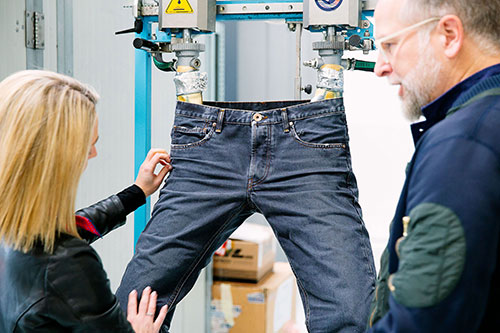 Italian brands take a long term perspective on teeing up the future. Also, these brands focus more on technology and innovation. For example Tonello manufactures incredible machines and technology for waterless washing. The company has also been involved in the creation of lasers for garment processing for denim for the last 12 to 14 years.
Sustainability at an affordable price
Though his brands introduced a bunch of initiatives for ensuring sustainability in denim manufacturing, these drove up the cost of the garment. So the real challenge before Morrision was to offer customers a more sustainable solution at much closer price value proposition. He believes, though people are interested in being carbon neutral to a certain extent, they are not willing to pay more for it. Fortunately, today there are enough brands offering sustainable denims at affordable rates.
Hence, Morrison is optimistic about the future of the denim industry. His recent documentary series Common Thread, explores how the most democratic of garments can survive the coming environmental storm. This project, inspired by Morrison’s passion for denim, focuses on three major denim players of the luxury denim industry: fashion brand Diesel, denim manufacturer Candiani, and garment finishing company Tonello. He looks at how these multi-generational businesses take a longview approach to both financial and environmental sustainability, and how that view stands in stark contrast to the race-to-the-bottom influence of fast fashion.
Cambodia’s GTF exports increase by 13.18%
A report from the Ministry of Economy and Finance’s General Department of Customs and Excise reveals Cambodia exported more than $7.97 billion worth of garment, textile and footwear (GTF) products in the first nine months of this year registering an increase of 13.18 per cent. The US accounted for $2.5 billion of these exports and the EU $2.4 billion – with $670 million going to the UK, Japan $711 million, Asean member states $121 million and other countries $1.5 billion.
Last year, the Cambodian government had announced those wishing to export their goods to the EU under the Everything But Arms (EBA) agreement are required to register in the EU’s Registered Exporter System (REX) to self-certify the Statement on Origin of their goods instead of applying for a Certificate of Origin.
Despite ongoing Sino-US trade tensions and facing a possible suspension of its access to the EU’s EBA agreement, Cambodia’s economic activity will remain strong with real gross domestic product growth expected at around seven per cent this year.
This is owing to continued export growth and strong construction activity. Inflation is expected to remain stable at around 2.5 per cent. The country’s stable macroeconomic environment, strong growth performance and ongoing structural reforms have contributed to its significant progress towards achieving Sustainable Development Goals. According to National Bank of Cambodia’s 2018 report, the Kingdom’s garment and footwear exports during the year increased by 24 per cent to $10 billion.