FW
American brands threatened by Chinese counterparts
American brands in China face are facing a threat from local brands offering innovative products at lower costs. Brands like Apple, Starbucks and Procter & Gamble's Pampers are being challenged by local brands, potential threat to the hundreds of billions of dollars US firms make in China. Analysts from Bain and Kantar say, local brands usurped almost three-quarters of China's 639 billion yuan ($97 billion) market for FMCG - a category that includes items like soft drinks and shampoo - last year, up from two-thirds in 2013.
US products like Pampers, Colgate toothpaste and Mead Johnson infant formula saw their market share drop around 10 percentage points in the past five years. The data was based on a survey of 40,000 urban households. Chinese brands like SeeYoung, offering a popular silicon-free shampoo, and Pechoin, a maker of skincare products that plays up local ingredients, gained rapidly.
Trade war may raise tariffs across globe
In case of a full-scale trade war, average tariffs could rise to as high as 30 per cent for American exporters, 35 per cent for the European Union and 40 per cent for Chinese exporters. Bangladeshi exporters may face an average tariff of over 40 per cent. The country currently enjoys around three per cent tariff on an average in the global market.
Exporters of India and Pakistan would face tariffs of 31.70 per cent and 40 per cent respectively. The tariff for Sri Lanka would be around 47 per cent. Bangladesh already faces a 15 per cent average tariff in the US market. In the EU, the country has tariff-free market access.
Least Developed Countries including Bangladesh will continue to enjoy tariff-free access to different developed countries for the time being. These countries may face higher tariffs only if there is an all-out trade war where every country will increase its tariff. However, the increased tariffs are calculated under the assumption that all countries would engage in a trade war and set tariffs to their optimal mercantilist levels.
The US is imposing high tariff on the imports of products it thinks should get protection. But other countries are also retaliating.
Bangladesh considering over US$ 1.2bn
The government is planning to form a Tk 10,000 crore special fund, similar to Export Development Fund, to provide low cost loans to jute industry and regain its past glory. Bangladesh Bank would be assigned to manage the funds where the loans will be disbursed at 5 per cent interest and half of the interest payments would come from the state coffers as subsidy.
A panel headed by Md Mahmudul Hassan, Chairman, Bangladesh Jute Mills Corporation (BJMC) has prepared the draft for the Jute Sector Development Fund. As per the draft, loan defaulters will not be eligible for applying for fresh loans. The draft policy targets providing the ailing sector with opportunities similar to what garment and leather goods industries enjoy.
According to the association, around 2 lakh people work in 176 public and private jute mills, which process two thirds of the country's annual jute production of 14 lakh tons of this 8.36 lakh tons are exported and the rest consumed locally.
Spain’s apparel and textiles imports up six per cent
Spain’s textile and apparel imports have increased by six per cent during the last five years. Spain is the world’s sixth largest apparel importer. Apparel is the largest imported category in apparel and textile making up 78 per cent, followed by manmade textiles, cotton textiles and others with a share of 10 per cent, eight per cent and three per cent respectively.
China is the largest textile and apparel supplier to Spain, with a 21 per cent share of Spain’s imports, followed by Bangladesh and Turkey with a share of 11 per cent each. India’s exports to Spain have grown at three per cent year on year. India is the seventh largest supplier of textile and apparel products to Spain. Apparel is the largest category, with a share of 77 per cent in India’s textile and apparel exports to Spain. This is followed by cotton textiles and manmade textiles having a share of 13 per cent and six per cent respectively.
Countries like Bangladesh and Turkey have increased their share in Spain’s textile and apparel imports over the last few years, owing to their market access arrangements with the European Union. The Spanish apparel industry is expanding fast with the growth of fast fashion brands like Zara and other clothing retailers like Desigual and Mango.
Solutions to enhance mill operations
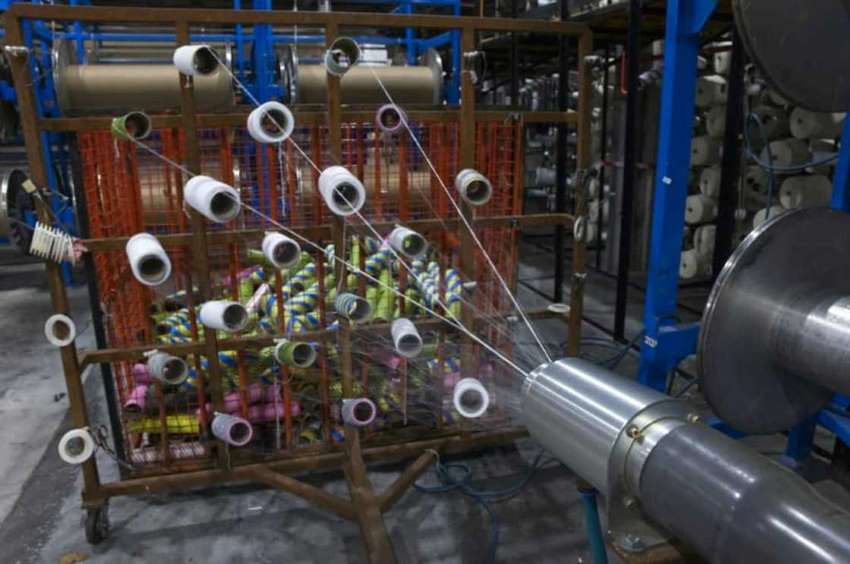
Stäubli’s state-of-the-art weaving and knitting technologies enable weaving mills to efficiently and cost-effectively produce high-quality fabrics for a wide range of applications. Its solutions for workflow automation, automated weaving preparation, and shedding for frame and jacquard weaving can enhance their mill operations.
The pioneering products are the result of a well-balanced combination of reliable performance, technical perfection, and proven technologies. Stäubli is a provider of high-quality automated systems and solutions for the weaving industry.
The Topmatic warp tying machine features double-end detection. It ensures optimum tying quality and helps minimize downtime of the weaving machine. Handling a broad range of yarns and offering easy operations and a quick set up, this machine can easily be integrated into the operations of any mill.
With its Safir automatic drawing-in installations, Stäubli brings further time savings into the weaving preparation process. Featuring state-of-the-art technologies such as double-end detection and repeat detection and management, Safir machines are suitable for a wide range of applications and use in a variety of set-ups. They are ideal for weaving mills of any size that seek to optimize their workflow and increase their product quality.
The broad range of Stäubli cam motions and dobbies includes ideal machines for any type of weft insertion system for any application.
Coats launches new website
Coats's the world's leading industrial thread manufacturer and a major player in the Americas textile crafts market, has launched a new website. The re-designed Coats.com site features fresh and revised content, enhanced design features and also merges assets from the previously separate coatsindustrial.com portal. This creates a single, unified ‘One Coats’ led digital platform for customers, other stakeholders and employees.
Coats.com features over 500 content pages and over 1,000 images. It brings together both corporate and B2B content for the first time. Besides showcasing a wide range of Coats products and services there is a dedicated area for its historic narrative which can be traced back to Paisley in Scotland. The site has been built using the technology that ensures page view optimisation, whether using a desktop, tablet or mobile. It can also deliver personalised, industry specific content to site visitors which they can save to their own ‘My Coats’ account.
The site’s design is bold and sleek, with content that presents Coats as a technology focused global manufacturer, relevant to daily life and operating with a sustainable business model. It positions Coats as connecting, pioneering and trusted, with a key focus on sustainability. The striking imagery brings to life Coats’ people as well as its products and services and the diverse range of industry end uses.
Singtex makes sustainable bio-based nylon fabrics from coffee grounds
Singtex introduced S.Café yarn technology in 2009. Through the S.Café producing process, it extracts 11 per cent oil from coffee grounds. The coffee oil is not only used in cosmetics but also in shelter membrane.
Singtex is the first textile company to use EcoPaXX to make Singtex Biotec bio-based nylon fabrics. EcoPaXX is made of 70 per cent tropical castor bean oil, reducing the use of petroleum. This eco-friendly, high performance nylon fabric is perfect for outdoor environment. Bio-nylon fabrics are durable, lightweight, abrasion and tear resistant which is perfect for backpack and outdoor equipment fabrics.
The company has also developed an eco-friendly moderate stretch fabric with long-lasting performance, S.Leisure, and it features comfort stretch with breathability, fast-dry, lightweight and good recovery while emitting less carbon footprint. S.Leisure is recyclable and designed to replace fabrics with six per cent spandex and below to tackle the issue. The dyeing process of S.Leisure is at least 20 per cent more energy efficient than spandex.
Iran bans import of over 1,300 goods, textiles is one of them
Iran is banning imports of over 1,300 products, preparing its economy to resist threatened US sanctions, amid rare public protests against the plunge of its currency to record lows. The prohibited imports include home appliances, textile products, footwear and leather products, as well as furniture, healthcare products and some machinery.
The government is justifying its latest imports ban by citing economic security. The ban would prevent an outflow of $10 billion of foreign currency. The IMF estimated in March that the government held $112 billion of foreign assets and reserves, and that Iran was running a current account surplus. These figures suggested Iran might withstand the sanctions without an external payments crisis.
But as US pressure constricts Iran’s access to the international banking system, its ability to deploy some of those resources may have suffered. India is planning to revive a rupee trade mechanism to settle part of its oil payments to Iran, fearing foreign channels to pay Tehran might close.
Innovative and sustainable solutions
Archroma has innovative and sustainable denim solutions for manufacturers and brands.
From fiber to finish, Archroma offers a scope of possibilities for effects and colors, from the authentic roots of indigo to the most innovative and eco-advanced solutions.
Archroma is a global leader in color and specialty chemicals and is a recognized leader in integrated solutions, offering the best-in-class auxiliaries for bespoke process packages.
Denisol is a pre-reduced liquid indigo solution that helps to produce fabrics suitable for current eco-labeling such as bluesign and GOTS.
Responding to demands for a non-toxic alternative to the dyes that are used for the iconic and traditional indigo blue that consumers associate with denim and jeans, Archroma launched the new Denisol Pure Indigo 30.
Archroma’s multi-awarded Advanced Denim dyeing technology allows savings of up to 92 per cent in water, 87 per cent in cotton waste and 30 per cent in energy compared to a conventional denim dyeing process. The technology has been adopted by brands like Patagonia.
With Optisul C dyes, denim manufacturers can expand their color horizons with this range of six dyes especially designed to produce soft denim colors in continuous dyeing processes, as well as on coating and printing.
Archroma’s dye portfolio of conventional and black Diresul specialties allows the creation of a universe of grey and deep black and navy.
Safeguard measures for air quality monitoring implemented
The Suzhou Meteorological Observatory and the Suzhou City Environmental Monitoring Center have jointly formulated environmental air quality monitoring and early warning work plan and fully implemented safeguard measures. In support of this, the 20th Tripartite Environmental Ministers meeting among China, Japan and South Korea was held in Suzhou, Jiangsu from June 24 to 25. The meeting brought out the fourth environmental protection inspectorate which aroused much concern from Jiangsu government. By June 19, 442 companies were punished for violation of environmental protection regulations.
The environmental protection treatment in Jiangsu affected polyester industry and its downstream market. The downstream water-jet looms in Wujiang had to strictly limit production, especially in Shengze, dyeing plants were forced to curtail production too. In Changshu, the operating rate of dyeing plants was forced to decline by 20 per cent, while the dyeing plants in Jiangyin were asked to shut down for correction temporarily.