


FW
Bangladesh garment earnings up 14 per cent from July to January
Bangladesh’s earnings from exports of readymade garments rose 14.51 per cent in July to January period compared with the same period of the previous fiscal year. Earnings from the sector were 7.65 per cent higher than target. Export earnings of knitwear products rose by 13.86 per cent. Export earnings of woven products rose by 15.18 per cent.
Relative peace in the country, US-China trade war, and improvement in safety conditions in the readymade garment factories are the main reasons behind the increase in readymade garment exports. Earnings from specialized textile sector was up 41.11 per cent while earnings from home textile fell 0.79 per cent. Earnings from leather and leather goods fell 11.71 per cent and earnings from jute and jute goods fell 24.66 per cent.
India, Brazil, Mexico and Chile are also turning into major export destinations for Bangladesh. Similarly, China, the largest apparel supplier worldwide, has also been turning into a major export destination for Bangladesh. China also allows duty-free access to over 5,000 Bangladeshi products, most of which are garment items.
Bangladesh’s garment exports to non-traditional markets have been growing since 2010-11 and have been made possible by a stimulus package and duty-free market access.
AATCC approves first international standards for e-textiles
AATCC research committee RA111, Electronically-Integrated Textiles, recently approved its first evaluation procedure. The AATCC EP13, Evaluation Procedure for Electrical Resistance of Electronically-Integrated Textiles, is one of the very first international standards for e-textiles.
The procedure provides detailed instructions for measuring resistance of e-textiles—a key indicator of functionality. It also includes guidance and calculations for determining change in resistance after laundering, stretch, or other treatment.
AATCC EP13 is currently available for purchase from the AATCC website as a downloadable PDF. It will be included in the 2019 AATCC Technical Manual Mid-Year Supplement published this summer.
AATCC standards are developed, approved, and periodically reviewed by a global team of volunteer subject matter experts. All stakeholders are welcome to participate in this consensus-based process. The standards are recognized and used around the world.
Shima technology goes on show at GTE 2019
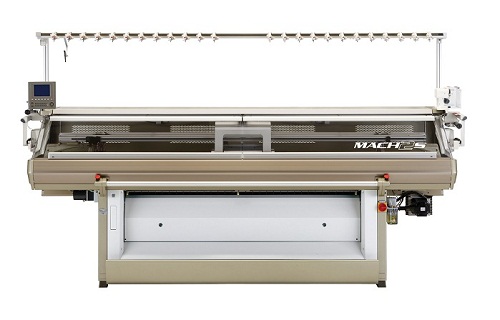 Leading Japanese computerised flat knitting machine manufacturer Shima Seiki, of Wakayama, Japan, will exhibit at the upcoming Garment Technology Expo (GTE 2019) to be held in New Delhi, India, later this month.
A pioneer of Wholegarment knitting technology, Shima Seiki will present exclusive solutions to meet the current needs of the Indian market, as well as future market needs. Such solutions are provided by the company’s MACH2S Wholegarment knitting machine that offers the flexibility of producing Wholegarment knitwear using every other needle, as well as conventional shaped knitwear using all needles. “This feature helps users to invest in their technology wisely,” the company says.
Demonstrations will also be performed on the latest version of Shima Seiki’s 3D design system SDS-ONE APEX3. At the core of the company’s Total Fashion System concept, APEX3 is designed to provide comprehensive support throughout the product supply chain, integrating production into one smooth and efficient workflow from yarn development, product planning and design to production and even sales promotion.
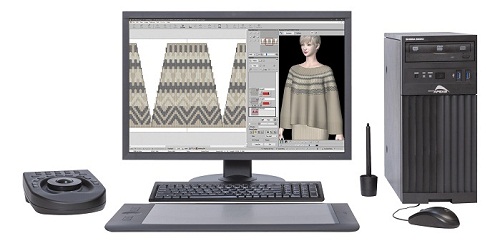
“Especially effective is the way APEX3 improves on the design evaluation process with its ultrarealistic simulation capability, whereby virtual samples minimise the need for actual sample-making,” the manufacturer explains. “Together with Wholegarment knitting, APEX3 realises significant savings in time, cost and material, contributing to truly sustainable knit manufacturing.”
Exhibition details
Exhibition: Garment Technology Expo 2019 (GTE 2019)
Date: 22-25 February 2019
Location: NSIC Exhibition Complex
Okhla Industrial Estate, Near Kalkaji Temple, New Delhi, India
Tel: +9111269262750
Organiser: Garment Technology Expo
Tel: +911141601662
Booth No.: C7
Exhibited technology
MACH2S 8G Wholegarment knitting machine
SDS-ONE APEX3 3D design system
For more information please contact:
Voltas Limited
Tel: +914226619002
Email: This email address is being protected from spambots. You need JavaScript enabled to view it.
Attn: Mr. Kishor Dash
+919958322200
Busi presents complete range of medical sock machines
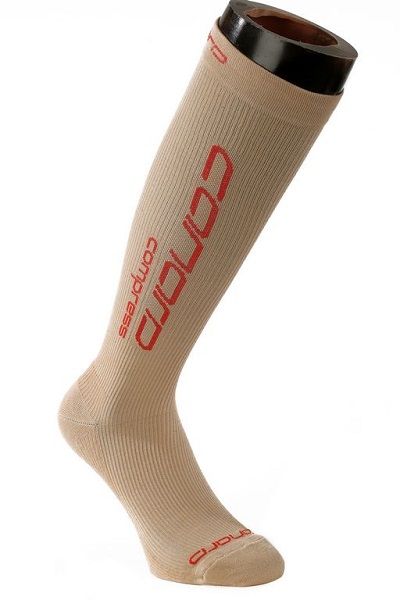
Family-run Italian hosiery knitting machine builder Busi Giovanni presents its complete range of machines capable of knitting certified-compression medical socks. The company announced extending its portfolio in September 2017, with the introduction of a 5-inch diameter to the previously existing ones of 4" and 4.5".
“Our complete range of machines for medical (certified compression) socks is available in 4", 4,5" and 5" diameters, capable of covering approximately 90% of the required sizes and producing items in compliance with the international medical classes 1, 2 and 3,” said Michele Castagna, Export and Marketing Manager.
The available versions include Busi Medical and Busi Medical Terry machines, equipped with two feeds for the main yarns, plus two more feeds for elastic ones. Sandwich terry and selected terry options are available on the Terry version only. The machines are provided with two knitting feeds for both plain stitch and true rib.
The compression graduation is achieved by using the automatic stiffening, which is available on all the stitch motors and by graduating the tension of the inlaid elastic yarn.
All of these versions are available equipped with the company’s Rimaglio automatic, stitch-by-stitch, toe-closing device, even up to the highest possible gauges. It downloads the sock from the machine, after completion of the knitting operation, and it transfers the sock to the linking device, where it is sewn loop by loop. The sock is turned inside out, so that the linking remains on the inside of the sock, resulting in a perfect traditional-looking linking. After being sewn, the sock, already reversed to the right side, is removed from the machine and is ready for the next boarding operation.
Since 1958 Busi Giovanni has specialised in the design and construction of single-cylinder machines with rib needles in the dial for the production of high-quality stockings, socks and tights. The company is a supplier to the most important producers of stockings, socks and tights, for the men's, women's and children's markets - classic, patterned, sports, technical-sports, as well as medical, with special solutions for graduated compression.
The family-run company sells in 63 countries around the world (90% export) through a network of partners that provide distribution and service. With 61 years in the business, Busi manufactured 8,066 machines so far.
Exhibitors announce product highlights ahead of Asia Print Expo 2019
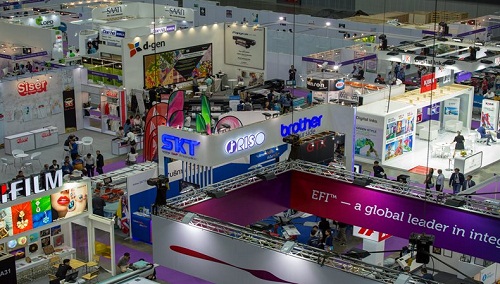
Asia Print Expo, the ASEAN region’s premier event for speciality print, takes place from 21 to 23 February 2019 at the BITEC Exhibition Centre in Bangkok, Thailand.
Asia Print Expo will be the number one destination for ASEAN print service providers (PSPs) and sign-makers looking for the latest wide format technology. With just under one week to go until the exhibition doors open, exhibitors are publicising what they will be demonstrating at the event. With 80 companies confirmed to exhibit, local and international PSPs will have a whole host of technology to discover, with some exclusive products being shown for the first time in Thailand.
Exhibitor highlights include:
Best In Ground Co., Ltd (stand D20) will debut the Massivit 1500 3D printer by Massivit 3D for the first time in Thailand. The printer is a mid-entry-level industrial 3D printer that can print models up to 1.5m tall, 1.5m wide and 1.2m in depth. It is a fast 3D printer that uses Massivit 3D’s own proprietary GDP technology and is suitable for a range of markets.
Chaiyaboon Brothers Co., Ltd (stand C11) will present Direct Color Systems’ UV LED printer, which features the TEXTUR3D™ printing process that uses one ink type to print on a variety of substrates including plastic, metal, wood and acrylic.
Inkcups (stand A15) will feature live demonstrations on its stand of its Brite ICN 2200PS and ICN 2200LI-2P pad printers. ICN 2200PS produces high quality one- and two-colour prints on t-shirts, while ICN 2200LI-2P is a high-speed printer for printing on shoe insoles. Inkcups will also host a live plate-etching demonstration on its laser plate-making system, the ColbaltONE, which boasts fibre laser technology able to precisely etch spot sizes down to 50 microns for over 30,000 impressions.
Technology 2004 Co., Ltd (stand D10) is a Thai importer and distributer specialising in creating, printing and cutting designs to suit PSPs’ needs in packaging, signage and textile. At Asia Print Expo, Technology 2004 will show its latest range of large format inkjet printers, cutters, plotters, laser cutting and engraving machines.
Epson Thailand (stand E10) will showcase its printing technology for the textile and outdoor advertising industries. Epson Thailand will unveil its advertising signage printers, the Epson SureColor S-Series and Epson SureColor B-Series, which can print products for both indoor and outdoor applications. Epson will also present its SureColor F-Series for textile printing to demonstrate the production process from pattern printing to the finished product, including pillows, scarves, t-shirts and bags.
The inaugural Print Make Wear Asia will also take place at Asia Print Expo, which is sponsored by Easiway Systems, Vastex and PSI Marketing.
Highlights from the sponsors include:
Vastex will showcase its manual screen printing machine, which requires fewer operators resulting in lower overhead costs as well as a dryer and flash unit
Gildan will present its printable garments, which will be printed live during the exhibition
Easiway will demonstrate how 3-minute stencil reclaiming can be made possible by the Easiway SUPRA, which reduces pre-press staff and makes the most of mesh fabrics.
In addition, visitors can take advantage of the other free-to-attend visitor features, including the Wrap Masters Asia competition, where 30 competitors will battle it out to be crowned the winner, and a packed programme in the FESPA conference theatre.
Visitors travelling by plane to Bangkok and still looking to book flights can book with FESPA’s official airline partner, Thai Airways, using code TG1902008. Booking can be accessed here: www.thaiairways.com/en/mice/index.page
Kornit Digital Reports 2018 Fourth Quarter and Full Year Results
Fourth quarter 2018 revenues increased by 26.2% to $37.8 million.
Full year revenues growth of 24.8% to a record $142.4 million, fueled by strong demand for Kornit’s HD portfolio of solutions.
Successful business and organizational transformation in North America.
Continued business momentum in EMEA, driven by shift to industrial systems, leading to a 42.7% year-over-year growth in revenues.
Full year services revenues grew by 37.2% to $16.6 million.
Fourth quarter 2018 GAAP operating profit increased by $1.4 million; Non-GAAP operating profit increased by $1.8 million, or 160.0% year-over-year.
Fourth quarter 2018 GAAP net income of $0.19 per diluted share; Non-GAAP net income doubled to $0.08 per diluted share, net of $0.04 per diluted share attributed to the non-cash impact of warrants.
Record cash flow from operations $15.7 million in the fourth quarter and $33.4 million on an annual basis.
Company completed development of multiple new products to be launched in 2019.
ROSH-HA`AYIN, Israel, Feb. 12, 2019 (GLOBE NEWSWIRE) Kornit Digital Ltd. (NASDAQ: KRNT), a leading provider of digital printing solutions for the global printed textile industry, today reported results for the fourth quarter and full year ended December 31, 2018.
Kornit reported fourth quarter 2018 revenues increased 26.2% to $37.8 million, net of $1.4 million attributed to the non-cash impact of warrants, compared to $30.0 million, net of $0.4 million attributed to the non-cash impact of warrants, in the prior year period. Increased revenues in the quarter were attributable to widespread growth across geographies and customers, and the delivery of systems on a large customer program.
GAAP operating income increased to $0.8 million in the fourth quarter, compared to the prior-year period operating loss of $0.5 million. Non-GAAP operating income increased by 160% to $2.9 million, or 7.8% of revenues, in the fourth quarter, compared to $1.1 million, or 3.8% of revenues, in the prior year period. Increased operating income was the result of increased revenues and higher operating leverage.
Ronen Samuel, Kornit Digital’s Chief Executive Officer commented, “We finished 2018 with accelerating momentum which delivered record quarterly sales. Our success in 2018 is attributable to another year of product innovation highlighted by the launch of HD systems and upgrades. Looking at the year ahead, we have a strong pipeline of unprecedented innovation, including the recently released Atlas which is already gaining momentum, and our dark poly solution which is in beta testing with general availability in Q2-2019.”
Samuel concluded… “We are investing in our business to drive long-term growth through new technology and improvements in our go-to-market strategy. These improvements will expand total impressions made on Kornit systems, as we continue to optimize total cost of ownership, expanding our reach into new segments and lead the industry in print quality.”
Fourth Quarter 2018 Results of Operations
Kornit reported fourth quarter revenues, net of the non-cash impact of warrants, of $37.8 million, compared with the prior-year period level of $30.0 million. The total non-cash impact of the warrants deducted from revenues was $1.4 million in the fourth quarter of 2018 and $0.4 million in the fourth quarter of 2017.
On a GAAP basis, fourth quarter gross profit was $18.1 million, compared with $14.5 million, in the prior-year period. Non-GAAP gross profit in the fourth quarter was $18.4 million, or 48.8% of revenue, compared with $14.6 million, or 48.9% of revenues in the fourth quarter of 2017. The lower gross margin was primarily due to the effect of warrants in the period.
On a GAAP basis, total operating expenses in the fourth quarter were $17.3 million, compared to $15.0 million in the prior-year period. Non-GAAP operating expenses in the fourth quarter increased to $15.5 million, or 41.0% of revenue, compared to $13.5 million, or 45.1% of revenues, in the prior-year period.
Fourth quarter GAAP research and development expenses were $6.2 million, compared to $5.6 million in the prior-year period. Fourth quarter Non-GAAP research and development expenses were $5.9 million, or 15.6% of revenues, compared to $5.4 million, or 18.2% of revenues in the prior-year period.
Fourth quarter GAAP selling and marketing expenses were $6.9 million, compared to $5.2 million in the prior-year period. Fourth quarter Non-GAAP selling and marketing expenses were $6.2 million, or 16.5% of revenues, compared to $4.7 million, or 15.5% of revenues, in the equivalent prior-year period.
Fourth quarter GAAP general and administrative expenses were $4.2 million, compared to $4.0 million in the prior-year period. Fourth quarter Non-GAAP general and administrative expenses were $3.4 million, or 8.9% of revenues, compared to $3.4 million, or 11.4% of revenues, in the prior-year period.
On a GAAP basis, fourth-quarter operating income was $0.8 million, compared to operating loss of $0.5 million during the prior-year period. Non-GAAP operating income in the fourth quarter increased to $2.9 million, compared to $1.1 million in the prior-year period. As a percent of revenues, Non-GAAP operating margin for the fourth quarter was 7.8% of revenues, compared with 3.8% of revenues in the fourth quarter of 2017.
In the fourth quarter, the company have formed a deferred income tax asset in the amount of $5.9 million that effected GAAP net Income.
On a GAAP basis, the Company reported net income of $7.0 million, or $0.19 per diluted share, compared to net loss of $0.4 million in the fourth quarter of 2017. Non-GAAP net income for the fourth quarter of 2018 was $3.0 million, or $0.08 per diluted share, net of $0.04 per diluted share attributed to the non-cash impact of warrants, compared to net income of $1.5 million, or $0.04 per diluted share, net of $0.01 per diluted share attributed to the non-cash impact of warrants in the prior year period.
Full Year 2018 Results of Operations
Full year 2018 GAAP revenues which are net of the non-cash impact of the warrants deducted from revenues were $142.4 million, compared to revenues of $114.1 million in the prior year. The full year impact from warrants was $4.6 million in 2018, and $2.9 million in 2017. Higher sales compared to the prior year were primarily related to higher volume of products sold, the success of new product introductions and incremental sales from services. For the full-year, the Company recorded 88.3% of revenues from products, and 11.7% of revenues from services.
Full year GAAP gross profit was $69.9 million, compared to $54.1 million in the prior year. Non-GAAP gross profit for the full year 2018 was $70.9 million, or 49.8% of sales, compared to $54.8 million, or 48.1% of sales for the full year 2017.
Full year 2018 operating expenses on a GAAP basis were $64.3 million, compared to $56.2 million for the full year of 2017. Non-GAAP operating expenses for the full year of 2018 were $58.2 million, or 40.8% of sales, compared to the prior year level of $50.7 million, or 44.4% of sales. The increase in total operating expenses was consistent with the previously stated growth strategy, as the Company continues to execute to its global infrastructure build out.
Full year 2018 research and development expenses on a GAAP basis were $21.9 million, compared to the prior year of $20.8 million. Full year Non-GAAP research and development expenses were $20.9 million, or 14.7% of sales, compared to $20.1 million, or 17.6% of sales in the prior year.
Full year 2018 selling and marketing expenses on a GAAP basis were $25.6 million, compared to the prior year of $21.3 million. Full year Non-GAAP selling and marketing expenses were $23.4 million, or 16.4% of sales, compared to $19.1 million, or 16.8% of sales in the prior year.
Full year 2018 general and administrative expenses on a GAAP basis were $16.4 million, compared to the prior year of $13.6 million. Full year Non-GAAP general and administrative expenses were $13.9 million, or 9.7% of sales, compared to $11.5 million, or 10.1% of sales in the prior year.
Full year 2018 GAAP operating income increased to $5.6 million, compared to operating loss of $2.1 million in the prior year. Non-GAAP operating income in the full year 2018 increased to $12.7 million, compared to $4.1 million in the prior year.
On a GAAP basis, full year 2018 net income was $12.4 million, or $0.35 per diluted share, compared to net loss of $2 million in the prior year. Non-GAAP full year 2018 net income was $13.1 million, or $0.37 per diluted share, compared with Non-GAAP net income of $4.0 million or $0.11 per diluted share in the prior year.
Balance Sheet and Cash Flow
At December 31, 2018, the Company had cash, deposits and marketable securities of $127.7 million, and no long-term debt. Cash flow provided by operations was $15.7 million during the fourth quarter of 2018, attributable mainly to higher net profit as well as reduction in AR. Cash flow from operations for the full-year of 2018 were $33.4 million attributable mainly to higher net profit as well as reduction in inventory.
First Quarter 2019 Guidance
The Company will discuss the details of its guidance live during its earnings conference call, which will be available for replay via webcast at ir.kornit.com.
Conference Call Information
The Company will host a conference call today at 5:00 p.m. ET, or 0:00 a.m. Israel time, to discuss the results, followed by a question and answer session for the investment community. A live webcast of the call can be accessed at ir.kornit.com. To access the call, participants may dial toll-free at 1-888-394-8218 or +1-323-701-0225. The toll-free Israeli number is 1 80 921 2883. The confirmation code is 4472432.
To listen to a telephonic replay of the conference call, dial toll-free 1-844-512-2921 or +1-412-317-6671 (international) and enter confirmation code 4472432. The telephonic replay will be available beginning at 8:00 p.m. ET on Tuesday, February 12, 2019, and will last through 11:59 p.m. ET on Tuesday, February 26, 2019. The call will also be available for replay via the webcast link on Kornit’s Investor Relations website.
Forward Looking Statements
Certain statements in this press release are "forward-looking statements" within the meaning of the Private Securities Litigation Reform Act of 1995 and other U.S. securities laws. Forward-looking statements are characterized by the use of forward-looking terminology such as "will," "expects," "anticipates," "continue," "believes," "should," "intended," "guidance," "preliminary," "future," "planned," or other words. These forward-looking statements include, but are not limited to, statements relating to the Company's objectives, plans and strategies, statements of preliminary or projected results of operations or of financial condition and all statements that address activities, events or developments that the Company intends, expects, projects, believes or anticipates will or may occur in the future. Forward-looking statements are not guarantees of future performance and are subject to risks and uncertainties. The Company has based these forward-looking statements on assumptions and assessments made by its management in light of their experience and their perception of historical trends, current conditions, expected future developments and other factors they believe to be appropriate. Important factors that could cause actual results, developments and business decisions to differ materially from those anticipated in these forward-looking statements include, among other things: the degree of our success in developing, introducing and selling new or improved products and product enhancements, the extent of our ability to consummate sales to large accounts with multi-system delivery plans, the degree of our ability to fill orders for our systems, the extent of our ability to continue to increase sales of our systems and ink and consumables, the extent of our ability to leverage our global infrastructure build-out, the development of the market for digital textile printing, availability of alternative ink, competition, sales concentration, changes to our relationships with suppliers, the extent of our success in marketing, and those additional factors referred to under "Risk Factors" in the company's Annual Report on Form 20-F filed with the U.S. Securities and Exchange Commission on March 30, 2018. Any forward-looking statements in this press release are made as of the date hereof, and the Company undertakes no obligation to publicly update or revise any forward-looking statements, whether as a result of new information, future events or otherwise, except as required by law.
Non-GAAP Discussion Disclosure
Non-GAAP financial measures consist of GAAP financial measures adjusted to exclude the impact of share-based compensation expenses, amortization of acquired intangible assets offering costs, deferred tax benefits and restructuring expenses and their tax effect. The purpose of such adjustments is to provide an indication of our performance exclusive of non-cash charges and other items that are considered by management to be outside of our core operating results. These Non-GAAP measures are among the primary factors management uses in planning for and forecasting future periods. Furthermore, the Non-GAAP measures are regularly used internally to understand, manage and evaluate our business and make operating decisions, and we believe that they are useful to investors as a consistent and comparable measure of the ongoing performance of our business. However, our Non-GAAP financial measures are not meant to be considered in isolation or as a substitute for comparable GAAP measures and should be read only in conjunction with our consolidated financial statements prepared in accordance with GAAP. Additionally, these Non-GAAP financial measures may differ materially from the Non-GAAP financial measures used by other companies.
About Kornit
Kornit Digital (NASDAQ:KRNT) develops, manufactures and markets industrial digital printing technologies for the garment, apparel and textile industries. Kornit delivers complete solutions, including digital printing systems, inks, consumables, software and after-sales support. Leading the digital direct-to-garment printing market with its exclusive eco-friendly NeoPigment printing process, Kornit caters directly to the changing needs of the textile printing value chain. Kornit’s technology enables innovative business models based on web-to-print, on-demand and mass customization concepts. With its immense experience in the direct-to-garment market, Kornit also offers a revolutionary approach to the roll-to-roll textile printing industry: digitally printing with a single ink set onto multiple types of fabric with no additional finishing processes. Founded in 2003, Kornit Digital is a global company, headquartered in Israel with offices in the USA, Europe and Asia Pacific, and serves customers in more than 100 countries worldwide.
Kornit Successfully Executes Direct-To-Customer Plan In North America
ENGLEWOOD, N.J. — February 14, 2019 — Effective February 7, 2019, Kornit Digital is now serving all customers and prospects directly in North America and has fully transitioned out of its distribution agreement with Hirsch Solutions. This strategic move strengthens the customer relationship and Kornit’s ability to provide superior customer experience.
Kornit has made significant investments in personnel and resources throughout its North American operations, including a new headquarters and Center of Excellence Center outside of New York City. The new state-of-the-art facility provides customers and prospects product advancements, demonstrations, product training and business growth seminars from some of the world’s most knowledgeable experts in digital textile printing.
“Moving closer to our customers is about accelerating and elevating their capabilities to be world-class businesses in partnership with Kornit” stated CEO Ronen Samuel. “As the global leader in digital textile printing, it is our goal and responsibility to provide our customers superior knowledge and innovation for business growth.”
Kornit Digital Americas President Shai Terem added, “As Kornit launches new systems that now break more barriers to what’s achievable for textile printing, our customers and prospects have complete access and advanced resources in North America to empower their success.”
Following the record-breaking unveiling of the Kornit Atlas in January, Kornit plans to unveil two new revolutionary systems and ink-sets in early April at the Kornit Digital Center of Excellence in Englewood, N.J.
Roland launches direct to garment printer
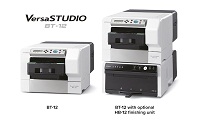 Roland DG will be selling its first direct to garment printer, the VersaStudio BT12, which it claims has been developed by Roland’s COTO business division but appears to actually be a rebadged Ricoh Ri100.
This is a desktop device designed to print full colour A4-sized prints directly on 50-100 percent cotton-based products such as t-shirts and tote bags. The greyscale printheads come from Ricoh with 1200 dpi resolution.
There’s an optional HB 12 finishing unit that’s designed to sit underneath the printer, which does make for a very neat solution that should easily fit onto a counter-top in a retail environment. This is a heat press with a choice of contact or non-contact fixing.
Roland set up the COTO Business Division at the end of last summer, ostensibly to “pursue the value of customer experience for individuals by expanding personalized printing and shaping services that go beyond the existing Retail field.” I have no idea what this means and only hope that it made more sense in Japanese.
Naturally, neither Roland nor Ricoh wanted to comment about the inks that this printer uses. It’s most likely that Roland is simply using the same ink as the Ricoh version, though it is possible the ink cartridges have been chipped. Nonetheless, customers should check this and shop around in case they can find a cheaper ink supply.
It will be available from April this year and costs £2999.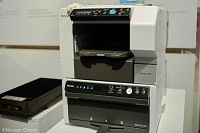
Here’s the Ricoh version, as shown at last year’s Fespa show, complete with the finishing unit underneath. It’s also worth noting that Roland has a new flatbed printer, the XT640S, designed to print to up to 12 t-shirts in a single print run. It looks as if Roland has just added a flatbed to one of its existing Texart textile printers. Strangely, despite showing the printer at the Printwear and Promotion Live show in the UK, Roland now seems reluctant to mention anything else about this device!
Sustainability is the paradigm of digital textile printing
As the awareness of sustainability grows throughout our industry, and the community that it serves, we are witnessing a huge swing towards sustainable supply.
Digital printing technologies are by nature more sustainable than traditional analog alternatives, and offer a way forward towards clean, efficient, profitable manufacturing. As an industry all sectors of the textile community are embracing sustainable manufacturing practice, from the fibers that we choose to spin, the fabric preparation chemistry that we use to coat and finish, through to the print machinery and inks formulations with which we print. Massive investment has and continues to be made within every sector, many of which now collaborate to futher develop innovative new stream-line processes and technologies.
Sustainability can only exist alongside supply chain transparency, and collaboration is the key to success. Digital Print Technologies and CAD /CAM software offer a sustainable solution to the negative environmental impact of traditional textile manufacturing practices.
 Caption: Image Credit: Kornit Digital: “Sustainability is one of the key trends and directions today and public awareness for a better and greener planet is rising, the textile industry shift towards digital printing aligns with reducing its environmental impact”. Sharon Donovich | KORNIT DIGITAL
Textile manufacturing across multiple industries using analogue technology previously consumed massive resources and generated (now valuable) waste as a bye product.
Prior to Digital disruption the Textile industry consumed massive amounts of water and energy, contaminating the environment with dye stuff and numerous toxic chemicals used in the manufacture of both textile fabrics, inks, printing and the finishing of products.
Digital Textile Printing saved over 40 billion litres of water worldwide in 2018. Offering an efficient solution when compared to traditional water usage for rotary screen printing which is in the region of 50-60 litres of water per metre. Digital Textile Printing also uses smaller quantities of colour, typically 10% of the volume used when compared to screen printing. Using pigment inks as an example, and its requirement for fixation only finishing (no washing) uses less than 10 litres of water per metre.
Digitally Printed Cotton virtually eliminates the consumption of water and the discharge of noxious effluents. Using low volumes of liquid dispersions of Pigment Colours, therefor offering a positive environmental impact. Digital Textile Printing using Pigments also removes the need for water and energy greedy post processing, since colour fastness is achieved by heat fixation alone as opposed to lengthy steam fixation and washing off procedures.
Caption: Image Credit: Sensient: "Sensient is committed to sustainable developments and any new technology developed is rooted in a need to consider total environmental impact”. Simon Daplyn | SENSIENT
Today the Digital print Industry offers a clean future for the environment and as the consumer and buyer becomes more conscious of their environmental choices, and the true impact that those choices make, digital technologies and their application will continue to move forward to replace unsustainable inefficient manufacturing.
The hidden waste within manufacturing is now being addressed and harnessed with innovative re-cycling processes whether that be energy, water, textile fibers, inks or the fabrics we consume, and this sector continues to expand to meet the demands of the environmentally conscious consumer.
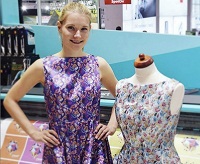 Caption: Image Credit: Roland DG: “Our commitment to sustainability has always been strong and with greater attention on the issue globally, this is an area we continue to invest in at every opportunity”. ROLAND DG.
As we move towards “Circular Design” we have to be both conscious of, and responsible for the origination and the future life of the textiles we create. Re-cycling offers extended life for many of the fibres used in textile production as do “fibre to fibre” re-cycling initiatives for Closed loop textile supply chains. Re-purposing our discarded textiles and waste products offers a viable solution for Circular Design. The choices we make in our design practices all have an impact on the future cycle of the product. Choosing sustainable textiles and practice is now corporate policy for many large brands who seek to improve their global impact on the environment.
How we design our products is also paramount. Utilising AR and CAD / CAM as an industry we are massively reducing waste. Both within the design process but equally in the production process utilizing digital sampling, automated pattern grading and cutting, print placement and print on demand business models for customized manufacturing.
We also see a new industry emerging for supply chain management, whereby large companies, brands and independents can source their finished products through sustainable practitioners who provide transparent manufacturing. Such companies offer managed sourcing from their partners and thereby guarantee certified sustainable manufacture to defined production objectives for Brands and Retailers.
Regulation in many sectors isn’t yet compulsory and so we now also see multiple options for voluntary certification being readily accepted and utilized across the textile supply chain. Oeko-tex, GOTS, SEDEX, to name just a few now help to define supply chain transparency.
Sustainability Statements:
Recently winning the Responsible Care for Sustainability Commitment Award the CHT group received the award for the process that controls the reduction of critical raw materials in the company.
“This project was started by CHT in 2015 as part of its commitment to sustainability. Since then 1,900 raw materials have already been valued. 20 percent of these were classified as critical, 8 percent were already replaced. In addition, CHT defined ten critical raw materials that are to be replaced or significantly reduced by 2020. CHT has therefore initiated new research and development projects for environmentally friendly and health-compatible raw materials and supplied its customers with the new substances. According to the assessment of the national expert jury, such a project in a medium-sized chemical company serves as milestone”. CHT GROUP
Sensient: “Sensient is committed to sustainable developments and any new technology developed is rooted in a need to consider total environmental impact. Recently released products are certified for Eco-Passport by OEKO-TEX but also aim to deliver savings on total consumption, water and energy use and reductions in waste whilst maintaining the highest standards of quality in printing and application performance. Sensient is working with partners around the world to develop inks and processes that make a difference in terms of sustainability.” SIMON DAPLYN | SENSIENT
Roland DG: “Our commitment to sustainability has always been strong and with greater attention on the issue globally, this is an area we continue to invest in at every opportunity. There are sound commercial reasons for us to adopt this stance – our customers and their customers are much more conscientious about their direct and indirect impact on the environment and this is playing a greater influence on buying decisions.
As has been the case for many years, all of Roland’s manufacturing facilities in Japan have been designed to be carbon neutral. Great effort is made to ensure that the components within our devices are recyclable and the same can be said for the packaging we use to transport our devices.
Developing environmentally friendly ink is a priority for Roland and we make a conscious effort to cut down on the use of controlled chemicals, for example, those outlined in the Pollutant Release and Transfer Register (PRTR). Our challenge is to create ink that exceeds the standards of sustainability whilst maintaining the exceptional quality our customers expect. Meanwhile, we have significantly reduced our environmental impact by changing the packaging for our ink from rigid plastic cartridges to flexible foil packaging.
We have made great strides in developing inks and software to maximize the efficiency of our devices, ensuring that consumption is never higher than necessary. By providing effective and efficient solutions at reasonable prices, businesses can easily make the transition from more wasteful, traditional systems and adopt more efficient technology. In turn, companies who use our newer devices consume less water and electricity” .ROLAND DG
Kornit Digital: “In today’s world, the number one environmental risk factor in textiles is water pollution. The amount of water currently used, wasted, and polluted is huge and actually the amount of water used in conventional dyeing and textile print processes could fill the Mediterranean Sea every two years.
As sustainability is one of the key trends and directions today and public awareness for a better and greener planet is rising, the textile industry shift towards digital printing aligns with reducing its environmental impact. Kornit’s technologies are leading this effort with a 100% waterless process utilized in every single printing system we manufacture. No pre-treatments, steaming or washing is required, and as part of Kornit’s waterless printing system, the biodegradable ink and energy saving process makes Kornit an eco-friendly printing solution” Sharon Donovich | KORNIT DIGITAL
“Sustainability” is just one word that seeks to define an unquantifiable number of actions and processes within the vast textile supply chain. Navigating through a sustainable supply chain is not currently easy. Educating the consumer or buyer to truly understand the positive social, economic and environmental impact of clean, sustainable manufacturing has driven the industrial sector to engage and collaborate directly with brands to share knowledge, develop new technologies and provide transparency.
From Chemistry and Textiles, onto to Inks, Digital Print Machinery and Software, “Sustainability” is at the Heart of the Digital Printing Industry…
Yarn piles up with Bangladesh millers
Textile millers in Bangladesh have stacks of unsold yarns and fabrics. The reason: invasion of cheap Chinese substitutes. A section of unscrupulous traders import yarn illegally. For example, they open letters of credit for importing one truck of yarn but they end up importing more due to lack of proper monitoring at the land port.
If illegal imports are not checked, millers fear the factories’ inventories will soar and they will feel discouraged to continue production. About 30 per cent of their inventory is unsold. Spinners, who can meet 85 per cent of the demand from the knitwear sector and 35 per cent from the woven sector, have already slashed production by 40 per cent because of this.
Another problem afflicting the textile millers is that a section of unscrupulous traders have been selling goods imported under the bonded facility. Imports of duty-free goods under the bonded facility are allowed only for export-oriented garment factories. Some businesses are importing yarns and fabrics under the bonded warehouse facility and later on selling the duty-free items in the open market at low prices.
Bangladesh frequently hosts yarn shows, which introduce the latest sophisticated yarn, fabrics, accessories and emerging technologies for textile and garment industries.











