FW
C.L.A.S.S organises conference on fashion sustainability
C.L.A.S.S will organise the third edition of “Rethinking Fashion Sustainability” conference at the Boston Consulting Group on March 7, 2019. The event will feature some of the most relevant initiatives undertaken by key opinion leaders in this field, including Zalando, The North Face, OVS and Caudalie.
Also, research from Politecnico di Milano will present the best practices for corporates to approach sustainability in a strategic way. C.L.A.S.S. CEO and founder Giusy Bettoni will share her expertise through the presentation "Integrate Sustainability into your brands" providing her expert insights on the integration of responsible innovation, circular economy within the textile and fashion sector.
Moreover, the results from the "Circularity Ideathon" developed by fashion and business students and coordinated by Milano Fashion Institute will be presented to give a flavour of the appetite of Millennials for a more sustainable fashion.
UKFT presentation to display fabric swatches from 20 companies
The UKFT British Textile Trends presentation will display fabric swatches from over 20 British companies, ranging from the finest luxury cashmeres and wools for tailoring, colorful tartans, tweeds, through to elegant silks and laces for eveningwear and occasion wear
The presentation will focus on new, innovative and exciting fabrics. Textile consultant Beryl Gibson will talk through the process of how these trends are developed. Attendees will also have the opportunity to find out more about the unique strengths of UK mills, as well as the diversity of fabric on offer. There will also be the chance to find out about exhibiting at Première Vision and grants which may be available to you.
Linda Laderman from Textile Forum will introduce the London Fabric Sourcing Show, which showcases luxury fashion fabrics with small minimums and both stock and short-order collections.
Bangladesh to grow at seven per cent
Bangladesh is likely to grow at a rate of 7.5 per cent in the ongoing fiscal year.
Domestic demand will be the main driver of this growth. Steps have been taken to ensure a fair wage and better working environment for workers in the readymade garment sector.
There are a number of challenges for the economy that can impact its growth in the short and long term. One is the high interest rate on bank loans, which is causing a massive capital flight from the country. Also, there is a possibility of global economic instability once Brexit gets implemented. This can have a negative impact on the country’s economy. In addition, the price of oil may increase further in the near future due to global economic unrest. At the same time, there are possibilities of job losses in the readymade garment sector due to technological changes, which may put the national economy at further risk.
But although the ongoing US-China trade war may have some negative impact on the economy, the country can benefit from this trade war by taking appropriate initiatives. Increased diversification of export items can increase Bangladesh’s share in the global trade. At the same time, the country needs to tap into the increased domestic demand to continue the growth momentum.
Circular knitting machines: Most ideal to make shoe uppers
Compared to warp knitting machines, circular knitting machines create shoe upper material that offers better breathability, more design possibilities and less waste. Even when used for more casual physical activity, athletic shoes must be designed in a way that keeps feet cool and dry. Because of this, the vast majority of shoe upper material is made using spacer fabric. This is an incredibly breathable fabric that is highly adept at dissipating heat and moisture, due to a 3D structure that interconnects two pieces of textile with yarn in a way that induces airflow.
Unlike its toxic, laminated-layer foam predecessor, spacer fabric is made using a single, synthetic fiber-type fabric. This not only enables shoe uppers to be easily up-cycled at the end of their life, but also reduces the cost of processing while simultaneously making shoes more lightweight.
In recent years, there has been a palpable global trend towards athletic footwear, and the shoe upper manufacturing industry has responded accordingly. However, most space fabric manufacturing has been limited to production on warp knitting machines. While warp knitting machines are 8-9 times more productive than circular knitting machines, they offer several distinct disadvantages and present a clear barrier to entry for anyone looking to carve out a piece of the athletic footwear market or for manufacturers who operate on a smaller scale.
Higher performing spacer fabric
Spacer fabric performs extremely well in terms of breathability. The reason for this lies in its sandwich-like structure that combines two textile substrates with interconnected monofilament yarn. The hollow structure creates a ventilation effect that increases airflow, while the thick fabric adds an extra layer of comfort.
Until relatively recently, the majority of spacer fabric was produced on warp knitting machines. While more efficient in terms of production value, the spacer fabric produced on a warp knitting machine tends to be rather stiff and sturdy, lacking an element of comfort that is essential for athletic shoe wearers. In contrast, circular knitting machines produce a spacer fabric that is much softer and more flexible, offering a snug, almost sock-like fit, while also providing comprehensive foot protection and abrasion resistance.
More design possibilities
Unlike warp knitting machines that can only knit different colored patterns by changing the beams – a process that requires several hours – circular knitting machines can easily match various yarns and knits to produce different textures and patterns. As such, manufacturers can quickly and easily satiate market demand for more shoe design options.
There are several benefits to being able to execute different design possibilities on a single machine. First of all, manufacturers are able to produce certain styles on a smaller scale. Not only is this essential for first-time shoe upper manufacturers, but is also ideal for those who want to test a certain style on a smaller scale before ramping up production.
Second, the circular knitting machine eliminates the labor- and time-intensive post-production dyeing step, allowing manufacturers to streamline production and cut costs.
While warp knitting machines cost around $500,000, the average cost of a circular knitting machines is just $180,000. Established shoemakers can more easily transition into knitting spacer fabrics by investing in circular knitting machines to either replace or complement any existing warp knitting machines.
For those who want to produce shoes on a smaller scale – for example, apparel manufacturers looking to expand further into footwear or new entrants to the industry – the substantial cost of a warp knitting machine may be dissuasive enough to avoid making the investment. By investing in the relatively more affordable circular knitting machine instead, manufacturers are able to more easily transition into shoe upper manufacturing without sacrificing a hefty sum.
More sustainable
Warp knitting machines produce large stretches of fabric at a time, which means the fabric still needs to be cut and sewn after production. This process is not only time consuming, but also generates a significant amount of waste – as much as 25%, according to some estimates. In comparison, circular knitting machines only waste approximately 10% of the original fabric.
Furthermore, as companies around the world are scrambling to improve their sustainability scores, transitioning to less energy-intensive circular machines is one way to reduce electricity consumption – not only helping to improve corporate image, but also presenting attractive savings possibilities on manufacturers’ utility bills.
The future of spacer fabrics
While spacer fabric all but dominates the industry in terms of breathability, knitting specialists continue to explore new ways to make spacer fabric even more breathable. A recent innovation in circular knitting technology enables spacer fabrics with fully perforated holes, further increasing airflow, to produce the world’s most breathable shoe upper material. In comparison, warp knitting machines are currently only able to produce spacer fabric with blind holes. As the spacer fabric technology continues to develop, this new innovation will help initiate even more possibilities for the future of footwear.
Pailung Products and Solutions
Pailung, one of the world’s largest knitting machinery companies, is the sole manufacturer of circular knitting machines that produce spacers with knitted eyelets. The knitted eyelet is breaking through the spacer fabric bottleneck to create the world’s most breathable shoe upper material. ShupperKnit circular knitting machines can knit spacers up to 6 mm thick.
While circular knitting machines generally create fabrics with enhanced breathability, the addition of knitted eyelets further increases airflow for an even more comfortable wearing experience. This new technology allows shoemakers to increase breathability, while incorporating all the benefits of circular knitting technology – lower initial cost, less environmental impact, and more design possibilities – into spacer shoe uppers.
Moreover, with an exclusive conversion kit, double-sided fabrics can also be knitted using the same machine without making any other changes to the knitting machine – offering a future-proof solution and further increasing application possibilities.
Zünd cutting solutions at Sign & Digital UK
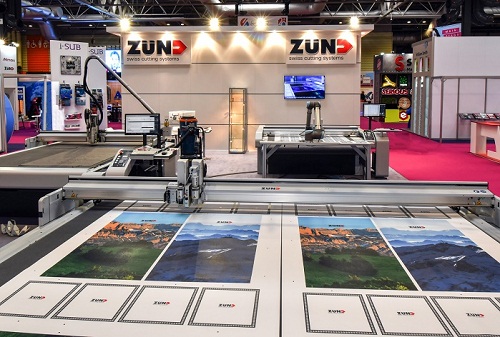
Zünd UK returns to Sign & Digital UK with a showcase of its precision cutting systems. © Zünd UK
Zünd UK will once again return to Sign & Digital UK from 2-4 April in Birmingham with a showcase of its precision cutting solutions. Built in Switzerland, every Zünd cutting machine is modular and can be retrofitted with new modules, tools and software at any time – enabling customers to future-proof their investment.
“We're delighted to return to Sign & Digital UK to once again demonstrate the versatility of our products and the future-proofed nature of Zünd technology. Along with their robust build, the innovation of Zünd digital cutting tables lies in their modular construction, which allows users to install the exact machine they need at the time of purchase and to make alterations later to accommodate the changing requirements of their business,” commented Nicki Kay, Managing Director of Zünd UK.
“We look forward to meeting with current and potential customers at Sign & Digital and discussing how Zünd's innovative technology can help them explore new and complementary markets.”
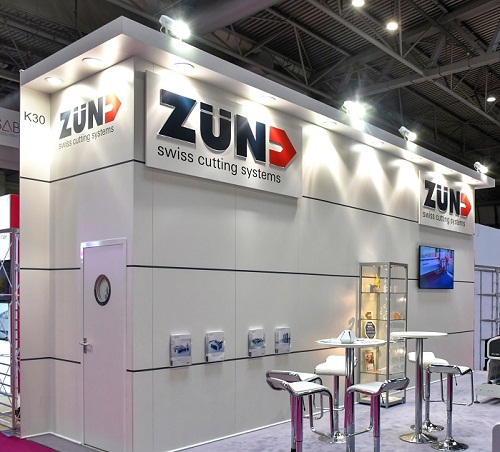
Zünd UK will demonstrate two different Zünd cutters at the show. © Zünd UK
Sign and Digital UK is a must-visit event for all professionals in the signage, display and graphics sector. At the show, Zünd UK will demonstrate two different Zünd cutters: the 3.2m x 3.2m Zünd G3 3XL3200 and the more compact Zünd S3 L1200, which has a working area of 1.8m x 1.2m. The machines will be configured to highlight the flexibility of Zünd's solutions.
The Zünd G3 can process a wide variety of roll media such as textiles, vinyls, banners as well as rigid media including acrylic, MDF, ACM and expanded PVC. Designed for high volume production, this large-format cutting system is uniquely qualified for industrial use and multi-shift, 24/7 operation.
The company will also be demonstrating a Zünd S3 L1200 machine, configured for the cutting and creasing of carton and corrugated sheets, as well as roll media such as vinyl. The cutter will be fitted with a robotic arm to show its productivity and accuracy in automatically picking cut parts off the machine bed, accelerating processes for a range of applications within the sign industry and freeing up operators’ time to work on other tasks.
The growth of the Digital Textile Print Bureau
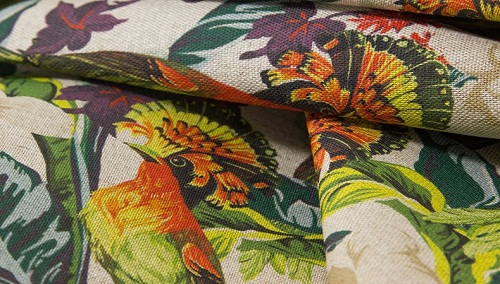
Debbie McKeegan discusses how digital textile printing, web to print software and vibrant ecommerce platforms have contributed in the growth of the Digital Textile Print Bureau across most textile applications.
No single shift in the Textile Business Model can have had more impact than the logarithmic growth of the Digital Textile Print Bureau. This market is driven by Millennial demand, where Customisation and Personalisation are paramount, along with the speed and instant customer satisfaction generated by Digital Textile Printing.
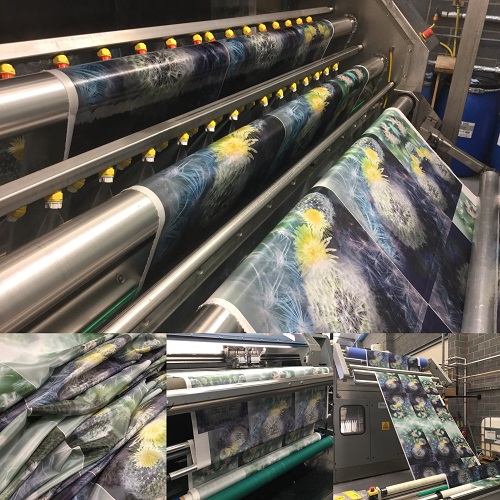
Caption: The Silk Bureau Limited is family owned business with more than 30 years’ experience. Founders Doug & Elaine Davies met at Art College and are both talented artists in their own right. Offering custom printed digital fabrics for individual designers, textile design studios and international retailers serving the Fashion and Home Décor industries. Credit: Leila Vibert-Stokes the ‘Greenfields Design a Scarf’ Competition winner & The Silk Bureau Ltd.
Fuelled by three enablers, Digital Textile Printing, Web to Print Software and Vibrant Ecommerce Platforms, the growth of the Digital Bureau crosses most Textile Applications, where it has generated huge potential from start-ups all the way through to mass manufacture. Success stories abound, and so it is difficult to single out any particular sector for mention, and yet, common to all of them, is the availability of sophisticated print machinery, and the upsurge in demand for customisation and personalisation.
None more so than in the DTG (Direct to Garment) sector, where machine prices and speeds cater for all needs. At one end of the market, a newcomer to the industry can set up a decent print shop and ecommerce business for well under £20k.
Entry level machines are popular, with Roland being the latest newcomer to the DTG machine market with the launch of their BT-12, aimed at small start-up businesses with limited budgets.
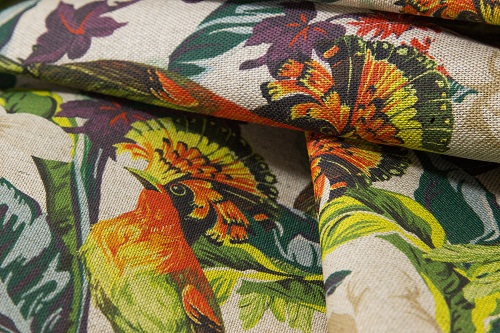
Caption: Prinfab was started in January 2016 by two brothers. Serving the creative community, they offer a range of fabrics for the Fashion and Décor industry, and have built a state-of-the-art production facility using the latest digital fabric printing technology. Credit: PRINFAB LTD.
At the other end of the market, Hi-Speed DTG machines such as the Atlas, recently launched by Kornit, offers a potential daily production in excess of a 1,000 units of personalised T-Shirts.
The machines on offer come with embedded design and workflow software, making it easy to meet an Ecommerce demand for customisation and personalisation. Installation of the machinery is not complicated, service support is widespread and, as the supplier base for blanks expands, so these businesses are moving from strength to strength.
The DTG Bureau can give 24 hr supply from one to one thousand t-shirts, all unique and individual, catering to and satisfying the huge demand for customisation.
Although the DTG market was a trailblazer, the real explosion in growth is in the production of bespoke fabrics in the Roll to Roll market.
Here, the bureau is not confined to producing prints on blanks, but creates unique fabrics on the roll that can then be used in a myriad of applications from Fashion to Homewares and from Craft to Interior Design.
Roll to Roll Bureaus are springing up in every country as the technology becomes more available and easy to use.
At its simplest level, the Roll to Roll Bureau is often a ‘one man band’ employing only two or three people, and yet, with Digital Textile Printing technology, capable of beating much larger enterprises to the punch when it comes to Service, Delivery and Price.

Caption: Print Unlimited offer a vast range of digitally printed fabrics for fashion, sports and beachwear, the entertainment industry, and Home Décor. Based in Holland they manufacture high quality digital textile prints in the quantity that you need and on the fabric of your choice. Credit: Designer Lucie Loete and PrintUnlimited.
In this entry-level Bureau, all the skills are present through multi-task training from Design to Pre-Press and on to Printing, Inspection and Dispatch. Typically they cater for a broad base of demand.
Up and coming Fashion Designers who need urgent prints of a few metres to complete their collection, Craft Businesses who need swift supply to minimise their stocks and maximise their sales, and Interior Designers who need a few exclusive metres of fabric for that never to be forgotten look.
All of these and more come to the Entry Level Bureau, where there is a wide spread of available technologies and fabric availability. Many of these Bureau’s offer over 50 Standard fabrics and a full range of printing ink-set options from Latex to Dyesub and from Reactive to Pigment.
Again, in the Roll to Roll sector machinery choices are many: Entry level machinery is available from Mimaki, Roland, Epson, Mutoh, HP, Pigment Inc, Fabrijet and D-gen, to name just a small selection, and all supply efficient, fast and high quality production machines, which cater to the speed and variability of demand which is a feature of this sector.
In many cases Bureau’s work with simple workflow software based around Adobe Photoshop for Design, and RIPs (Raster Image Processing Software) supplied by the manufacturer. Yet, however simple the system it gives the entry level printer the ability to manoeuvre images and print quickly and accurately to satisfy the requirements of their clients who need Customisation and Personalisation in a hurry.
But it would be a mistake to think of the Digital Textile Bureau as only a small scale enterprise, for this business model has created leviathans as well, and none exemplifies this more than the American giants Spoonflower and Merch by Amazon.
Spoonflower reputedly processes over 4,000 orders a day of two yards or less, taking designs from their clients and delivering finished product to them within a day or two. Spoonflower’s Roll to Roll business uses a variety of machinery printing with a number of ink-sets, however the offer is always the same, just the quantities are higher.
Similarly at Merch by Amazon, which is basically a DTG Bureau offering, a wide range of products, individual design, and the rapid delivery that Amazon is so renowned for.
So, whether a large Industrial Enterprise, or a more modest Local Print Shop, the message is the same, Customisation, Personalisation and Delivery, are the mantras for the Digital Textile Printing Bureau in the proliferation of Individual Textile Design.
Visit FESPA’s Print Make Wear at the Global Print Expo 2019 to see the latest technology in textile production for fashion, showing both direct to garment and roll-to-roll workflows. The feature will host a live production line but also a catwalk and tours. Register now and use code FESM906 for free entry.
Three-day Textile, Garments Exhibition IGATEX Pakistan Successfully Concludes--Attracts Over 15,000 Quality Trade Visitors, Closing Billions Of Rupees Deals
Attracting over 15,000 quality trade visitors and closing billions of rupees deals of the most modern technology and machinery, three-day textile and garments exhibition IGATEX Pakistan successfully ended on Thursday at Expo Centre Karachi.More than 500 companies from 37 countries participated and remained there despite tension between Pakistan and India showing their commitment towards peace and stability
KARACHI (UrduPoint / Pakistan Point News / NNI - 28th February, 2019) Attracting over 15,000 quality trade visitors and closing billions of rupees deals of the most modern technology and machinery, three-day textile and garments exhibition IGATEX Pakistan successfully ended on Thursday at Expo Centre Karachi.More than 500 companies from 37 countries participated and remained there despite tension between Pakistan and India showing their commitment towards peace and stability.More than 116 exhibitors from China and 92 from Italy alone attended this over-crowded event.
Other countries present at IGATEX 2019 were France, Belgium, Austria, Korea, United Kingdom, United States of America, Brazil, Thailand and many more.IGATEX Pakistan is a pioneer exhibition being organized by the FAKT Exhibition since 2002.
It was the 12th edition of this mega event.Sharing details about expo's outcome, CEO FAKT Exhibitions Saleem Khan Tanoli companies exhibited their latest machinery and technology used in spinning, finishing, weaving, dying and garments which attracted large number of visitors.
Majority of visitors showed their interest in European technology.
Deals worth billions of rupees were matured and large number of inquired developed. All exhibitors were very happy and more than 350 foreigners remained present in expo despite current situation which was very positive message, he said.To compete with neighboring and other countries of the world, we need most modern technology.
We have to enhance our exports following vision of present government. Best equipment and technology is necessarily required to produce better products. Textile is like backbone of Pakistan economy.
It has key role in more than 60 percent of exports, he added.Saleem Khan Tanoli said such exhibitions provide a platform to all stakeholders to learn from each other and enhance their businesses.
These events are very fruitful for the national economy as well and will improve our image internationally. Exhibitions also provide temporary and permanent jobs, he concluded.Chairman Nazar & Co. Abbas Mooraj stressed the need to manufacture machinery used in textile sector locally to decrease dependency on other nations. NNI
Success Story: Ring spinning system G 32 – the first choice for mixed yarn production
Rieter’s customer Sharmanji Yarns has been faced by a high demand for their well-known polyester/cotton yarn. To increase their production the company has decided to invest in a ring spinning system G 32. The customer profits from this new investment with higher returns in terms of overall productivity and product quality.Sharmanji Yarns Pvt. Ltd. manufactures and exports yarns made of 100% cotton as well as cotton and polyester blends. The company uses a ring spinning system with 98000 spindles. Before venturing into yarn spinning in 2007, the company had been involved in yarn trading in Ludhiana, Punjab since 1964. The company’s star product is a polyester/cotton yarn, which is well-known in Ludhiana for its outstanding quality. Thanks to its recent investment in a Rieter ring spinning system, the company has managed to increase its capacity to 132000 spindles.
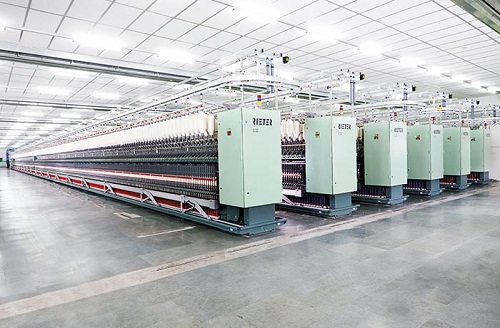
RIETER G-32 Figure. 1: Ring spinning machines G 32.
The Challenge: Increase production of polyester/cotton blends
As a former yarn trader, Sharmanji Yarns is well versed in the quality requirements of yarn customers and the company places high importance on producing yarn of the same high quality as it was distributing as a yarn trader. It was the sharp increase in the demand for polyester/cotton blends that influenced Sharmanji Yarns to add this yarn to its product range. For them, it was crucial that this new investment would provide higher returns in terms of overall productivity and product quality. Further, Sharmanji Yarns wanted to take advantage of lower installation lead time to be able to grasp complete advantage.
The Solution: Ring Spinning Machine G 32
Since 2007, combers and draw frames from Rieter have been meeting the high demands that the company places on yarn quality. Rieter recommended that company management invests in a complete, powerful system, from the blowroom right down to the end-spinning machine. So Sharmanji Yarns became the first company in India to install the new Rieter bale opener UNIfloc A 12, an exceptionally productive machine which processes up to 2 000 kg of raw material per hour. The card C 70, draw frame RSB-D 45 and ring spinning machines G 32 were equipped with the Rieter man-made fiber package (synthetic fiber packages for processing polyester fibers and its blends). The combing preparation system OMEGAlap E 36 with its innovative winding belt technology and the comber E 86 with circular comb Ri-Q-flex were offered for processing cotton.
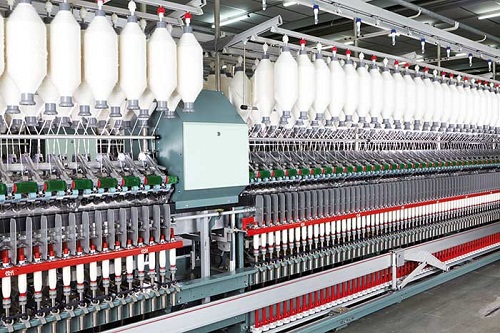
RIETER G-32 ring spinning Figure. 2: Ring spinning machine G 32 – for the production of high-quality yarns produced with high efficiency.
In 2013, the company tested six ring rails on the G 32 to discover for themselves the benefits it would offer in terms of saving energy and reducing yarn conversion costs. The impressive test results led Sharmanji Yarns to use Rieter machines in the realization of its 27648-spindle project.
Rieter’s dedicated project team worked closely with Sharmanji Yarns’ technical team throughout the preparation and installation phases to ensure fast installation and commissioning. After a three-month installation process, the system was ready for operation, delivering yarn which met the customer’s requirements for both quality and quantity.
The Benefits for Sharmanji Yarns:
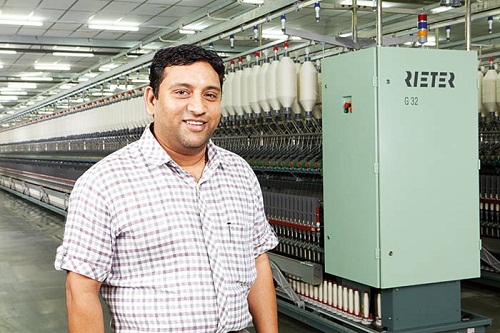
Ashu Jain Sharmanji Yarns Figure 3: Mr. Ashu Jain, Managing Director of Sharmanji Yarns Pvt Ltd. Sharmanji Yarns is now enjoying the benefits of a Rieter system: higher plant productivity with high yarn quality. The suction tube ECOrized installed on the ring spinning machines G 32 reduces the energy consumption. Together with the energy-saving machines in the blowroom line, the cards, and draw frames allow the company to save around 8% of energy in the UKG values. The entire Rieter system offers higher productivity, so it requires 10% less space. This reduces the company’s indirect costs.
Sharmanji Yarns was hugely impressed by these benefits. For its next expansion, the company has placed an order for a second system project (once again for polyester and cotton yarn production) consisting of 34272 spindles.
The Customer’s Statement
“We have been working with Rieter for a number of years, largely because of Rieter’s innovation. The company is continuously developing its machines and offers us first-class solutions. This enables us to produce high-quality yarn while keeping operation and production costs low. The level of dedication of the company’s After Sales support team is also very impressive. We are very pleased with our decision to work with Rieter.” says Mr. Ashu Jain, Managing Director of Sharmanji Yarns Pvt Ltd.
India’s Textile Machinery Imports In Q2 Surpasses Records
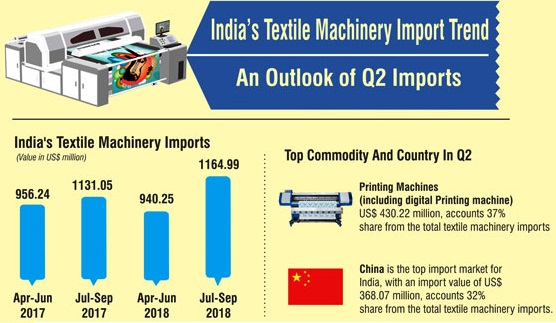
India imports printing machinery, including digital printing, the most from the world and China is the top sourcing market for the commodity.
India’s textile machinery imports have witnessed a skyrocketing growth in the Q2 of this fiscal year. The imports totalled to US$ 1164.99 million with growth of 23.90% over the previous quarter and 3% over CPLY. All the commodities except nonwoven machines have perceived a positive growth in the second quarter of this fiscal. Printing machines, including digital printing machines account for a major portion of 37% from the total textile machinery imports of India in Q2 with an import value of US$ 430.22 million.
For India, China remains the top sourcing market of textile machinery in Q2 too. The imports in the quarter totalled to US$ 368.07 million. In the previous quarter and CPLY too China was the top import destination for India’s textile machinery requirements.
Commodity-wise imports of textile machinery
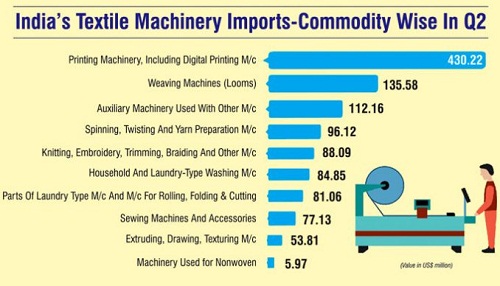
Printing machinery items were imported the most to India from the world, the commodity perceived a growth of 13.13% over the previous quarter and 14.29 over CPLY. Under this commodity, machine which performs two or more functions of printing have been imported the most to India. Imports totalled to US$ 111.06 million in Q2 with a growth of 37.54% over the previous quarter and 27.16% over CPLY. Inkjet printing machinery has shown an average growth of 20.80% over the previous quarter and 20.09% over CPLY and imports totalled to US$ 20.56 million in Q2 FY 18-19. Offset printing machine other than sheet fed and reed feed have witnessed a substantial growth of 24.29% to US$ 44.40 million in Q2 FY 18-19 over the previous quarter and 78.53% over CPLY. Flexographic printing machinery also have shown an impressive progress in the quarter, the imports totalled to US$ 14.36 million in Q2 FY 18-19 with growth of 26.86% over the previous quarter and 84.58% over CPLY.
India’s weaving loom imports on the rise
Imports of weaving machine (looms) are the second topmost commodity in this segment. The imports of weaving machine in Q2 totalled to US$ 135.58 million with growth of 13.51% over the previous quarter, but over CPLY the commodity has witnessed a fall of 4.41%. Shuttleless weaving machine not exceeding a width of 30 cms was imported the most to India under the weaving machine commodity in Q2. The imports of shuttleless weaving machines totalled to US$ 131.77 million with growth of 13.58% over the previous quarter. But the same commodity perceived a negative growth of 2.17% over CPLY.
Auxiliary machines used with other textile machines have shown an interesting growth in Q2 over the previous year as well as over the CPLY. The commodity’s import value totalled to US$ 91.58 million, making it the third largest commodity to be imported to the country from the world. This was 22.47% higher over the previous quarter and 1.54% over CPLY.
Nonwoven machine is the only commodity that has witnessed a drop in imports in Q2 over the previous quarter and CPLY. The commodity’s imports totalled to US$ 5.97 million in the second quarter, 14.84% and 26.30% lower compared to the previous quarter and CPLY respectively.
Spinning machine imports too pick up in Q2
Spinning, twisting and yarn preparation machine imports have witnessed a rise in the Q2 by 41.85% to US$ 96.12 million over the previous quarter, but while compared to CPLY, the commodity has down by 23.13% and the commodity stakes 8% share from the total imports of India’s textile machinery in Q2. Under this commodity, other textile fibre spinning machine is imported the most to India from the world. The product registered a growth of 565.04% in Q2 totalling to US$ 25.87 million over the previous quarter, while over the CPLY the growth declined by 3% only.
Knitting machine imports show mixed trend Knitting machinery imports has witnessed a seesaw trend in the second quarter of this fiscal. The commodity registered a positive growth of 33.35% over the previous quarters while over the CPLY the same commodity registered a negative of 39.45%. The commodity imports in Q2 totalled to US$ 88.09 million. Under this one, machines used for making embroidery have been the imported the most to India, with import value of US$ 34.17 million in Q2 with a growth of 57.99% over the previous quarter.
Sewing machine imports have gone up by 19.38% over the previous quarter totalling to US$ 77.13 million in Q2 and it perceived a growth of 21.91% over the CPLY. Under this commodity, other sewing machine was largely imported product to India from the world, the imports of the same totalled to US$ 52 million with growth of 21.35% over previous quarter.
Country-wise textile machinery imports to India
China remains the top sourcing destination for India
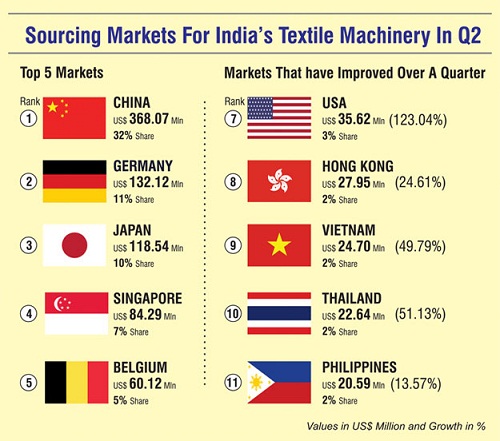
China remains the top sourcing market for India’s textile machinery. India imported textile machinery worth of US$ 368.07 million in Q2 from China. China managed to perceive a minute positive growth of 1.48% over the previous quarter, while over the CPLY imports from China declined 7.87%.
China accounted for 32% of India’s textile machinery imports in the Q2. Printing machinery including digital printing is the topmost commodity exported from China to India. Textile printing machinery, including digital printing, imports to India from China totalled to US$ 85.62 million in Q2, but while compared to the previous quarter and CPLY the growths have dropped for the commodity by 37.04% and 1.01% respectively.
Imports of knitting machines have done quite well in the second quarter. Imports totalled to US$ 52.47 million with growth of 27.08% over the previous quarter. Auxiliary machine used with other machine and sewing machine too have done well, with import value of US$ 32.55 million and US$ 36.7 million respectively.
Germany is an important supplier to India
Germany has gone one notch up, making itself the second largest sourcing market for India’s textile machinery. Germany’s exports to India totalled to US$ 132.12 million and share of 11% from the total imports of India’s textile machinery. Germany perceived a growth of 45.55% in Q2 over the previous quarter, but has gone down by 18.86% over CPLY. Printing machinery including digital printing exports from Germany to India was recorded to be the highest in the Q2.
The exports of printing machinery totalled to US$ 35.42 million with growth of 66.21 % and 29.89% over the previous quarter and CPLY respectively. With a few digits away is the auxiliary machine used with other machines, which is registered to be the second topmost commodity imported in Q2. The imports of auxiliary machinery totalled to US$ 33.20 million with growth of 28.83% over the previous quarter and 28.33% over CPLY.
Japan loses share to Germany
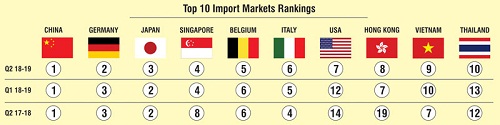
As Germany has exported textile machinery in larger quantity to India, Japan has lost its ranking to third place. In Q2, Japan stands as the third largest sourcing market for India’s textile machinery. Japan’s exports to India totalled to US$ 118.54 million with growth of only 6.57% in Q2 over the previous quarter, while over the CPLY, Japan’s exports declined by 27.69%. Japan stakes 10% share from the total imports of India’s textile machinery. Weaving machinery (looms) remains the topmost commodity imported from Japan to India. Weaving machinery imports totalled to US$ 52.96 million in Q2 with growth of 53.24% over the previous quarter and 9.72% over CPLY. Printing machinery including digital printing, imports from Japan have gone by 29.74 in Q1 over the previous quarter with a value of US$ 27.12 million, but has dropped by 52.11% over CPLY.
Imports from other destinations
Singapore’s textile machinery exports to India in Q2 have gone up by 5.07% to US$ 84.29 million. Whereas compared over CPLY the country has witnessed a growth of 293.14% and stakes 7% share from the total imports of India’s textile machinery in Q2 FY 18-19. Printing machines including digital printing was exported the most from Singapore with value of US$ 58.17million, but the growth has declined by 5.48% and over the CPLY the country has witnessed a growth of 369.87%. Auxiliary machine exports from Singapore have done quite well in the Indian market. It perceived a growth of 65.71% over the previous quarter with import value of US$ 2.32 million.
The other top sourcing countries for India’s textile machinery are Belgium with 5% share and imports of US$ 60.12 million, Italy with 4% share and imports of US$ 49.49 million, USA with 3% share and imports of US$ 35.62 million, Hong Kong, Vietnam and Thailand with 2% share each and imports of US$ 27.95 million, US$ 24.70 million and US$ 22.64 million, respectively.
From the top ten countries, imports from Italy (the sixth top sourcing destination for India’s textile machinery), recorded a drop of 17.97% in Q2 over the previous quarter.
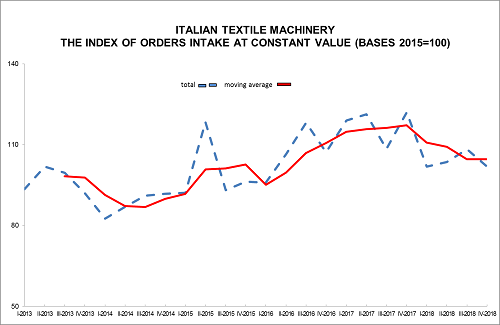
ITALIAN TEXTILE MACHINERY: FOURTH QUARTER ORDERS DROP
The orders index for textile machinery for the period ranging from October to December 2018, as compiled by ACIMIT, the Association of Italian Textile Machinery Manufacturers, fell compared to the same period for 2017. The index value stood at 101.9 points (basis: 2015 =100).
Orders gathered by Italian machinery builders were thus negative both in Italy and abroad. On the domestic front, the index stood at an absolute value of 148 points, that is, fully 12% less than the same period for October to December 2017. However, foreign markets were even further down at -16%, with the index standing at an absolute value of 98.1 points.
ACIMIT president Alessandro Zucchi commented, “The evolution of the domestic market reflects an overall sense of uncertainty that has accompanied the new national budget legislation, not to mention the comparison with a record fourth quarter for 2017.” Zucchi added that, “On foreign markets, our machinery manufacturers are having to face geopolitical situations that have considerably slowed investments. Turkey, Iran, and even China, all primary markets for our sector, have recorded a drop in demand for textile machinery, for a variety of reasons.”
“Based on preliminary results elaborated by our Association,” concludes ACIMIT’s president, “2018 closed with a downswing both in terms of foreign sales and total production. The overall sentiment for 2019 isn’t very positive either, but the entire sector is putting its trust in ITMA, the primary trade fair for the entire world textile machinery industry, held every four years. This year, the fair will be held in Barcelona from 20 to 26 June. It could very well present an opportunity for a revival of the entire sector.”