FW
Indian mills profit margins rise in Q2
Profit margins of Indian textile mills improved during the second quarter. Input costs were low, driven largely by a fall in cotton prices. Welspun India’s net profit for example grew 21.4 per cent. Sales grew 11 per cent. Raymond’s sales increased 16 per cent, ebitda by 36 per cent and net profit by 63 per cent. Better capacity utilisation in garmenting, higher gains from currency depreciation and continued focus on efficiencies may drive Raymond’s margin expansion in the second half.
Raw material prices remained subdued during the quarter, though cotton demand from domestic textile manufacturers was robust, as mills needed to prepare stocks for the festival and seasonal demand in October-November. These dynamics might change in the coming quarters with demand for cotton coming from Pakistan, China and other importing countries at a time when output of the natural fiber is estimated to decline. As against the earlier forecast of 36 million bales of output, the new estimate is about 33 million bales this year.
Cotton prices in major producing centers such as Punjab and Madhya Pradesh have declined to nearly 10 per cent below the minimum support price. China has since turned to India for import of cotton due to a higher import duty levied on its traditional supplier, America. Pakistan is also likely to procure from India this year.
Invista launches three new technologies for Lycra
Invista, owner of Lycra, Thermolite and Coolmax brands, and an innovation leader in the legwear segment, has introduced three latest hosiery innovations at the fifth edition of Lycra Fiber Moves conference that took place in Lake Como, Italy on October 18, 2018.
The first of these included the Lycra Fusion True To You technology, a patent-pending innovation allowing the creation of transparent 3D hosiery that delivers a natural-looking shine to the legs. The innovation is a combination of a new Lycra Fusion yarn with new 3D knitting construction, therefore combining the ‘no ladder’ benefits to the fit and uniformity, all in a natural shine sheer hose.
The Thermolite FIR technology comprises a spun dyed black fibre embedded with special ceramic pigments that absorbs the wearer’s infrared radiation and reflects it back to them as heat energy. This improves the body’s heat retention and keeps legs warmer, longer. Knitted with Lycra Black technology, it fulfils consumers’ expectation for true black leggings that won’t fade or wash out after wearing or washing.
The third technology was Lycra Made to Fit You technology, originally created for knee-highs, which has been expanded to offer the same benefits to stay-ups (thigh-highs). The technology uses a patent-pending construction that can be knitted on a standard hosiery machine. It features a single-layer tube with a special knit structure on the edge to limit roll-over.
Holistic strategy needed for Bangladesh
A holistic strategy will be adopted by the apparel industry in Bangladesh.
There has been a realization that tax benefits and similar incentives go only so far and do not ensure sustainable growth.
Domestic competitiveness, cost of doing business, workplace safety, product and market diversification, skilled labor force, foreign direct investment and technological advancement and automation in production process are also seen as key to retaining the momentum in apparel export growth.
The fact that Bangladesh’s exporters have not really made efforts to ensure a living wage for workers also places the industry at a competitive disadvantage compared with other Asian countries. While apparel workers in Cambodia work for 47 hours a week, in Bangladesh it is 60 hours a week. Moreover, 54 per cent of workers are paid below the minimum wage.
To reap fair prices for export product, a strategy will be adopted to improve negotiation skills at both the entrepreneur and the government level and to empower local exporters to develop a relationship with global buyers on an equal footing.
Another issue is that of lead time. This would be a matter in readymade garment exports in future as the country might lose the cost advantage in coming days.
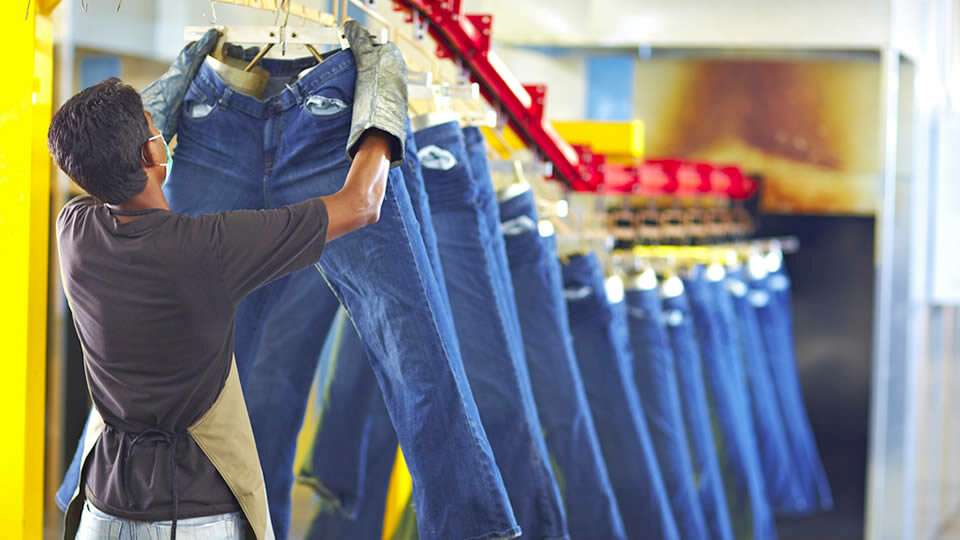
New sustainable denim dyes from Garmon Chemicals save energy, water, time
Garmon Chemicals has unveiled a line of 22 direct dyes that use less energy, water and time than their reactive-dye counterparts. These Old Vintage Dyes range were launched at denim expo Kingpins in Amsterdam. These dyes offer “excellent dischargeability” and a deep and even distribution color that meets the rigorous requirements of even the “most demanding buyers,” according to the Italy-based firm. The dyes are used in the cationised dyeing process, which employs the surface deposition of color to create vintage effects characterized by high contracts on abraded areas, Garmon said.
The company’s new offerings require an average of five process steps instead of the usual eight, a lower quantity—and higher performance—of both dyes and auxiliaries and “much easier” corrections for final shades. Branded by Garmon as eco-friendly, safe for human health and Restricted Substances List-compliant, the dyes save 40 percent more processing time, while saving 40 percent more water and 35 percent more energy than rival products, yet deliver no aesthetic compromises.
Garmon also used the Kingpins Expo to preview the new features of its Stretch Care innovation line, including Elam Sense, an aminoethylethanolamine (AEEE)-free softener for high-quality finishes on super- and hyper-stretch fabrics; and Fortres Flex, an “outstanding” dispersal agent that protects elastane fiber even at low temperatures, preventing backstaining —i.e, the redepositation of dyes—during all washing steps.
EU adopts restrictions on 33 textile chemicals
The European Union (EU) has restricted the use of 33 hazardous substances in clothing, footwear and other textile articles based on recommendations by the European Chemicals Agency and following broad consultations with stakeholders. These measures are designed to protect the health of European citizens by limiting their exposure to CMR chemicals—substances classified as carcinogenic, mutagenic and toxic for reproduction—that may be “particularly harmful” when in frequent contact with human skin.
The EC originally had considered 286 substances, which textile-trade groups such as the European Apparel and Textile Federation, Independent Retail Europe and the International Wool Textile Organisation balked against in 2016, calling the expansive scope of the proposal “deeply concerning” and “likely to have a negative economic impact.” Now much whittled down, the new rules have been incorporated into REACH (Registration, Evaluation and Authorization of Chemicals) legislation
7th Euratex Convention emphasises on interregional colloboration
The 7th Euratex Convention, organised on October 24, in Ontinyent, Valencia, Spain, by the Consejo Intertextil Español (CIE), attracted over 200 participants from the textiles and apparel sector, as well as prominent figures from regional and national representations. Hosted for the first time in Spain, the event offered an opportunity to exchange views and present approaches for regional collaboration, to encourage the development and modernisation of the fashion and textile industries.
The Convention also included a round table discussion with representatives from textiles clusters around Europe. In showcasing the role of clusters in the sector, the testimonials offered a first-hand perspective into best practices, particularly the importance of providing high level services and products, maintaining a flexible approach, and focusing on innovation.
With textiles and clothing companies all around Europe sharing common challenges and priorities, the convention emphasised on interregional collaboration as the key to the future.
Esprit Q1 revenues down 16 per cent
For the first quarter Esprit’s revenues slumped 16.2 per cent year on year in local currency. The fashion brand’s own offline store sales reduced 10.6 per cent. The decline was due to a reduction in net sales area of 11.5 per cent year on year, a result of continued rationalisation of the company’s distribution footprint, including the closure of the Australia and New Zealand markets, and a decline in comparable retail store sales (excluding e-shop) of 14.1 per cent.
Offline same-store sales in Asia Pacific grew by 0.3 per cent, mainly due to promotional activities. But online sales, which account for 24.9 per cent of the company’s revenue, fell by 14.9 per cent globally. E-shop, almost entirely in Europe and representing 24.9 per cent of group revenue, recorded a decrease of 14.9 per cent. Online sales in Asia Pacific, which account for a mere 2.6 per cent of total e-shop sales, plummeted 36.7 per cent, largely blamed on the closure of the Australia-New Zealand business.
Wholesale revenue, almost entirely from Europe, fell 15.5 per cent. The company plans to sharpen its brand identity, putting the customer at the centre of everything it does, improve product offering and brand positioning.
US: PCE for clothing and footwear declines by 0.6 per cent
According to Bureau of Economic Analysis (BEA) figures, real personal consumption expenditures (PCE) for clothing and footwear declined to $2.62 billion in September, to $402.94 billion—a 0.6 per cent drop from August. Overall real PCE, which includes adjustment for inflation, rose by 0.3 percent in September, reflecting an increase of $33.5 billion in spending for goods and a $3.5 billion increase in spending for services. Within goods, motor vehicles and parts was the leading contributor to the increase, with strong contribution from recreational goods and vehicles.
Clothing and accessories stores, along with general merchandisers, posted small sales gains in September compared to the previous month, with weather and politics blamed for the stymied growth, the U.S. Census Bureau’s Monthly Retail Trade report showed earlier this month.
The BEA report showed personal income increased by $35.7 billion, or 0.2 percent, in September, while disposable personal income (DPI), an important barometer for retail spending, rose by $29.1 billion, or 0.2 percent. Real DPI increased 0.1 percent in September.
The PCE price index increased 0.1 per cent in the month, as the core index, which excludes the volatile food and energy sectors, was up 0.2 percent. BEA noted the increase in personal income in September primarily reflected increases in wages and salaries, government social benefits and rental income partially offset by a decrease in proprietors’ income. Personal outlays increased by $57.9 billion in September, while personal saving was $975.7 billion. The personal saving rate—personal saving as a percentage of disposable personal income—was 6.2 percent.
Indian apparel industry plagued by volatile prices, fabric-sourcing challenges
 Fabric sourcing, till a few years ago, was one of the most challenging tasks. But increasing options of fabric sourcing, advanced technologies and awareness about quality have improved the conditions for fabric sourcing; though some challenges still prevail and industry continues to struggle with those issues.
The procurement of synthetic fabrics or yarns is more of a concern than cotton yarn or fabric. There are some yarns or blends that are not available in India, like Cashmere in wool. Additionally the man-made fibre sector attracts a lot of duties which increases the costs of these fiber manufacturers. Local Indian producers then often quote high and unexplained prices. Import duties on fabrics, is another cause of concern as it increases the price of fabrics; especially linen and imported silk.
Need to control price volatility
Garment manufacturers using cotton fabric are almost helpless when it comes to price volatility as prices increase anytime  without any strong and valid reason.
Though in past 10 years, situation in sourcing of Indian fabric has improved, the main challenge of sourcing cotton and cotton blends yarn still exist like before. When prices of yarn increase, suppliers prefer to deliver it at current rate to gain extra profits though they are supposed to deliver it first to the buyer to whom he has already agreed upon earlier at lower prices. Such issues need to be addressed as they not only delay fabric development but also the overall efficiency of the business.
Low fabric quality a bane
As for quality, apart from good vendors, fair price, strong check, trial runs are being adopted by many apparel manufacturers. However, whenever there is a tilt towards cotton export, yarn manufacturers or suppliers increase prices without any reason. There is no way to control illogical price hiking. Some exporters see it as market dynamics and manage accordingly. Chinese or imported fabric quality is better. Most buyers approve Indian fabric as there is no other viable option and prices of Indian fabrics are a little lower. Therefore, Indian companies need to adopt similar advanced infrastructure like China.
AEPC organises the Fabric of Unity to commemorate the Indian Textiles Industry
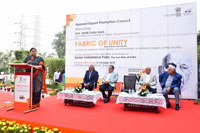 AEPC, to mark the unveiling of the ‘Statue of Unity’ in Gujarat on October 31, 2018, organised the ‘Fabric of Unity", an event to commemorate the Indian textiles industry. Smriti Zubin Irani, Union Minister of Textiles, Government of India graced the event attended by EC Members of AEPC, Officials from Ministry of Textiles and senior representatives from the textiles councils and associations, representatives from brands, ETI, ATDC students, NGOs working in this sector.
Integrating the entire industry
Incorporated in 1978, AEPC is the official body of apparel exporters in India that provides invaluable assistance to Indian exporters as well as importers/ international buyers who choose India as their preferred sourcing destination for garments. In recent years AEPC has worked tirelessly to integrate the entire industry - starting at the grass root level of training the workforce and supplying a steady stream of man power to the industry; identifying the best countries to source machinery and other infrastructure and brokering several path breaking deals for its members, and finally helping exporters to showcase their best at home fairs as well as be highly visible at international fairs the world over.
Speaking at the event HKL Magu, Chairman, AEPC said “Indian textiles have played an important role in the Indian freedom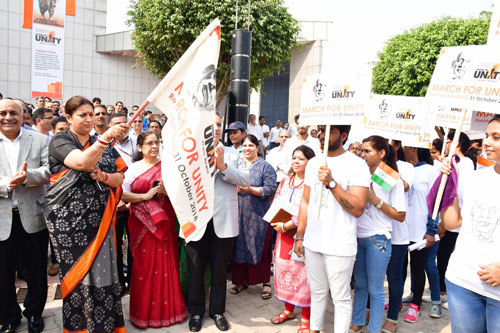 movement and what can be a better example of Unity in diversity than the Indian textile heritage. The Fabric of Unity is an event to celebrate this. This year happens to be AEPC's 40th year of service for promoting apparel exports around the world. We feel proud to be working on some very important initiatives to promote inclusion and sustainable apparel eco system. ”
Smriti Zubin Irani, Minister of Textiles said, “AEPC has organised this Fabric of Unity event in which industry, workers, and volunteers took the pledge to work for the betterment of the nation. In continuation to this spirit of the Unity Pledge - to contribute to the nation building as an unified entity, AEPC can take this concept of Fabric of Unity forward by showcasing the rich history of the diverse fabric and textiles traditions of India at AEPC premises. ”
Encouraging skilled workers into the organised sector
Irani revealed that Prime Minister, Narendra Modi has gifted a package of Rs. 6,000 crore especially to the textile and apparel council AEPC with a desire to encourage the skilled workers and people into organised sector. He also wished the Indian textile Industry to bring about newer heights in the world economy.
Irani hoped that AEPC will work hard towards achieving this target. She also requested to extend the concept of Fabric of 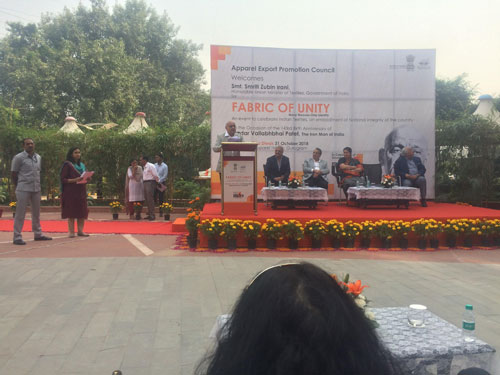 Unity to every office of AEPC and every member of AEPC, “only then can we bring Sardar Ballabh Bhai Patel’s dream come true. Patel formulated solutions one by one, weaving the warp and weft of unity on the axis of a single thread,” she said.