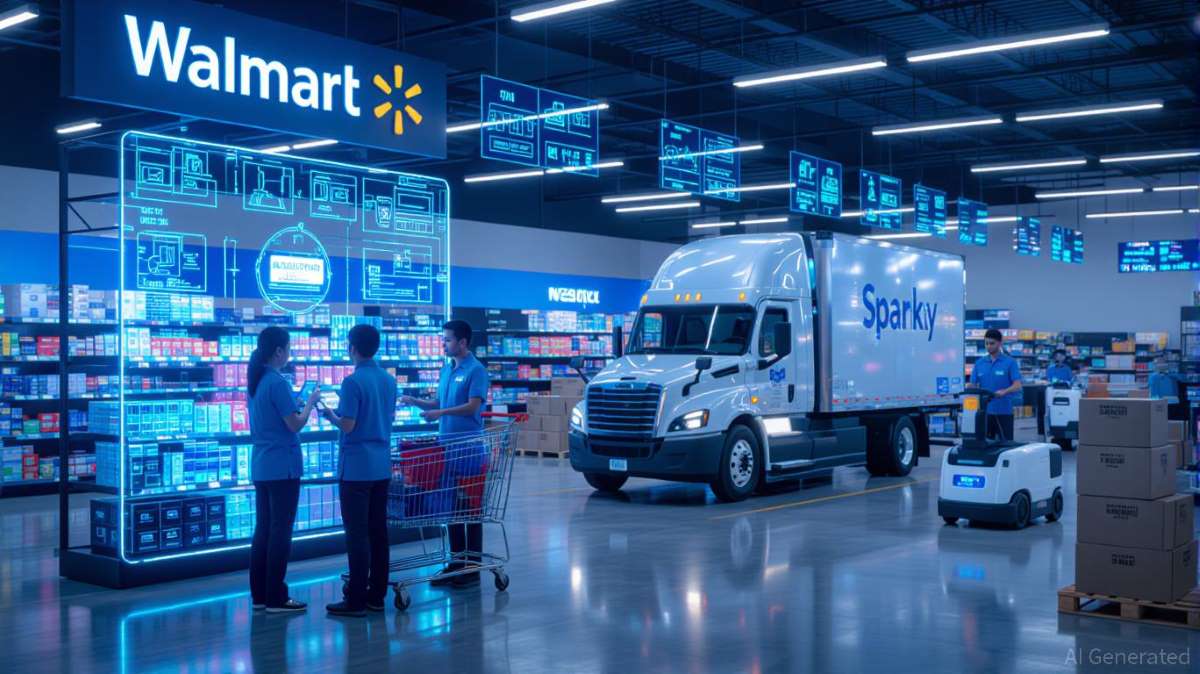
Walmart is fundamentally rewriting the commercial real estate and retail logistics playbook with the rise of its ‘Walmart Depots’ a hybrid middle-mile infrastructure layer designed to bridge the widening gap between large-scale regional distribution centers and hyper-local storefront delivery demand. As the company surpasses a $1 trillion market capitalization in 2026, this evolution signals a decisive shift: Walmart is no longer just a retailer, but a logistics-as-a-service operator embedded deep into the physical economy.
Unlike traditional retail outlets or even conventional warehouses, Walmart Depots are high-density, tech-enabled micro-fulfillment nodes. They are engineered to reduce the distance between digital demand signals and physical product movement. By converting underutilized retail real estate into high-velocity distribution points, Walmart is targeting the most expensive and operationally complex segment of retail the last mile.
Vacancy arbitrage in pharmacy real estate
One major catalyst for this strategy is the decline in the US pharmacy retail sector. With major chains such as CVS and Walgreens rationalizing store portfolios and Rite Aid undergoing restructuring, thousands of 10,000 to 15,000-sq ft properties have entered the market across high-traffic urban and suburban corridors.
These formerly prime retail boxes, once viewed as distressed assets, are now being repositioned as micro-fulfillment infrastructure. Walmart’s strategy is to selectively absorb these locations and convert them into Depots stocked with high-velocity SKUs, particularly in apparel, home essentials, and fast-moving consumer goods where speed-to-market directly determines margin performance.
This real estate repurposing enables shortening of delivery timelines. A significant share of Walmart’s urban customer base can now be served in under three hours, contributing to a broader operational milestone: by fiscal year 2026, nearly 95 per cent of US households are within a three-hour delivery radius. What was once a scale problem has been reframed as a proximity solution.
Table: Walmart supply chain acceleration metrics
|
Metric |
Performance FY 2025 |
Projection FY 2026 |
|
Global E-commerce Sales |
$122.6 bn |
Plus $150 bn |
|
E-commerce Revenue Share |
18% |
Plus 20% |
|
3-Hour Delivery Reach |
80% of US Households |
95% of US Households |
|
Home Delivery Unit Cost |
-12% Y-o-Y |
-20% (Cumulative 2-yr) |
These gains reflect Walmart’s aggressive shift toward infrastructure-led retail economics, where logistics efficiency directly determines revenue scalability.
The economics of automation and density
At the core of the depot strategy lies a disciplined focus on unit economics and automation-driven throughput. Approximately 60 per cent of Walmart’s US stores are already replenished by automated distribution systems, while the company continues to accelerate capital expenditure toward robotics and supply chain modernization.
Walmart is currently retrofitting 23 of its 42 regional distribution hubs with advanced automation systems, revealing that the transformation is not incremental but systemic. Supply chain investments are expected to peak over the next two years, reflecting a short-term capital intensification phase aimed at long-term cost compression. This allows Walmart to reassign functional roles across its network. Supercenters are increasingly shifting toward experiential and high-margin retail, while depots absorb the operational burden of high-frequency replenishment. The result is a bifurcated retail system: visible consumption in stores and invisible velocity in logistics.
As Walmart’s EVP and CFO John David Rainey says, technology-driven productivity is central to expanding the company’s omnichannel model at lower marginal cost. The depot layer is effectively the mechanism through which this cost advantage is realized.
Apparel as a high-velocity test case
Nowhere is this transformation more visible than in Walmart’s apparel and private-label strategy. The integration of RFID (Radio-Frequency Identification) across the supply chain has enabled near real-time inventory visibility, dramatically improving forecasting precision and stock allocation.
Previously, apparel cycles were constrained by slow replenishment systems and broad, regional inventory assumptions. Today, Walmart can dynamically reposition inventory based on localized demand signals, often within hours. When fashion trends emerge in specific metropolitan clusters, inventory is rapidly reallocated from regional hubs to nearby Depots, enabling same-cycle responsiveness. This has resulted in a 15 per cent% reduction in apparel markdowns, driven primarily by improved inventory positioning and reduced overstocking. In effect, Walmart is replacing seasonal forecasting with continuous demand sensing.
From cost centers to revenue engines
The depot network is also evolving into a platform for external monetization. Through Walmart GoLocal, the company’s white-label delivery service, these micro-fulfillment hubs are increasingly used to serve third-party retailers. This transforms internal logistics infrastructure into an external service layer, generating incremental revenue from capacity that would otherwise remain underutilized. This marks a shift in retail economics: logistics assets are no longer purely cost centers but hybrid revenue-generating infrastructure platforms.
In fact, the broader retail sector is now facing a divergence. Companies must either integrate into Walmart’s emerging logistics ecosystem or risk being structurally disadvantaged by its scale and speed advantages.
The competitive frontier is no longer defined by store count or brand strength alone, but by proximity-to-demand and velocity-to-fulfillment. Walmart’s strategy effectively compresses geography, turning physical distance into an engineered variable rather than a constraint. With automation now handling roughly half of its e-commerce fulfillment volume, Walmart is positioning itself as a direct challenger to digital-native platforms by matching algorithmic efficiency with physical infrastructure depth.
Omnichannel at industrial scale
Walmart’s transformation reflects a broader evolution from discount retail pioneer to omnichannel infrastructure leader. Serving approximately 280 million customers weekly across 10,900 global locations, the company now operates in the middle of retail, logistics, and technology.
The depot model is the connective tissue in this system, enabling Walmart to unify online and offline commerce into a single operational framework. By maximizing volume per sq ft, regardless of whether demand originates in-store or digitally the company is effectively redefining what retail real estate is meant to do. In this new paradigm, competitive advantage is no longer about owning the most stores, but about owning the shortest and smartest path to the customer.