FW

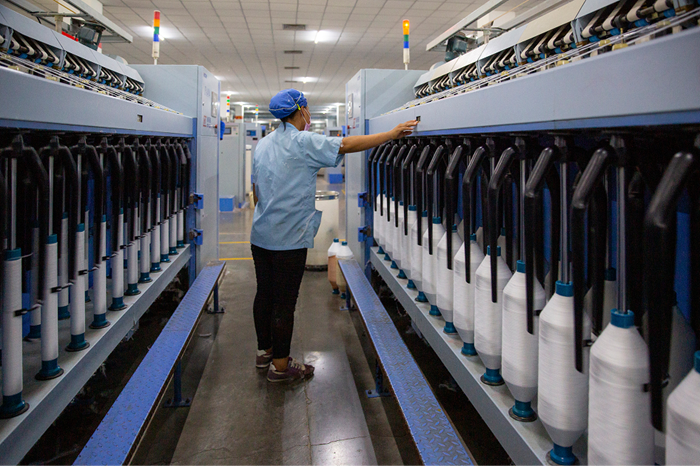
Teejay, based in Sri Lanka, is a circular knitter has seen its Q2 revenue grow 25 per cent. Profit before tax was up 11 per cent and net profit increased 15 per cent over the corresponding three months of the previous year.
One of the region’s largest textile manufacturers, Teejay supplies fabrics to some of the top international brands across the world. The company is part owned by Sri Lanka’s largest apparel exporter, Brandix Lanka, which has a 33 per cent stake and Pacific Textiles of Hong Kong, which owns 28 per cent of the company.
This was the fourth consecutive quarter of revenue and net profit growth for the company in the face of stiff challenges, and was made possible by expanded capacity and a strong order book arising from the GSP facilities that it enjoys.
Although margins were impacted by raw material and utility cost increases in the second quarter, Teejay was able to improve its gross margin to 11.3 per cent from 10.2 per cent in the corresponding quarter as a result of better loading and an improved mix, with its USA and EU business units increasing sales volumes. The plan is to expand in India in the second half of the financial year.
The trials and changes presently facing supply chains may have spurred attendance at Sourcing at MAGIC in Las Vegas last week. One feature of the latest show was a virtual reality experience dubbed X-Ray Fashion. It’s a film made by an Italian director [Francesco Carrozzini] that takes you into various places impacted by fast fashion.
As a part of the sustainability focused immersive experience produced by Vulcan Productions, attendees could remove their shoes and virtually traverse rivers in Bangladesh and other areas that have taken a hit at the hands of the fashion industry.
Waterless denim was a major feature at the show too, with companies like Jeanologia showcasing nanotechnology and advancements in waterless and laser finishing for jeans. Levi’s has also been a major player in the area of saving water in denim processing, with its Water
Beyond sustainability and water saving, tariffs, trade and Made in China 2025 were other big focuses at Sourcing. The show floor featured micro factories showcasing technologies like a body scanner from Tukatech that can make 3-D fit models from a series of measurements derived from scanning the body, and a CAD system that creates the style in a 3-D format to bypass physical sample making, saving time and costs..
Pakistan Textile Exporters Association (PTEA) lauded the government’s move for liquidation of outstanding refunds through promissory notes but expressed concern over long outstanding liquidity under textile policy incentive schemes. It also demanded supplementary grant for payment of incentives under textile policies 2009-14 and 2014-19
The association claimed that inadequate liquidation of refunds would result in failure of getting desired results as huge amounts of exporters were still stuck against textile policy incentive scheme. The association says, exporters’ claims of Rs 10,300 million were outstanding against export finance markup support, Rs 1,500 million against Markup Rate Support, Rs 19,405 million against Technology Up-gradation Fund, Rs 434 million against Reimbursement of EOBI & Social Security contribution of women and handicapped employees of textile industry whereas Rs 2500 million were outstanding against Drawback of Taxes & Levies (DLTL) 2009-11.
Moreover, Rs 10 billion were outstanding on account of income tax; whereas Rs 10 billion was pending against income tax credit u/s 65B & 65E. With huge shortage of funds, textile industry was unable to tap its potential in accordance with capacity.
For the nine month period Nandan Denim’s capacity utilisation stood at 63 per cent. Gross margin stood at 30.2 per cent and declined by 199 bps due to lower sale realisation and relatively higher price of key raw materials such cotton, power etc.
Employee expenses and other operating expenses marginally increased by 3.2 per cent and 3.3 per cent respectively. Ebitda margin was 10.7 per cent. The temporary oversupply, aggression in pricing and higher credit period which the industry is facing impacted the volumes, realisation and profitability of the company.
Net finance cost declined by 52.8 per cent. Nandan Denim is India’s largest denim fabric manufacturer. From a year-on-year perspective, Nandan has completed capacity expansions at the denim fabric, shirting fabric, and yarn manufacturing units.
The company’s fabric manufacturing capacity is 110 million meters per annum. Going forward, emphasis will be laid on fashion denim fabrics to target better realizations compared to regular denim material.
A combination of higher sales volumes and value added products is likely to fuel top-line growth in the coming fiscals. Denim fabric contributes 80 to 90 per cent to Nandan’s annual turnover. Nandan is gradually steering the business towards the value added denim category.
The late Robert H. Chapman, III, who served as Chairman, Chief Executive Officer, and Treasurer of Inman Mills in Spartanburg, S.C., received the 17th Oscar Johnston Lifetime Achievement Award. He was honored at the National Cotton Council’s 2019 annual meeting held in San Antonio, Texas.
The award was presented by outgoing NCC Chairman Ron Craft to Ellis Fisher, a son-in-law of Chapman who serves as Inman Mills’ vice president and general counsel and who accepted the award on behalf of Chapman’s family.
Along with his service at NCTO, Chapman served the NCC as a manufacturer delegate from 1999-2017, a Board member from 2005-2017 and as an advisor in 2016. He was a member of the NCC’s 1989 Cotton Leadership Class. A graduate of the University of the South, where he majored in economics, Chapman also earned degrees from the Institute of Textile Technology and Harvard Business School. In 1976, he joined Inman Mills, a company founded by his great-great uncle, James A. Chapman in 1901.
As per representatives of the Vietnam National Textile and Garment Group (Vinatex), the country’s garment and textile industry aims to achieve an export turnover of $40 billion this year. The group advocates that in order to achieve this goal, garment and textile companies should prepare specific solutions for each market scenario and closely collaborate with fiber and fabric firms to together overcome difficulties as well as market fluctuations.
This year, positive sign is expected from the Comprehensive and Progressive Agreement for Trans-Pacific Partnership (CPTPP) with two potential markets: Canada and Australia. If market scenario is good, the EU market in the last six months of this year will add about $1 billion to garment and textile exports. Therefore, Vietnam’s garment and textile industry will be able to maintain steady export to main markets and achieve its export target of $40 billion this year.
The European Union may suspend trade privileges for its imports from Cambodia. Right now Cambodian exports to the EU are duty-free. The EU had announced in October last year that Cambodia could lose its special trade access to European markets under the EBA preferences, citing concerns over human rights and labor rights issues in the country.
The process consists of a six-month period of intensive monitoring and engagement with the Cambodian authorities, followed by another three-month period for the EU to produce a report based on the findings.
After 12 twelve months, the European Commission will conclude the procedure with a final decision on whether or not to withdraw tariff preferences. Any withdrawal would come into effect after a further six-month period.
The EU is a major trading partner of Cambodia, especially for the textile and footwear sector. As a Least Developed Country, Cambodia has enjoyed duty free exports of products, except arms and ammunition, to European markets for decades. Cambodia exported products to the EU bloc worth €4.9 billion in 2018. Over 46 per cent of Cambodia's total exports of apparel and footwear are to the EU.
The Apparel Textile Sourcing Miami (ATSM) will introduce a range of new sections, including machine demonstrations, a technical textiles section and a footwear sourcing pavilion. The event will host a number of apparel industry professionals, from buyers and sellers to supply chain executives, from the U.S. and Latin America
This year ATSM will be held one week later than originally planned. The new dates, May 28-30, 2019 will coincide with MiamiFashion Week. ATSM made its debut in 2018, and in its sophomore year, the event will double in size, with around 12,000 industry professionals expected to attend the event in South Florida.
There will be a special focus on how advancements in manufacturing grant microbrands the chance to add more design seasons to their collections and welcome new designers into the market. ATSM 2019 will examine the future of retail through the lens of microbrands and their influence on fashion’s transactional infrastructure, from raw materials to retail.
The competitive landscape in Brazil’s apparel market continues to rise as some of the world’s top brands seek a place to start operations. Puma, Adidas, WinCraft, and Nike have all made a push to provide products domestically, increase manufacturing capacity, and promote a stronger export market.
That makes Brazil one of the most promising apparel industries in the world today. The country features a high level of fashion consciousness, diversified demographics, and eagerness within the primary population to shop and experiment.
A secondary market for apparel is starting to open as well thanks to manufacturers opening their old stocks to the retail segment. Local companies can sell brand-name products at discount pricing, encouraging even more sales activity from the targeted demographics. Although there will still be growing pains to endure in the next 10-year period for the Brazil apparel industry, the stage is set for consistent growth. Brazil expects a CAGR of 4.5 per cent annually through this forecast period if conditions remain constant.
 With China becoming health conscious the country has over 37,000 fitness facilities. A recent wellness trends report published by the Global Wellness Summit notes over 104 million Chinese have at least one fitness app on their phones while another five million have a gym membership. The country, home to approximately 500 gyms in 2001, currently boasts of over 37,000 fitness facilities. This includes several international franchises and specialized gyms.
Various governmentincentives also boosts this growing fitness trend in the country. The State Council had introduced the Healthy China 2030 initiative in 2018. Through this plan, the Chinese government hopes to engage 700 million people in physical activities at least once a week, while 435 million will exercise regularly. With so much happening in China on the wellness front, no wonder the athleisure trend has taken off.
Brands exploit growth through new initiatives
As per Euromonitor International, sportswear in China grew by 12 percent to $31.4 billion in 2017, and analysts expect this positive growth trend to continue in coming years. Analysts predict athletic brands will continue to capitalise on this trend. In 2016, Adidas had announced a plan to expand from 9,000 to 12,000 stores across China by 2020, and their strong results of 16 per cent in 2019 represents yet another strong and encouraging start to the year. Adidas saw 20th consecutive quarter of double-digit growth in Greater China.
Meanwhile, Canadian yoga-inspired brand Lululemon, which plans to generate 25 per cent revenue from its Asian markets by 2020, targets China for achieving this growth. The brand will adopt advertisement campaigns, influencer marketing and partnerships with wellness gurus for achieving this growth.
Similarly, Japanese brand Uniqlo also plans to exploit China’s newfound affinity for wellness by offering a colorful selection of hoodies, shorts, sweatshirts, leggings, tops, and sports bras and is a popular choice in middle-class Chinese households. The brand’s products stand out for their versatility, functionality and innovative fabrics such as odor neutralising dry-ex and the water-repellent Blocktech. The brand also plans to expand its brick-and-mortar stores in China. The forecast calls for over 1,000 stores by the end of August 2021.
Local brands make a mark
The Chinese wellness craze is benefitting not just international but also local brands like Particle Fever and Maia Active. These local brands have created niche businesses by appealing to younger, consumers who crave authenticity or individuality — and aren’t afraid to experiment.
The Chinese idea of a perfect activewear is different from that of the Western countries. To cater to this difference, the products of Maia Active are designed as per consumer-centric business mindset. The brand’s products are specially Asian-fitted which differentiates it from a lot of existing activewear brands in the market. The brand breaks through the conventional design approach and blends in fashion elements in its products.
Independent sports brand Particle Fever, on the other hand,offers a trendier version of the athleisure trend through its innovative and avante garde designs. The brand’s partnerships with the Woolmark Company and the posh retailer Lane Crawford reflect its extraordinary growth. The wellness sector in China is thus on a continuous growth path and is sure to scale new heights soon.