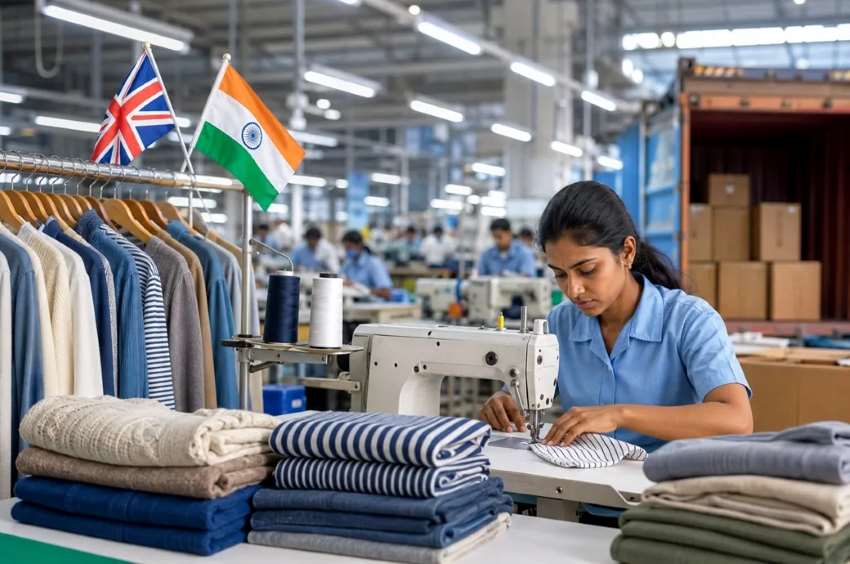
While India aims to scale its textile and apparel exports to $100 billion by 2030, a persistent lack of supply chain coordination is currently hindering the sector’s global competitiveness. Recent analysis indicates, India is missing out on an estimated $3–7 billion in annual apparel export opportunities due to fragmented planning and operational inefficiencies. Unlike competing hubs in Vietnam or Bangladesh, where integrated ecosystems facilitate faster turnarounds, many Indian garment factories remain constrained by sewing efficiencies between 58 per cent and 70 per cent. Consequently, exporters frequently resort to expensive airfreight to meet deadlines, which erodes profit margins and weakens the industry’s reliability in the eyes of global retailers.
Transforming production into a coordinated ecosystem
Recently unveiled at Bharat Tex 2026, the India Textiles & Apparel CXO Blueprint 2030 highlights, future growth must stem from ‘capability competitiveness’ rather than mere volume expansion. Industry leaders are now prioritizing digital inventory systems, closed-loop water management, and AI-driven quality controls to rectify a significant ‘value-add’ deficit - wherein roughly 35-45 per cent of India’s produced fabric is exported as raw material rather than converted into higher-margin apparel. Santosh Katariya, President, Clothing Manufacturers Association of India (CMAI), notes, the opportunity now lies in transforming fragmented operations into a coordinated production ecosystem. By clustering manufacturers within integrated zones like the PM MITRA parks, the sector aims to reduce logistics costs by 15 per cent - 20 per cent and establish the traceability required by major European and American brands, ultimately shifting the industry from a volume-focused model to a high-value, partner-oriented framework.
Achieving global leadership through sustainable production
The Clothing Manufacturers Association of India (CMAI) is the apex body representing India's apparel sector, which employs over 45 million people. With a strong base in cotton and man-made fibers, the industry is focused on diversifying into high-value technical textiles and achieving global leadership through integrated, sustainable, and technology-led production.