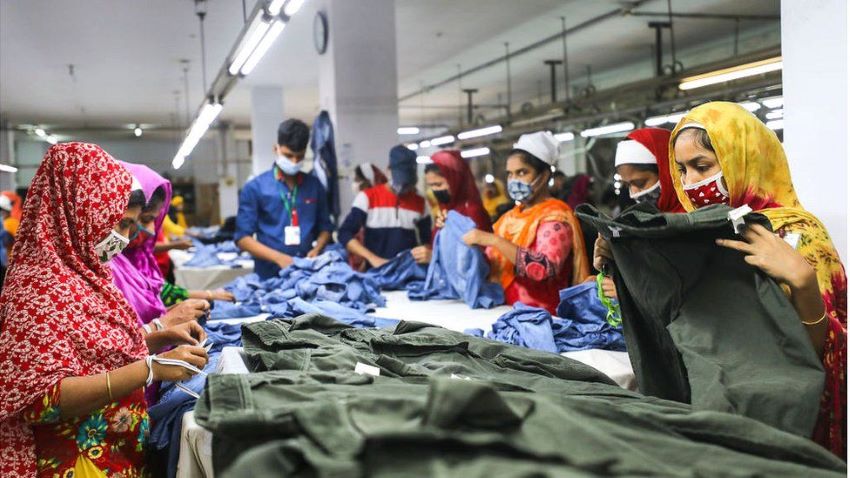
Indonesia hopes to increase export of Muslim apparels by 10 per cent this year. The country’s exports of Muslim fashion products in 2017 were up 8.7 per cent from the previous year. Indonesia will continue to encourage Muslim fashion industrialists and designers to make innovations by increasing their productivity and strengthening their brands to be able to penetrate the export market.
At present, Muslim fashion industry is projected to absorb 1.1 million of the total 3.8 million fashion industry workers in the country. World Muslim fashion market is expected to grow to $327 billion by 2020. Indonesia, at present, is the fifth biggest exporter of Muslim fashion products among members of the Organization of Islamic Cooperation after Bangladesh, Turkey, Morocco, and Pakistan. Several established international brands have looked to tap into growing demand for modest and Islamic clothing and footwear, with the likes of Zara, Louis Vuitton, Gucci and H&M all releasing collections targeting the sector. Dolce & Gabbana has a hijab and abaya collection, specifically aimed at Muslim women.
Muslim consumers spend an estimated $230 billion on clothing - more than the combined clothing markets of the UK, Germany and India.
- 1
- 2
- 3
- 4
- 5
- 6
- 7
- 8
- 9
- 10
Zero-tariff paradigm drives strategic re-sourcing at Global Sourcing Expo 2026
Projected to reach a valuation of $30.3 billion this year, the Australian textile and apparel market is entering a period... Read more
Strategic manufacturing takes center stage at Gartex Texprocess Mumbai 2026
A $179 billion industrial cornerstone contributing 2 per cent to the national GDP, the Indian textile and apparel sector is... Read more
The Hidden Tax on Fashion: 2026’s EPR rules squeeze margins and shake supply cha…
As the 2026 enforcement deadlines for California’s SB 707 and the European Union’s harmonized Waste Framework Directive loom, the global... Read more
Guess? Inc. retreats from China as American cool hits a cultural wall
For more than two decades, Guess? Inc., the emblem of ‘accessible American cool’, maintained an ambitious footprint in China. At... Read more
The Hormuz Effect: Why a distant war is shaking Bangladesh’s garment exports
The immediate impact of the Iran- Isarel-US conflict is being felt in the logistics arteries that connect Bangladesh’s factories with... Read more
The rise of localized luxury, MEA, North America, and India lead growth
The global luxury industry is no longer defined by relentless expansion. The ‘2025 Global Luxury Brandwatch Report’ highlights a sector... Read more
Hormuz blockade sends shockwaves through India’s textile chain as polyester cost…
What began as a geopolitical escalation in the Gulf has rapidly metastasized into a full-scale industrial disruption for India’s textile... Read more
India’s National Fibre Scheme decouples textiles from global supply risks
For decades the Indian dominated spinning, weaving, and garment exports while remaining paradoxically dependent on imported man-made fibres and specialty... Read more
From London to Tokyo, premiumization redefines retail and office markets
Global real estate landscape has changed. Gone are the cautious narratives of recovery that defined the post-pandemic years. Today, flight... Read more
Compliance drives India’s $176 bn textile shift
India’s textile economy is no longer selling fabric alone; it is selling proof. As compliance rules harden across export markets,... Read more