The curtains have fallen on Milan Fashion Week (MFW) Fall/Winter 2026, leaving behind a landscape defined by "industrial realism", a strategic pivot where high-concept design meets rigorous commercial viability. In a week overshadowed by global macroeconomic volatility and a cooling luxury appetite in Asia, Italy’s fashion titans delivered a masterclass in precision. The narrative was not one of wild experimentation, but of extreme garment utility and "cost-per-wear" logic. Designers responded to a value-conscious global consumer by stripping back the theater to reveal the structural bones of luxury: Italian wools, bonded leathers, and sculptural silks designed for longevity rather than just the "gram."
Layered Realism: Prada’s masterclass in wardrobe economics
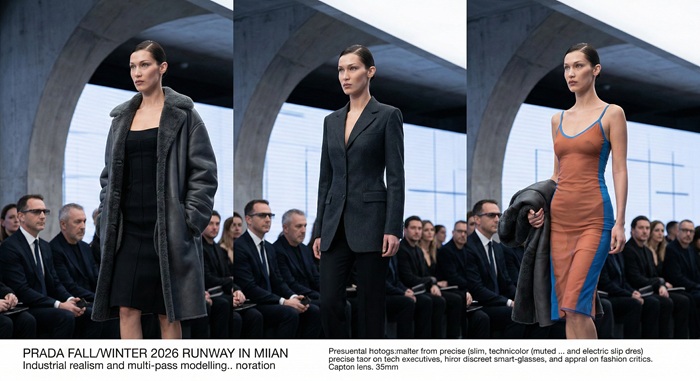
At the core of the week’s discourse was the Prada show, where co-creative directors Miuccia Prada and Raf Simons addressed the "complexities of a woman’s life" through a hyper-edited lens. In a revolutionary move for a major house, the show utilized a cast of only 15 models, including a triumphant Bella Hadid, who each completed four distinct laps. On each pass, models methodically shed layers, transforming a heavy, oversized shearling coat into a sharp blazer, and finally into a delicate, technicolor slip dress. This "layered realism" was a direct response to a retail environment where versatility is the ultimate luxury; the modern client demands an investment piece that can navigate a 16-hour day. The front-row presence of Meta CEO Mark Zuckerberg further fueled rumors of a "tech-luxe" collision, with insiders whispering about an upcoming Prada-integrated smart-glass collaboration with EssilorLuxottica.
The ‘Senseless’ Sex Appeal: Gucci’s high-stakes hype shift
While Prada leaned into intellectualism, the atmosphere at Gucci was electric with the debut of Demna’s first physical runway for the house. Departing from the "quiet luxury" and archival restraint of the previous era, Demna unleashed what critics called an "unapologetically emotional" and "senselessly sexy" vision. The collection was a high-octane blend of Tom Ford-era provocation and Demna’s signature subversion: skin-tight white sheath dresses, distressed denim, and neon-trimmed leathers that moved with an aggressive, old-school runway strut. Strategically, this is a calculated gamble by parent company Kering. By leaning into shock-value and viral "hype" silhouettes, Gucci aims to recapture the attention of the Gen-Z demographic in the lagging APAC region, moving away from safe, commercial basics toward high-impact, conversation-starting fashion.
The €1.4 Billion Reset: Industrializing craft and the Versace myth
Perhaps the most significant business development of the week was the strategic repositioning of Versace following its €1.38 billion acquisition by the Prada Group. Bypassing the traditional runway spectacle for an intimate "apartment" setting, the brand signaled a sharp turn toward grounded, sensual luxury. Under the executive oversight of Lorenzo Bertelli and design lead Dario Vitale, the brand is undergoing a "Prada-fication", an industrialization of craft that moves production to the group’s state-of-the-art Scandicci factory. The focus has shifted from loud logos to "hourglass" tailoring and artisanal construction. This move aims to stabilize Versace’s margins by reducing SKU counts by 15% and exiting low-tier wholesale accounts, focusing instead on high-margin core categories like footwear and structured handbags.
Institutional Resilience: Chiuri’s Fendi and the digital mandate
The institutional weight of MFW was anchored by Maria Grazia Chiuri’s homecoming debut at Fendi. Her "personal geography" collection focused on "less I, more us," emphasizing collective authorship and Roman craftsmanship. While her parade of austere black lace and Art Nouveau-inspired silhouettes was noted for its restraint, the business-critical move was her introduction of a "fur-upcycling" program, a pragmatic response to sustainability pressures. Across the board, Milanese houses are now accelerating the adoption of Digital Product Passports (DPPs). With over 70 million items registered via the Aura Blockchain Consortium, 2026 marks the year that traceability became a retail non-negotiable. As the industry moves toward "agentic commerce", where AI assistants help match personal style to purchase,Milan has proven that its future lies in the marriage of historical soul and industrial precision.
The evolution of Versace under Prada Group
The Prada Group is treating the Versace acquisition as a "high-growth turnaround" project. By centralizing leather goods production and leveraging Prada’s superior manufacturing "know-how," the group is shifting Versace away from a volume-driven model. The strategy focuses on "retention excellence," targeting a 10% boost in consolidated group revenue by 2027 by emphasizing full-price retail sell-through and high-margin artisanal accessories over discounted logo-wear.