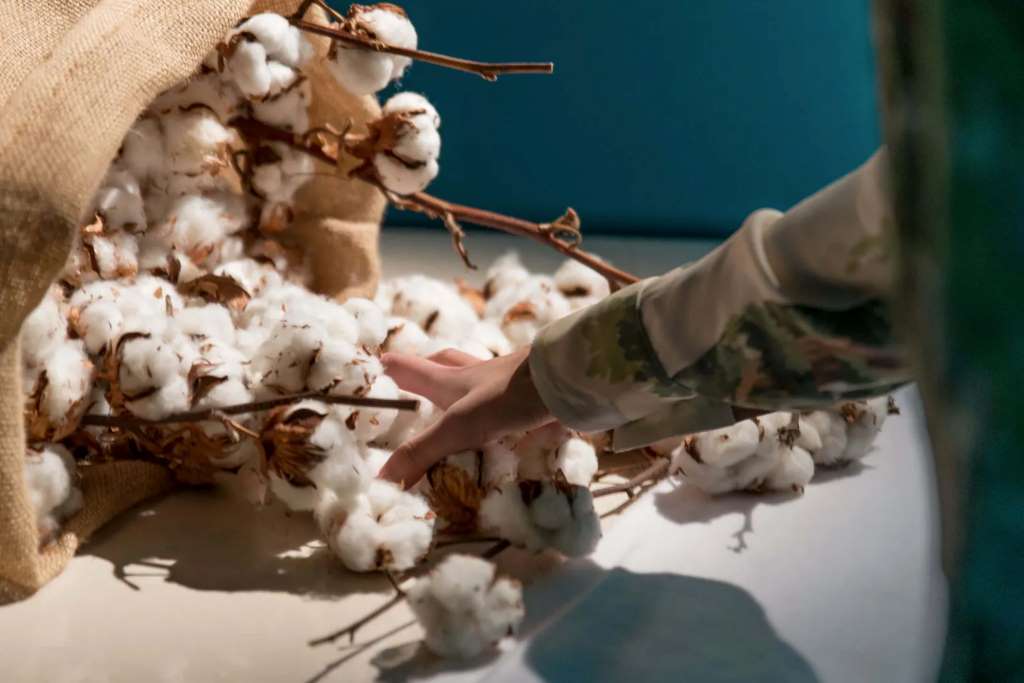
An incubation center in Tirupur is promoting production of banana-silk clothing. India happens to be the largest banana producer in the world. Banana fiber was primarily used for making ropes, mats, and some other composite materials. With increasing environmental awareness, and the growing importance of eco-friendly fabrics, the banana fiber is finding application in other fields such as garments and home furnishings. Banana cultivation in a 1000 acre plantation is capable of generating revenue of Rs 16 crores if the fiber is extracted on a large scale and utilized for clothing. Rugs made from banana silk yarn fibers are popular the world over. Banana fiber is also used to make cushion covers, neckties, bags, table cloths, curtains etc. In Japan, it has long been used for making traditional dresses like the kimono. It’s lightweight and comfortable to wear, and is preferred by people in Japan as summer wear.
In fact, Khadi and Village Industries Commission (KVIC) is promoting the use of banana fiber for making handmade paper bags, statues, pen stands and garments. Once the fabrics match the three categories of fineness, softness and durability, fine, soft and durable yarn will be extracted from banana leaves and stitched into clothes.
- 1
- 2
- 3
- 4
- 5
- 6
- 7
- 8
- 9
- 10
The £7 Billion Question: Who pays for fashion’s ‘free rental’ habit?
The global fashion industry is facing an uncomfortable paradox: its most valuable customers may also be its most destructive. A... Read more
India, China Bangladesh face fresh headwinds as global apparel markets rebalance
Global apparel trade is entering a more uneven recovery phase, with demand growth persisting but losing uniform momentum across major... Read more
Global cotton enters a deficit year in 2026 as supply drop meets logistics risk
The global cotton economy has entered a fragile and sensitive phase. Early projections for the 2026-27 season suggest that world... Read more
India’s textile trade gets a Pacific push as New Zealand FTA removes tariff barr…
India and New Zealand have inked a ‘once-in-a-generation’ Free Trade Agreement (FTA), one that will have a profound impact on... Read more
Lululemon’s world-first nylon circularity push signals a new apparel arms race
The global apparel industry’s circularity narrative is entering a more technically demanding phase. Polyester recycling once the flagship of sustainable... Read more
Beyond the DTC Rush: Levi’s hybrid channel strategy sets a new retail benchmark
The global apparel sector is entering a phase where channel strategy is no longer a tactical lever but a core... Read more
The New Rules of Resale: EPR turning secondhand into fashion’s strategic growth …
The global fashion industry is facing a decisive regulatory and commercial reset. What began as a sustainability narrative around reuse... Read more
The 2027 Mandate: Why denim’s future hinges on verifiable data
For decades, the global denim industry has relied on a narrative of durability, heritage, and authenticity. That narrative is now... Read more
Europe’s textile core unravels as costs, imports and policy pressure bite
Europe’s textile and apparel sector, long seen as a benchmark for craftsmanship and industrial depth, is slipping into a prolonged... Read more
Automation, innovation, regulation are the forces shaping textiles in 2026
The global textile sector has entered a new era. Early 2026 saw the industry breach a $1.06 trillion valuation, reflecting... Read more