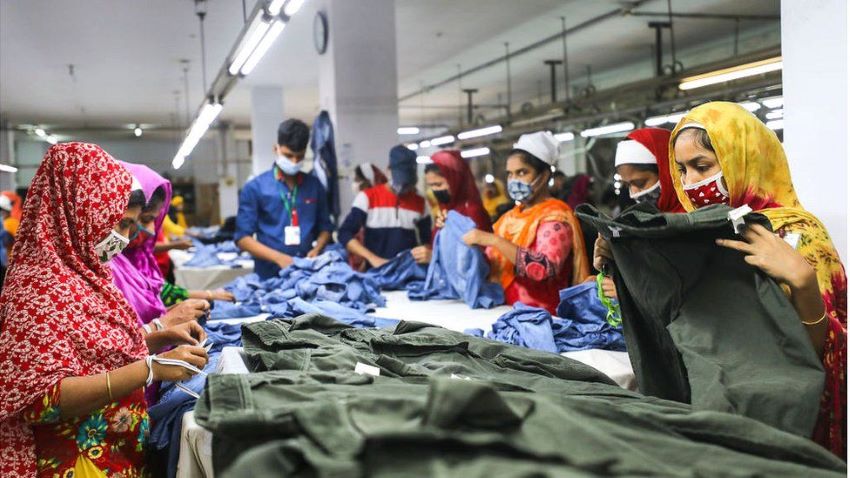
More than a third of all microplastics released into the oceans are from synthetic textiles used in the fashion industry, according to a new report. Each time an item of clothing is washed, up to 7,00,000 microscopic fibers make their way into oceans, where they are swallowed by sea life and become incorporated into the food chain, potentially ending up on dinner plates says a study by The Institution of Mechanical Engineers. Garment aftercare affects an item’s carbon footprint. A way out is for individuals to wash their clothes at a lower temperature, use mesh laundry bags to catch threads, rely on tumble dryers less often or install filters on washing machine waste pipes. Research by the International Union for the Conservation of Nature (IUCN), cited in the report, calculated that 34.8 per cent of releases of microplastics in the oceans are due to the laundry of synthetic textiles.
Fashion is a thirsty industry, one that contributes significantly to water pollution globally. It also is energy-intensive, producing 1.2 billion tons of Co2 equivalent– more emissions than international flights and maritime shipping combined. Annual growth in global demand for clothing is projected to increase from 1.5 per cent in 2016 to between 3.5 and 4.5 per cent by the end of 2018 and is likely to continue to grow, according to McKinsey & Company released earlier this year..
Urgent action needs to be taken to tackle the waste produced over the lifecycle of an item of clothing. This includes addressing water-intensive processes during manufacturing, such as removing excess dyes, and tackling the problem of disposing of a garment at the end of its life. Three-fifths of all clothing produced is sent to landfill or incinerated within a year of being made.
The garment industry is one of many industries that has a threefold impact with emissions to air, water, and large amounts of waste produced for landfill and incineration.
- 1
- 2
- 3
- 4
- 5
- 6
- 7
- 8
- 9
- 10
Industrial automation and AI take center stage at Garment Technology Expo (GTE) …
The conclusion of the 39th Garment Technology Expo (GTE 2026) in Greater Noida has signalled a decisive shift in South... Read more
The End of Geographic Masking: Shein and peers reclaim Made in China as a strate…
The era of the corporate ghost is ending. For years, the world’s most aggressive retail disruptors operated under ambiguity, relocating... Read more
$120 Crude, Zero Margin: How India’s textile hubs are paying the price
For India’s textile clusters, the current West Asia crisis is no longer a distant geopolitical headline. In Surat’s polyester corridors... Read more
Luxury under pressure as stagflation and geopolitics redefine the winners’ circl…
The 2025 earnings for Europe’s listed luxury majors have delivered a verdict that has far more implications than the prevailing... Read more
Luxury resale goes global, sneakers, handbags, archival fashion redrawing border…
The luxury resale market in 2026 is no longer a monolithic global block. According to the RB Insights January 2026... Read more
China out but can India deliver? The realities of the global sourcing shift
With the US imposing a flat 15 per cent tariff on Chinese imports under Section 122 as of February 2026,... Read more
Luxury in Retreat: Why the aspirational consumer is gone for good
The global luxury industry is confronting an unprecedented situation. The active consumer base, which peaked at 400 million in 2022,... Read more
The Invisible Bleed: How a single chemical is slowing India’s apparel machine
The global fashion industry has spent the better part of the past two years obsessing over visible disruptions viz. volatile... Read more
The Closet Paradox: How ‘nothing to wear’ is driving global overconsumption
In an era of overflowing wardrobes and instant fashion gratification, a striking paradox has emerged: the more clothes we own,... Read more
US trade rulings and labor slowdown reshape 2026 cotton supply chains
The global cotton industry is entering a period of adjustment, shaped by legal rulings, trade policy recalibrations, and a softening... Read more