FW
Global footwear market growing at three per cent
The global footwear market is expanding at a CAGR of 3.1 per cent between 2018 and 2026. Shoe knitting technology is becoming widespread. This contributes to less waste and reduced labor costs, and also lends itself to customization and speed to market.
The ongoing digitization of the creation process, such as the use of advanced CAD programs, will also gain momentum in 2019. Digitization allows for access to better materials and is also a way to create sample shoes without actually having to go to a factory and build them. Digital resolutions are now extremely high, making it easy to see complex design details, and the use of 3-D printing means that a brand can print a single shoe in multiple color ways, thus saving time and money in the selection process.
The use of sustainable and recycled materials and eco-friendly manufacturing processes is a top priority. Brands are reducing waste in supply chains and at the factory and using materials that are sustainable. Part of this involves things like transforming the operations process. The other part requires companies to consider making adjustments in production and considering how they could reuse or sell waste instead of discarding it.
Fitch upgrades Levi’s long term issuer default rating
Credits ratings firm Fitch Ratings has upgraded Levi Strauss & Co.‘s long term issuer default rating. The upgrade has the rating now at “BB+” from “BB.” The upgrade recognises Levi’s stable performance, with accelerating growth in revenue and EBITDA (earnings before interest, taxes, depreciation and amortisation) in 2018, as well a meaningful cash flow generation.
As David Silverman, the primary analyst wrote the upgrade report, Levi’s top-line has accelerated, with 8 per cent revenue growth in fiscal 2017, ended November 2017, and 11 percent growth expected in fiscal 2018. The company’s merchandising and branding efforts are bearing fruit, with strong growth across categories and geographies. Levi’s offering are trendsetting and the company is successfully exploiting opportunities to capitalize on this momentum through new product assortments, brand and celebrity collaborations, and square-footage expansion.
H&M Q4 net sales increase 12 per cent
H&M’s fourth quarter net sales rose y 12 per cent to SEK 56.4 billion. Its online sales rose by 24 per cent in SEK. Gross profit in the quarter reached SEK 30.6 billion, with a gross margin of 54.2 per cent, as the cost of markdowns declined by 0.6 percentage points. Quarterly profit after financial items declined 11 per cent to SEK 4.35 billion.
For the full year, net sales increased 5 per cent to SEK 210.4 billion, with sales and market share rising in most markets during the second half, the company also said. Its online sales increased by 22 per cent to about SEK 30 billion, reaching 14.5 percent of total sales. Gross profit for 2018 was SEK 110.9 billion as gross margin reached 52.7 per cent. Profit after financial items was SEK 15.6 billion and profit after tax was SEK 12.65 billion.
The company plans 175 new stores in 2019, with about 335 new stores opening, of which 240 will be H&M stores, with a focus on growth markets.
Mixed reactions for the interim budget from Surat textile industry
The interim budget garnered mixed response from textile Surat industry. While the one-time tax rebate for those with a taxable income of up to Rs 5 lakh annually and the businesses with annual turnover less than Rs 5 crore being allowed to file quarterly GST returns has been welcomed by the industry, the absence of any announcements regarding Input Tax Credit has left them waiting for the next GST council meeting. Manoj Agrawal, President of the Federation of Surat Textile Traders Association (FOSSTA), expressed his disappointment over the lack of subsidy or schemes for garment package.
Pakistan: Government grants Rs 29 bn bailout package to textile industry
The Pakistan Tehreek-e-Insaf (PTI) government has given another bailout package worth Rs29 billion to the textile tycoons by waiving taxes and duties on the import of cotton. The government is offering support to industrial barons, who have got billions of rupees worth of incentive packages. They are now receiving gas and electricity at discounted tariffs. The government also recently approved a Rs25-billion gas subsidy for five zero-rated export-focused industries where textile giants are the major beneficiaries.
Another support package for textile manufacturers has been announced by waiving 50 per cent of the outstanding Gas Infrastructure Development Cess (GIDC), which amounts to Rs 40 billion. The textile industry will pay a total of Rs80 billion in GIDC arrears. With the scrapping of taxes and duties on cotton import, the government would lose Rs 14.6 billion in customs duty, Rs 6.9 billion in additional customs duty and Rs7.7 billion in sales tax.
Despite getting such incentive packages, textile exports from Pakistan to the global market have not increased significantly as Bangladesh exporters are eating into the share of their Pakistani counterparts.
World cotton stocks to drop 5 per cent
Cotton stocks across the world are projected to drop to 17.6 million ton by 2018-19 end, reflecting a decrease of 5 per cent from the prior year and registering the fourth straight year of decline. Consumption is expected to remain steady but production will decline by 3 per cent. Cotton production in China is expected to increase by 1 per cent to 5.94 million ton, and when combined with a 7 per cent decline in India’s production due to insufficient rainfall, China will regain the ‘top producer’ title it lost to India in the 2015/16 season.
Although cotton prices have come under pressure, current projections for global consumption are unchanged at 26.8 million ton with production projected to be slightly lower at 25.9 million tons. Cotton prices are feeling the effects of uncertainty related to the global economic environment, as opposed to the impact of trade barriers. Price fundamentals still look solid, as reflected in the price forecast.
Interim Budget 2019: Mixed reactions from Coimbatore textile belt
Response in the western region of Coimbatore to the Interim budget 2019 was a mix of elation and disappointment. While knitwear and garment industry broadly hailed the interim budgetary, small scale manufacturers expressed disappointment over few measures to boost industrial activity.
Raja M Shanmugham, President, Tirupur Exporters Association (TEA), welcomed the the announcement of Rs 6,000 per annum to the Small and Marginal farmers and increasing the income tax exemption limit from Rs 2.5 lakh to Rs 5 lakh to individuals, and a monthly pension for unorganised sector workers are considered as better measures. He, however, urged the centre to allocate adequate funds for textile and knitwear sectors.
K V Srinivasan, Chairman, The Cotton Textiles Export Promotion Council (Texprocil) termed the budget growth oriented. He feels, hike in the taxable income threshold, increase in standard deduction to Rs 50,000 are measures that would leave more disposable income with the salaried class, leading to higher consumption including textiles. He urged the inclusion of cotton yarn and fabrics under ROSL scheme.
V Lakshminarayanasamy, President, Indian Chamber of Commerce and Industry, Coimbatore hailed the budget's focus on two major points: farmers and general tax payers.
Interim Budget 2019-20: Outlay for textile sector reduced, optimism about higher IT exemptions
"Textile industry welcomed the Interim Budget 2019-20 announced by the Finance Minister, Piyush Goyal. Sanjay Jain, Chairman, CITI feels the budget will give a major impetus to the textile and apparel consumption in India by increasing the purchasing power of middle class and farmers. He feels, the announcements highlight the commitments of the present government to improve overall socio-economic condition of the country by touching upon the healthcare sector, infrastructure, ease of doing business, more beneficial schemes for low income strata of the society by enhancing their purchasing power, protecting them through pension scheme, minimum income through MGNREGA, etc."
 Textile industry welcomed the Interim Budget 2019-20 announced by the Finance Minister, Piyush Goyal. Sanjay Jain, Chairman, CITI feels the budget will give a major impetus to the textile and apparel consumption in India by increasing the purchasing power of middle class and farmers. He feels, the announcements highlight the commitments of the present government to improve overall socio-economic condition of the country by touching upon the healthcare sector, infrastructure, ease of doing business, more beneficial schemes for low income strata of the society by enhancing their purchasing power, protecting them through pension scheme, minimum income through MGNREGA, etc.
Goyal said the 2 per cent interest subvention for Micro, Small and Medium Enterprises (MSMEs) loans with a ticket size of Rs 1 crore will give a thrust to MSMEs to boost employment and economic growth. A few banks exiting PCA, relaxation for MSMEs on funding and interest rates will benefit 80 per cent of the textile and clothing industry which falls under MSMEs.
Textile sector outlay reduced
The outlay for textile sector has been reduced from Rs 6943.26 crores to 5,831.48 crore. The Budget allocation for A-TUFS has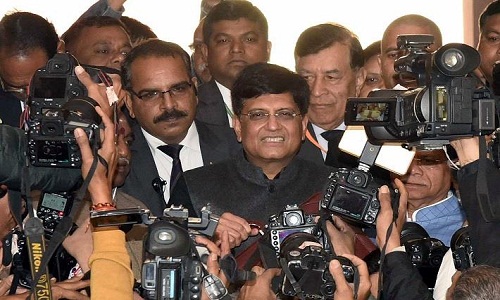 been decreased from Rs. 2, 300 crore to Rs. 700 crores. The Budget for ROSL has also been reduced significantly which is a cause for great worry to the industry as this could lead to working capital blockages and delay in ROSL receipts. Further the industry has been expecting upward revision in ROSL rates which would need more funds.
Procurement of Cotton by CCI under Price Support Scheme has increased from Rs 924 crore to Rs. 2018 crore. Allocation for Central Silk Board has also been increased, which is a welcome step by the Government.
Rahul Mehta, President, CMAI, welcomed the proposals of increasing tax exemptions limit and income support scheme. He believes, this will increase consumption and spending among the middle class and rural India.
Budget to benefit handloom weavers, MSME workers
P Nataraj, Chairman, The Southern India Mills’ Association (SIMA) hailed the announcement of Rs 6,000per year for farmers having below two hectares of land under Prathan Mandri Kisan Samman Nidhi Programme. He also welcomed the pension scheme for the workers in the unorganised sector enabling them to receive Rs 3,000 per month as pension after attaining 60 years as the textile industry is predominantly in the unorganised sector. According to him, the scheme would largely benefit handloom weavers and powerlooms and also the workers of several other small, micro units from other segments of the industry.
The decision of doubling the income tax exemption limit from Rs 2.5 lakh per annum to Rs 5 lakh per annum apart from enhancing the standard deduction limit from Rs 40,000 to Rs 50,000 was also approved by Nataraj as it would benefit several lakh middle class employees in the textile industry.
A boon for retailers
Krish Iyer, President and CEO of Walmart India feels the Budget gives huge resources in the hands of people. As it focuses on fiscal consolidation, it will bridge the divide between India and Bharat. Kunal Bahl, CEO & Co-founder of Snapdeal welcomed tax exemption upto Rs 5 lakh income as it will increase consumption, both through online and offline retail.
Fashion for Good to include Reformation in its new collection
Reformation will be one of six sustainable brands to be included in Fashion for Good’s new capsule collection focused on transparent brands, called “Naked.” Reformation launched denim in 2017. The brand uses dead stock and surplus denim fabrics, as well as new fabrications with sustainable fibers like Tencel Lyocell for its women’s jeans collection. Along with public tours of its LA facility, the brand provides a transparent view of its production through open progress reports and RefScale, which measures how much carbon dioxide, water and waste is saved by purchasing a Reformation garment.
The Amsterdam-based interactive museum is the first dedicated to sustainable fashion innovation. The carefully curated selection of brands—Reformation, A.BCH, Allbirds, ASKET, la fille d’O and Swedish Stockings—will be featured in the museum’s contemporary retail space. Some of these brands are exclusively sold at Fashion for Good, including Reformation, sneaker brand Allbirds and circular fashion label A.BCH, which are making their Netherlands debut.
India: Leading knitwear exporting centre, Tirupur wants knitwear board
Tirupur hopes to be the headquarters of a board for knitwear. This is expected to help in getting on-ground inputs about what is going on in the industry and would aid in the development of all stakeholders. Exporters also want relaxed credit and loan mechanisms.
Apart from these two major concerns, the Tirupur garment sector has also been pressing for the establishment of labor-supportive infrastructure such as housing colonies and a research and development park. Decent housing for migrant labor is expected to help them focus on the work and also attract more people from all corners of the country. Since two-thirds of the industry consists of small and medium scale units, which cannot afford to have their own research wing, it would make them competitive if there is a central pool of R&D talents from which they can pay and take designs from.
Tirupur, India’s leading exporter of knitwear, contributes around 50 per cent of the country’s knitwear exports. Around 20,000 production units – including micro, small and medium scale enterprises – function in Tirupur, employing nearly seven lakh people directly. However, an industrial cluster that was once growing at 20 per cent saw negative growth in 2017 for the first time in a decade due to demonetization and the roll out of GST.