FW

The textile industry is an immensely global value chain that has a great impact on every country in the world either directly or indirectly. For example, solid waste problem generated mainly in the west from the ‘Fast Fashion’ trend has created a demand of establishing ‘Circular Fashion’ and the whole textile world is likely to feel the corresponding changes. The advent of ‘Industry 4.0’ and its impact also will not only be confined in its developers mainly the European country.
 So whether it is a problem or an innovation, everything has to be shared globally in the age of globalization. So, the global platforms are very important which are setting the trends and changing businesses of the future. In addition, whether it is sustainability or anything else, all the stakeholders in the textile industry are looking forward to ITMA 2019 to be held in Barcelona, Spain.
ITMA has been called, as the Olympic of textile machinery is the world’s most important textile and garment machinery exhibition since 1951. It has been a catalyst for changing and competitiveness for the industry over the years. This time the exhibition will be held from 20 to 26 June 2019 at Fira de Barcelona, Gran Via venue where over 1,600 exhibitors will exhibit their latest technologies and sustainable solutions.
Why sustainability is the center focus
In recent time, sustainability issues are getting priority in all aspects of the textile and apparel industry. The drive towards sustainability in the entire textile and garment value chain is increasingly integrated with enlightened business practices, and innovative technology holds the key to environmental sustainability.
Sustainability to-do is not only about reducing economic, environmental and social risks it also means to integrate things in a single objective for living a better life. Thanks to the latest developments in science and engineering and more in data processing, communication and digital integration of concepts and processes which are giving industries a complete change. In addition, the next generation textile industry is going to be completely different because of below-mentioned technologies. Everything, which not even we can imagine, is to be showcased in ITMA 2019.
ITMA to set new trends
Industry 4.0
Innovation is vital for the textile and apparel industry’s success as Industry 4.0 gains momentum in the manufacturing world. The use of artificial intelligence, processing of big data and connecting the dots together in quick and fast decision-making would be the key changes in the industry.
Companies will shift towards open innovation and so will result in the increased exchange of knowledge and new types of cooperation among educational institutions, research organizations, and business.
And so technology providers are ready to showcase their latest developments in integrating the concept of Industry 4.0 and presenting the outlook of next-generation machinery. All are likely to break the earth in ITMA 2019.
Maria Ludovica Murazzani, Commercial Consul of Italy in Shanghai recently has told that the Italian government has set up a clear vision for Industry 4.0 and Italian companies are making significant progress in this by the legal and others support from the Italian government. Alessandro Zucchi President, ACIMIT further confirmed it and declared that many of those amazing developments will be showcased for the first time in upcoming ITMA 2019 to be held in Barcelona. Companies from Germany, Switzerland, and the UK will not fall short as well.
Digitalization & Automation
Every company’s solution need to complete in a digital way, which aims to maximize profits while achieving zero inventory loss, zero leftover stock, and zero, lost sales opportunity and most importantly zero waste through smart, speedy and sustainable production. Without automation and integral decision making it won’t be possible.
Machinery companies are continuously working on bringing new featured machinery making things digitalized connected through smart devices. They will be showcasing the latest technology for better productivity to cope up with fast fashion trends as automation can offer cost reduction and value-addition in garments products.
Automation, especially in an integrated textile and garment manufacturing chain, will help address the fashion and clothing industry’s current concerns of short production cycles and sustainable business practices, according to CEMATEX, the European Committee of Textile Machinery Manufacturers.
What is new in ITMA 2019?
ITMA innovation lab is the main attraction of the people aims at driving industry focus on technological research and development. Innovation Lab will provide an opportunity to connect and exchange ideas with a truly international gathering of expert researchers and academics who are involved in a vast range of textile-related projects.
ITMA 2015 a remarkable number of global visitors turned up Figure 2: At ITMA 2015, a remarkable number of global visitors turned up for textile solutions. Christine Karin Schmidt, Chair of the CEMATEX working group of the ITMA Innovation Lab, and Technical Director of VDMA Textile Machinery Association explained, “There is much more to be discovered at the ITMA Innovation Lab. The Innovation Video Showcase will spotlight the most groundbreaking exhibits at ITMA 2019.
“By presenting these latest innovations in a video format at the Speakers Platform, CEMATEX aims to further promote excellence in R&D and make the Innovation Lab a hotspot that will inspire visitors from all sectors of the textile and apparel making industry.”
Automation and Industry 4.0 are one of the key focus areas in Europe, and Germany’s Institutes of Textile and Fibre Research Denkendorf (DITF), for example, has recently been involved in the multi-company co-ordination of digital textile micro-factories. These have involved fully automated and interlinked textile production lines for ‘make on demand’ products – from design through to the finished and printed garment.
Many major textile institutions from across Europe, organizations will also be present at the show from North and South America, Asia and Australia. Adding to the vibrancy of the area will be a number of first-time participants, such as Fundació Eurecat, Leitat Technological Centre, Manchester Metropolitan University, Mittelstand 4.0-Kompetenzzentrum Textil Vernetzt, Thomas Jefferson University, and Universidad De Buenos Aires’ Fadu, Cátedra Nirino Diseño Textil.
Within Europe, some key research trends in individual countries are notable, even as the European Union’s comprehensive research programs strive towards encouraging co-operative projects across borders.
In both France and Germany, for example, there is a strong emphasis on the further development of textile technologies for the composites industry, backed by major end-user organizations such as Airbus, as well as car brands such as BMW, Daimler, Peugeot-Citroen, Renault and Volkswagen.
Reinforcements for composites involve a wide range of technologies, which will be displayed at ITMA 2019, including weaving and knitting, as well as nonwovens manufacturing, embroidery and braiding.
One nerve center for developments in this area is RWTH Aachen University, where more than 20 university institutes focus on state-of-the-art production techniques and are cooperating with machinery makers, robotics companies and software developers to make manufacturing processes efficient enough to allow high-wage countries such as France and Germany to compete on a global level.
Another intriguing development from a German research institute is the Fibre Dynamics Simulation Tool (FIDYST), which makes it possible to simulate the movement of fibers in turbulent air currents for the first time. This was developed at the Fraunhofer Institute for Industrial Mathematics, another R&I Pavilion participant, and will have a very positive effect on the process planning of nonwoven manufacturers.
"As per the US Bureau of Labor Statistics, retail apparel prices, following months of rise, fell to a seasonally adjusted 0.9 per cent in November. The prices, compared to year earlier, declined by around 0.4 per cent. Now some of these retailers expect prices to increase as cotton prices spiked by $1 per pound in June only to level off at around a current 75 cents a pound. According to Cotton Incorporated, average import prices for cotton-dominant apparel increased 0.9 per cent month-over-month in October. Year-over-year, cotton-dominant apparel import prices were 2.7 percent higher."
 As per the US Bureau of Labor Statistics, retail apparel prices, following months of rise, fell to a seasonally adjusted 0.9 per cent in November. The prices, compared to year earlier, declined by around 0.4 per cent. Now some of these retailers expect prices to increase as cotton prices spiked by $1 per pound in June only to level off at around a current 75 cents a pound. According to Cotton Incorporated, average import prices for cotton-dominant apparel increased 0.9 per cent month-over-month in October. Year-over-year, cotton-dominant apparel import prices were 2.7 percent higher.
Glenn J Chamandy, President and CEO, Gildan Activewear, recently said that cotton and polyester prices have gone up during the year, as have other costs across the supply chain. Gerald W Evans Jr, CEO, Hanesbrands, also instituted price increases of around 4 to 5 per cent in its innerwear business due to higher raw material costs.
Labor and other cost inflation causes concern
As per Moody’s Investor Services, apparel companies face input cost inflation from labor and cotton. However, it’s the US- China trade war and threats of stiff tariffs on the industry that poses the biggest dilemma. The uncertainty has already caused importers to make major changes in their sourcing strategies, while increases labor and other costs in Asia and elsewhere have made it more challenging than ever to chase the cheapest needle.
Tariff rise to be a long-term trend
A tariff survey by Purchasing Manager’s Index, IHS Markit revealed that the US manufacturers expect tariffs to increase prices over the next two years. In the survey, conducted in second half of October, 44 per cent respondents expect tariffs and trade wars to lead to higher domestic prices for their goods in the US over the next two years.
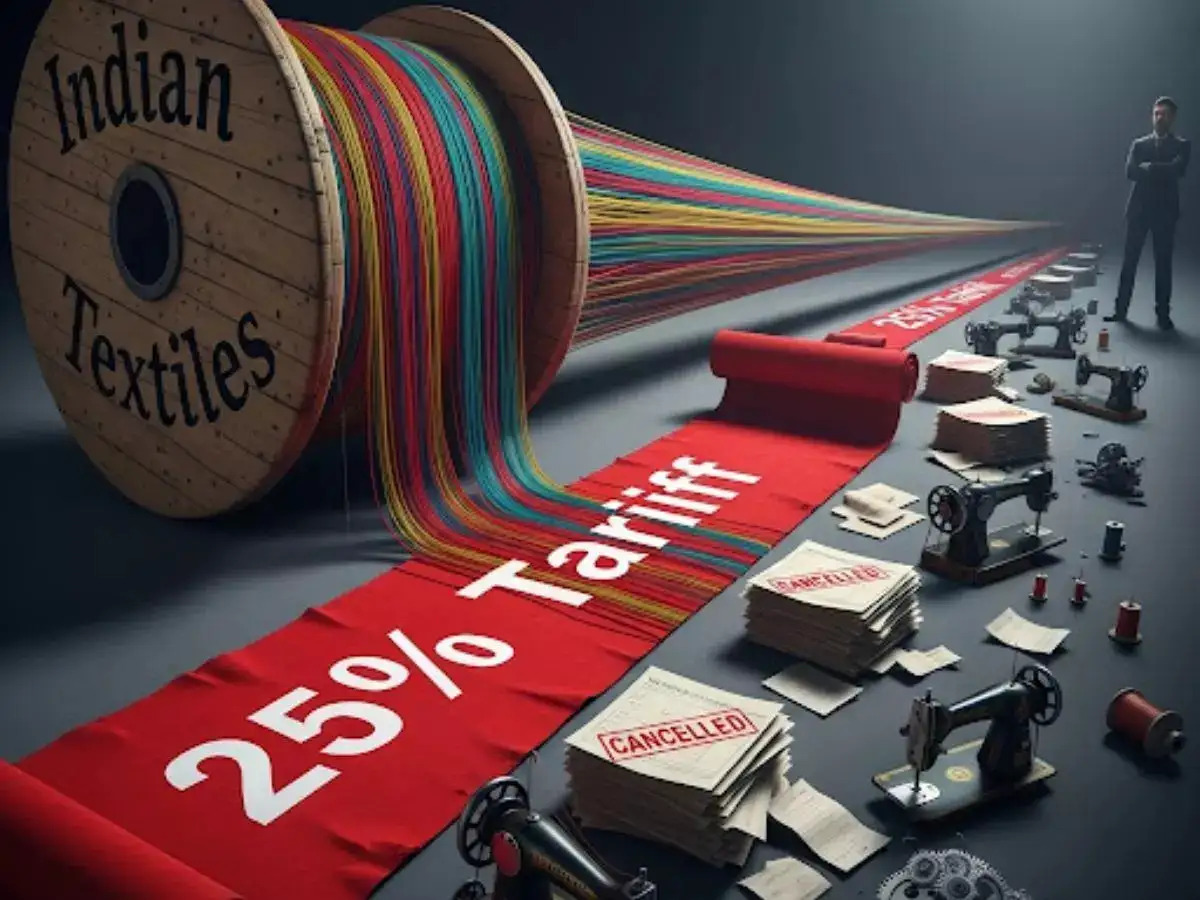
Nicole Bivens Collinson, President of International Trade and Government Relations at Sandler, Travis & Rosenberg sees the tariffs and their threat as a long-term, multiyear trend. The results will be an overall rise in global prices. President Trump first imposed $50 billion worth of tariffs aimed at China that left the apparel industry largely unscathed. The next 10 per cent tranche came in the form of an additional $200 billion in tariffs, hitting certain apparel items, some leather, and hats and handbags. Now a threatened 25 per cent tariff–first set for January but postponed for 90 days–would likely hit apparel, textiles and footwear.
Fear leads to the inevitable
Fear is an important factor that will lead to price rise, believes Rick Helfenbein, President and CEO of the American Apparel & Footwear Association. The retailers, even with all the leverage they have will not be able to avoid increase in prices. They may force some of it back to their vendors—and that would be part of the natural process—and vendors will try to force some of it back to their factories. At the end of the day, there will be an increase in prices.
Bangladesh has the opening for fresh investment in woven fabrics production. Currently, local spinners can supply 85 per cent of the raw materials to the export-oriented knitwear sector and 35 per cent to 40 per cent to the woven sector.
There is scope for investments in the primary textile sector over the next five years as demand for locally made fabrics has been rising in both domestic and international markets. Bangladesh garment makers use 12 billion meters of fabrics a year for making export-oriented garment items. Of the quantity, domestic weavers can supply three billion meters of fabrics, with the rest imported from India and China.
If local weavers can supply 60 per cent of the requirement for woven fabrics in the next five years, that will reduce the dependence on imports. In the last one year, entrepreneurs set up 19 spinning mills, 23 fabrics mills and two dyeing printing mills. The main impediments for the sector are land and energy. Supply of energy and industrial land at a reasonable price can encourage spinners and weavers to invest in the sector.
The listed textile mills have been unable to give dividends for years mainly due to higher bank interest rate, high energy prices and other operational costs.
London Fashion Week Men’s revealed bold menswear styles for Fall ’19. The event showcased racing motifs, athletic apparel logos, hooded sweatshirts, mock or turtle neck tops and sling bags. Destroyed knits, statement scarves and silver chains with charms (worn over high neck tops) added newness to the show which displayed 90’s inspired looks.
The men’s and women’s accessories were electrified with neon green and pink. The colors—found on everything from sneakers, fanny packs and socks, to nail color, hair color and eye glass lenses—were the exclamation point to all-black ensembles and après ski-inspired sets.
Puffer coats were emboldened with high-shine silver fabrics, colorful patchwork and lacquer-like color. Likewise, jeans were coated with splashes of multi-colored paint. Color denim made a statement worn head-to-toe.
Jeans, track pants and non-denim woven bottoms were worn loose and baggy. Straight cuts were hemmed or cuffed at ankle-grazing lengths. Chunky sneakers, in white or bold licks of color, remain the shoe of choice. Others wore a low heel, pointed-toe cowboy boot silhouette—a shoe that took on opposite personalities in slouchy brown suede and black patent.
The 5th session of Spinexpo, a trade fair dedicated to promoting innovation in the yarn, fibre and knitwear industry, will present a preview of its collections and color ranges for the Spring/Summer 2020 season from January 16 to 17, 2019.
Spinexpo Paris is the European branch of Spinexpo Shanghai, which has been active in China for more than 20 years, gathering together flagship spinning mills and manufacturers of knitwear globally. The exhibition is aimed at brands with a knitwear division, manufacturers of flat and circular knitwear, weavers, sporting goods manufacturers, hand knitting wool distributors and all users of yarns and knitwear.
For the Spring/Summer 2020 season, HUBO has organised its collection into five separate parts. © Spinexpo. New printing techniques are emerging, some of which are based on bacteria, and Spinexpo is closely monitoring all these initiatives. This theme promotes natural fibres, with vegetable dyes or used without dyes, discoveries from the field of medicine, and techniques from traditional crafts.
Buyers have started paying attention and are calling for organic cotton, recycled cotton, silk and linen. In taking this demand into account, HUBO had developed a series of new yarns combining Ecovero viscose, Refibra fibre, Tencel and recycled polyester. HUBO is certified Oeko-Tex Standard 100, the Higg Index, Global Recycle Standard (GRS) and Organic Content Standard (OCS). The spinning mill is also a member of the Better Cotton Initiative (BCI).
H&M is the world’s second-largest apparel retailer has improved its purchasing practices by excluding labor costs from price negotiations in support of fair wages. In July, H&M implemented a new wage management system, aimed at better work environments and fair wages at 500 supplier factories representing 50 per cent of its product volume.
H&M plans to create a new mind-set both at its supplier factories and within its own operations. In 2013, the company determined that its strategic suppliers should have pay structures in place to pay a fair living wage by 2018. This was expected to reach around 8,50,000 textile workers in 750 factories, or about 60 per cent of its global garment workforce.
But labor groups say H&M has watered down its initial commitment by trading one measurable target (the 8,50,000 workers) for something less determinate (improving wage-management systems.)
A wave of actions against poverty wages has hit H&M’s largest markets and production locations. There have been street actions and online campaigning in Austria, Belgium, Cambodia, Croatia, India among others.
Member nations of the Regional Comprehensive Economic Partnership are eager to get it up and running. RCEP encompasses China, Japan, South Korea, India, Australia, New Zealand and the ten members of the Association of Southeast Asian Nations. Negotiations for the trade deal began in 2013. If realized, RCEP would cover half the world's population and about 30 per cent of global trade.
Negotiations have not gone smoothly, however. A wide gap remains between nations seeking substantial free trade, including Australia and Japan, and those cautious about opening markets rapidly, such as China and India. Progress has been made in some areas. For example, Japan and China are close to an agreement on tariffs. About 90 per cent of products are expected to be tariff free.
But India is hesitant to eliminate tariffs which may lead to an influx of Chinese goods, causing its trade deficit to balloon. Domestic industry and even certain ministries, including steel, have been critical of the RCEP deal and fear dumping, especially by China.
China is the biggest contributor to India’s trade deficit with all RCEP partners. The scrapping of tariff lines means import duties on specified items would be cut to zero over a mutually agreed-upon time frame.
Gartex will be held in New Delhi from August 10 to 12, 2019. This is a trade show dedicated to garmenting and textile manufacturing solutions and technologies. This exhibition brings together the entire denim community and focuses on innovations in the industry. The show acts as a one-stop-destination for suppliers, manufacturers, distributors, retailers, designers and other stakeholders in the denim and allied industries.
Broad exhibit categories include embroidery machines, cutting and sewing machines, fabrics and accessories, needles and threads, laundry and washing equipment, finishing equipment, laser cutting machines, digital textile printing machines, automation and software. Along with fabrics and textiles, the show would prove beneficial for the value chain of denim.
The show caters to the ultimate requirements of exhibitors and helps amalgamate the denim fraternity together under one roof. It provides the denim fraternity with a much needed platform to push the consumption of denim to its full capacity in light of the fact that it has penetrated deep into towns and villages owing to its comfort and durability.
India has graduated to become the world’s second largest producer of denim fabric with a manufacturing capacity touching 1,600 million meters annually. In the 2018 edition, the exhibition saw participation from market leaders such as Arvind, Raymond, Creora, Ginni, Jindal, Rossari, Mafatlal etc.
The 16th Textile and Garment Machinery Exhibition, to be held from January 9 to 12, 2019, in Bangladesh will be jointly organised by BTMA and Yorkers Trade and Marketing Service Company. It will introduce local entrepreneurs with innovative machinery and transformative technologies.
Around 1,200 machinery manufacturing organisations from 37 countries will participate in the exhibition. These countries include Australia, Austria, Belgium, China, Czech Republic, Brazil, Croatia, Denmark, Finland among others. Spot sales of machinery were registered at $280 million last year and BTMA expects more spot orders this year. Bangladesh, being the second largest exporter of the readymade garments in the world, earned $30.61 billion from export of textiles in the 2017-18 financial year, which is 83.47 per cent of the country’s total export income.
JETRO (Japan External Trade Organisation) will hold the second edition of Japan Textile Salon on January 16, 2019 at The Altman Building in New York. This season, the event will feature discussion panels with: Angela Kramer, Sr. Manager Fabric Research & Development for 3.1 Phillip Lim and Scott Morrison of NYC-based luxury denim collection 3×1. They will discuss the importance and use of Japanese textiles within both collections. The seminars will be during the event and open to attendees.
The Japan Textile Salon will host 21 exhibitors, who will highlight and demonstrate new techniques and the use of fabrications and materials such as high-quality silk, Swiss cotton and indigo pile jacquard. Other highlights will be special dyeing techniques (such as bespoke dyeing, rope indigo dyeing, yarn dyeing, etc) unique weaving techniques, selvedge denim woven on old-fashioned power looms and a high-grade silk threading process. As well as premium fabrics made by spun silk using advanced technology.
Through this event, the Japan Textile Salon in NYC provides an opportunity for fashion, design and textile editors along with designs to meet textile companies from Japan, selected from among the world’s top weavers, printing producers, designs studios and manufacturers with R&D capability.