FW

"A growing phenomenon-- RPTN -- refers to geographically proximate countries forming a regional supply chain. Deepening of this RPTN increases the concentration of world textile and apparel exports. In general, three primary textile and apparel regional supply chains operate in the world today. Asian supply chain. Here, economically advanced Asian countries such asJapan, South Korea, China and Indiasupply textile raw material to the less economically developed countries such as Bangladesh, Cambodia, and Vietnam."
 A growing phenomenon-- RPTN -- refers to geographically proximate countries forming a regional supply chain. Deepening of this RPTN increases the concentration of world textile and apparel exports. In general, three primary textile and apparel regional supply chains operate in the world today:
Asian supply chain: Here, economically advanced Asian countries such asJapan, South Korea, China and Indiasupply textile raw material to the less economically developed countries such as Bangladesh, Cambodia, and Vietnam. Based on relatively lower wages, the less developed countries typically undertake the most labor-intensive processes of apparel manufacturing and then export finished apparel to major consumption markets around the world.
European supply chain: Developed countries in Southern and Western Europe such as Italy, France, and Germany, serve as the primary textile suppliers. Regarding apparel manufacturing in EU, products for the mass markets is typicallyproduced by developing countries in Southern and Eastern Europe such as Poland and Romania, whereas high-end luxury products are mostly produced by Southern and Western European countries such as Italy and France. Furthermore, a high portion of finished apparel is shipped to developed EU members such as UK, Germany, France, and Italy for consumption.
US supply chain: In this regional supply chain, the United States serves as the leading textile supplier, whereas developing countries in North, Central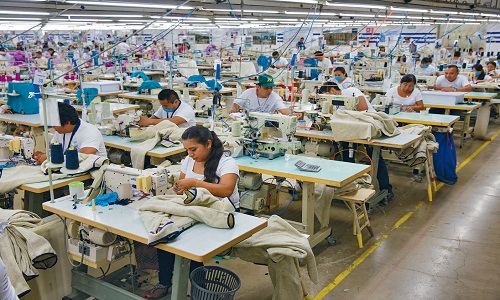 andSouth America (such as Mexico and countries in the Caribbean region) assemble imported textiles from the United States or elsewhere into apparel. The majority of clothing produced in the area is eventually exported to the UnitedStates or Canada for consumption.
Associated with these regional production and trade networks, three trade flows are important to watch:
Asian countries emerge major sourcing hub for Asia: In 2017, close to 80 per cent of Asian countries’ textile imports came from other Asian countries, up from around 70 per cent in the 2000s.
EU intra-region trade in textile, apparel stable:In 2017, 55 percent of EU countries’ textile imports and 47 percent of EU countries’ apparel imports came from within the EU region. Over the same period, 68 percent of EU countries’ textile exports and 75 percent of their apparel exports also went to other EU countries.
Western hemisphere supply chain becomes unbalanced
In 2017, as much as 80 percent of textiles and 89 percent of apparel exports from the Western hemisphere went to the same region. However, the operation of Western hemisphere supply chain is facing competition from Asian suppliers. For example, in 2017, only 24.8 percent of North, South and Central American countries’ textile imports and 15.7 percent of their apparel imports came from within the region, a record low in the past 10 years.
Implementation of several new free trade agreements, such as CPTPP, RCEP, EU-Vietnam FTA, and the potential US-EU and US-Japan FTAs is on the cards. How they affect regional pattern of world textile and apparel trade remains to be seen.
Domestic production in the German textile and clothing sectors in October decreased. Textiles fell 3.4 per cent and clothing by 2.7 per cent. Total imports increased over the last 10 months by one per cent against the same period of 2017. Total exports in October increased by 5.6 per cent mainly as a result of the increasing seasonal clothing exports. Import surplus is 8.8 per cent lower than in 2017.
The two sectors on an average employ 0.5 per cent less people than in 2017. Clothing has seen a fall of four per cent while textile enterprises employ 1.2 per cent more people. Working hours fell by one per cent against the same period of 2017. Textiles have increased working hours by 0.8 per cent whereas clothing working hours have dropped by 4.7 per cent.
Production prices increased slightly, for textiles by 0.9 per cent and clothing by 0.7 per cent. October proceeds of clothing retail contracted 1.3 per cent below the 2017 level. Total German retail volume increased by 3.1 per cent.
Raw material imports sank in October by seven per cent despite increasing raw material prices. The forecast for the German economy as a whole is negative with the trade crisis and increasing raw material prices.
Around 222 Pakistani companies will participate in the textile industry’s biggest exhibition, Heimtextil, which will be held on January 8, 2019 in Frankfurt, Germany. The fair, which will continue till January 11, will play host to 2,908 exporters from different countries. Last year, about 2,975 exporters and 70,000 traders had participated in the fair from across Europe, Turkey, Germany, Britain, France, Spain and Italy.
This year, over 800 traders and visitors from Pakistan participate in the exhibition while a large number of students from Pakistani arts and textile institutes will also be present there. The Trade Development Authority of Pakistan has also set up a pavilion at the fair to showcase Pakistan’s products. Pakistan is the fourth biggest participating country in the event.
Pakistani companies will be present at all four levels of the Hall 10. Big exporters of Pakistan such as Gul Ahmed, Kamal Textile and Sapphire will be present at the fair as they have set up large and elegantly designed stalls.
Ind Texpo will be held in Tamil Nadu from January 27 to 29, 2019. This is a reverse buyer seller meet. The objective is to promote the textile and clothing sectors. With an exhibition area of 5000 sq mt, Ind Texpo 2019 is a specialized B2B fair in the textile sector offering a one-stop destination for worldwide importers to source Indian textiles from fibers to fashion.
Along with the support of Indian missions abroad, an extensive visitor promotion campaign by direct mails, invitations, advertisements in trade magazines and road shows etc. is expected to bring top decision-makers from around the world to visit Ind Texpo 2019.
Efforts will be undertaken to invite over 150 buyers from around the world. Major textile associations all over the world have been invited to lead importers’ delegation to visit the show.
The event is being organized by the Cotton Textiles Export Promotion Council in association with the Powerloom Development Export Promotion Council and supported by the Ministry of Textiles and the Ministry of Commerce, Government of India.
Visitors will include buyers and importers of all textile items including fabric made-ups, home textiles, garments and yarns. Exhibitors include manufacturers and exporters of fabrics, made-ups and home textiles of various fibers, designs and blends.
The Indian textile ministry has for the first time given awards to people who have made significant contributions to the textile sector. Seventeen awards in different categories were given away by the vice president of India for outstanding performance and excellence in various spheres of the textile industry.
The vice president stressed on improving the quality of products to become competitive in international markets and called upon the textile industry to create brands for Indian textile products. During the ceremony he was presented commemorative stamps on GI registered handicrafts.
Eight special recognition awards were presented for excellent work in the textile sector. In addition, 16 artisans were felicitated who have enriched the handloom sector with their creative work in weaving and printing.
The textile sector plays a pivotal role in India’s economy. The last few years have been transformational for this sector. Industry specific policies, technological upgradations, focus on research and development, investment in human resources and strategic intervention for market promotion have made Indian textiles a desirable and trusted brand on the global map. There is no dearth of talent in the country and the only thing that is needed is to tap the available talent by proper skilling and encouragement.
Sri Lanka’s apparel exports increased 10.10 per cent year-on-year in November 2018. Exports to the US increased 16.58 per cent while to the EU increased marginally by 3.01 per cent in the period. Total exports during the January to November period grew 4.92 per cent.
With November export results, Sri Lanka hopes to surpass the US $5billion magical figure for the first time in history. Cumulative apparel exports to the US from January to November increased 5.61 per cent while exports to the EU increased 4.13 per cent. Overall exports to other countries too increased 5.11 per cent.
The industry expects around four to five per cent year on year growth in apparel exports for 2019. This is based on the assumption that there will be no hard Brexit and there will be a negotiated Brexit.
Apart from Bangladesh and Vietnam, some African nations such as Ethiopia are also emerging as major apparel exporters to the US and EU, as they have the capacity to manufacture garments at a low cost while meeting the sustainability standards as demanded by US and EU retailers. Sri Lanka is not able to fully capitalise on the US-China trade war, as Sri Lankan manufacturers don’t have the capacity to cater to the export orders that China is losing.
The Federation of Indian Exporters Organisations (FIEO) officials are pushing for fiscal and non-fiscal incentives for exporters in Gujarat. The state currently accounts for 25 per cent of India’s total exports in sectors such as pharmaceuticals, textile, ceramics, chemicals, gems and jewelery and even auto components. It aims to increase these exports to 33 per cent by 2020.
The state government will roll out an exports policy soon. These incentives will help boost growth of Small and Medium Enterprises (SMEs) to a great extent. At the same time, non-fiscal incentives in the form of ease of doing business initiatives to address industry problems will be crucial for exporters. In a move to facilitate ease of doing business for exporters, the Union minister also emphasised on better financing by banks.
The weaver community in Venkatagiri has sought support from the government for their eco-friendly products as several schemes launched by the Union and state governments have failed to reach them in the past. Presently, these weavers get Rs 1,000 subsidy on silk yarns worth Rs 25,000 per ‘Maggam’. They want the subsidy to be enhanced to at least Rs 2,000.
These weavers also suggest more expos in cities all through the year to eliminate middlemen, and a special drive to promote saris and dress material made out of organic cotton can go a long way in improving the fortunes of the handwoven cloth makers.
From a glorious past, the weaving community in Venkatgiri has now been reduced to looking for unskilled jobs in order to survive, despite their exquisite saris getting a Geographical Indication tag. Some young weavers are trying to improvise in order to stay afloat, and are relying on silk weaving as they can get decent returns as the cost of the sari goes up. They have tied up with leading boutiques in Hyderabad and other cities to market their specially-woven saris with elaborate designs within the country and abroad.
The Indonesian Textile Association (API) expects textile exports in 2019 to reach $14 to $15 billion. In 2018, the association exceeded its export target of $13 billion to reach $13.5 billion. API feeks, in 2019, the condition of world economy will be better. The government has also begun to working on trade agreements with Europe, especially EFTA countries namely Switzerland, Liechtenstein, Iceland and Norway.
These will open market access to Europe, although not all European countries. Alongwith exports, domestic sales will also continue to grow. These domestic sales still face with the challenges from imported products that continue to enter the market. In 2018, the volume of imported products dropped to 20 per cent due to government policies that limit imported products. At present, the percentage of these imported products is decreasing.
Bangladesh export earnings from readymade garments grew 15.65 per cent in July to December of 2018. The sector is continuing its positive export trend, fuelled by value-added products, policy support and completion of 90 per cent of the factory remediation work set by Accord and Alliance. This is attracting buyers from the US and Europe.
From July to December 2018, knitwear exports rose by 13.92 per cent and woven garments exports rose by 17.48 per cent. The four months from October to January are the peak season for shipments of apparel. Future prospects are even brighter for garment shipments.
The tax at source in the export-oriented readymade garment sector was reduced to 0.25 per cent from the existing 0.6 per cent in a bid to enhance the competitive edge of the sector. With the latest reduction, the tax at source for exports in the sector has been reduced for the second time in the current fiscal year. Earlier, on September 5 this year, the tax at source for exports in the sector was reduced to 0.6 per cent from 1.0 per cent.
The US-China trade war has forced many US fashion companies to look for alternative supply sources beyond China, creating a big opportunity for Bangladeshi apparel exporters.