FW
Global home textile market to grow at 6.9% CAGR from 2023-2031: TMR
The global home textile products market is estimated to grow at a CAGR of 6.9 per cent between 2023-2031and reach a value of $195.7 billion by 2031, as per a study by Transparency Market Research (TMR).
Offering insights based on an industry SWOT analysis, the report provides detailed information on market growth drivers, restraints, trends, economic and financial structure, etc.
The report also focuses on the market segments formed by combining different prospects such as types, applications, and regions. Apart from this, it discusses, key growth drivers, restraints, potential growth opportunities, and market challenges.
Bangladesh RMG exports decline from July-November’23: EPB
Bangladesh’s RMG exports to all its major markets declined during the July to November period due to global economic situation, a decline in demand and policies of the Western countries.
As per a report by the Export Promotion Bureau (EPB) and BGMEA, Bangladesh’s RMG exports to the EU fell by 0.15 per cent in the five months from July to November of the current fiscal year compared to the same period of the previous fiscal year. Exports to the largest markets within the eu, Germany fell by 15 per cent to $231 million in the last five months..
Bangladesh’s apparel exports to the United States declined by 5.76 per cent to $328 million in the last five months. The US share of total apparel exports fell to 17 per cent during the period..
According to Dr. Abdur Razzaq, Chairman, Rapid, the reason for this decline in exports to the US market is the fear of sanctions, and reduced demand in the country.
Exports to Canada decreased by 2.71 per cent to nearly $61 million with the share of this market in the total exports of garments decreasing from 3.40 to 3.22 per cent.
Levi’s x BEAMS unveil Super Wide V2 collection
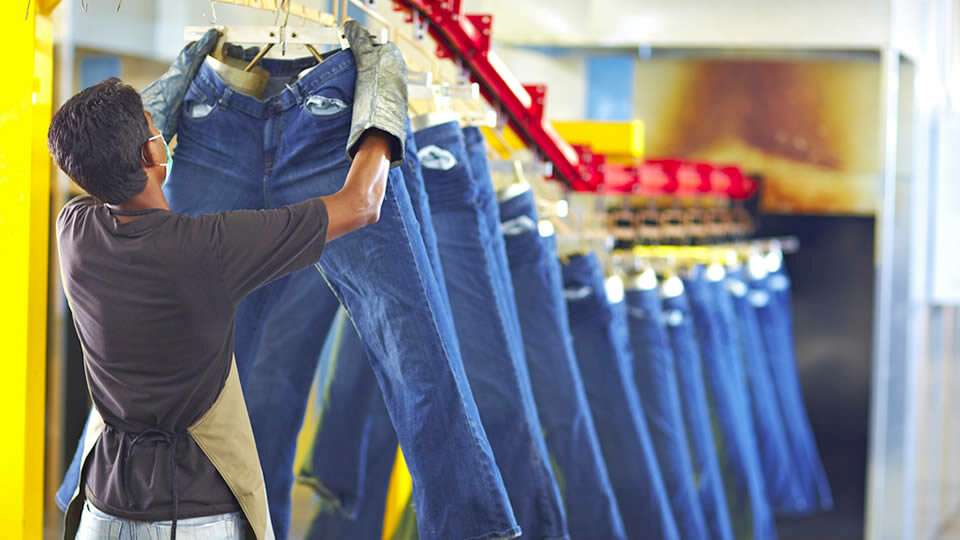
Levi’s and BEAMS have unveiled their fourth collaborative capsule collection, the Levi’s x BEAMS Super Wide V2. This exclusive lineup pays homage to Levi’s rich heritage, drawing inspiration from the subtle and elegant garments of 1944. The collection features standout pieces such as the Super Wide V2 Type I Trucker, the Super Wide V2 Jean, and a Graphic Tee.
The Super Wide V2 Type I Trucker, a nod to the 1944 Levi’s denim jacket, is crafted from heavyweight 16 oz. denim with a custom Orange Tick selvedge. Notable details include a super-wide custom leather back patch and a BEAMS-exclusive tongue.
Complementing the Trucker is the Levi’s x BEAMS Super Wide V2 Jean, inspired by the 1944 501 and made from Orange Tick selvedge denim exclusively developed for BEAMS. Both garments are available in a lighter vintage wash and an exclusive darker lightening wash.
The collection is rounded out by a white Graphic Tee featuring co-branded graphic prints on the back and a screen-printed "stitched" bow.
The Levi’s x BEAMS Super Wide V2 campaign, featuring nine models, showcases a blend of traditional Japanese landscapes against a studio backdrop, creating a captivating juxtaposition between the familiar and unfamiliar aspects of Japan. This collaboration seamlessly combines timeless American style with Japanese aesthetics, delivering a unique and bold fashion statement.
Bangladesh apparel industry fights back against unfair discounts
In a bid to counteract a rising trend of deceitful bargaining tactics by certain global garment buyers, the Bangladesh Garment Manufacturers and Exporters Association (BGMEA) is taking a stringent stance. Reports reveal that a surge in incidents where buyers exploit exporters by seeking "illogical" discounts on clothing prices has prompted the industry apex body to contemplate blacklisting such entities.
The BGMEA issued a circular on December 21, urging its member-factories to compile a list of buyers engaging in dubious discount negotiations. The association's move aligns with the central bank's discount committee decision following deceptive dealings by these buyers. The circular highlights the manipulative practices of certain buyers who, after receiving goods, announce bankruptcy or demand discounts based on unfounded pleas.
Faruque Hassan, BGMEA president, emphasized the exporters' vulnerability, noting that fraudulent buyers, buying houses, and freight forwarders often trap them into accepting discounts. The circular warns of the financial repercussions for exporters, who end up paying bank interest and loans, potentially leading to factory closures if export proceeds (EXP) become overdue.
Mohammad Hatem, executive president of the Bangladesh Knitwear Manufacturers and Exporters Association (BKMEA), expressed concern over the increasing incidents of unwarranted discounts. Both BGMEA and BKMEA are advocating for the blacklisting of buyers seeking illogical discounts and are working to raise awareness among their members.
Furthermore, the committee discussed issues related to Letter of Credit (LC) clauses and urged apparel makers to exercise caution regarding sanctions-related conditions. A recent LC clause, which absolved the buyer of liability for transactions involving sanctioned parties, raised concerns and confusion among exporters, leading to its subsequent removal. The trade bodies are now advising against accepting LCs with unwanted clauses or conditions.
Chandigarh's L'Aspiration Summit redefines luxury
In a glittering affair at JW Marriott, Chandigarh, on December 22, 2023, News 18 Punjab/Haryana hosted the L’Aspiration Summit, a distinctive event dedicated to the world of luxury.
The summit brought together India’s erstwhile royals, including Aaliya Sultana Babi, Mallyka Singh Dundlod, and Siddharth Daspan, scions of Balasinor (Gujarat), Jhunjhunu (Rajasthan), and Jodhpur, respectively. Sharing the stage were renowned actors Jonita Doda, Aahana Kumra, and Niharica Raizada, alongside artist and collector Shan Bhatnagar.
L’Aspiration Summit stands as a celebration of ideas reshaping luxury, directly from those who have experienced and continue to live it. Divided into six sessions, the event delved into topics such as Rethinking Luxury, Reviving Tradition, and Redefining Royalty, providing a captivating evening of royalty, glitz, and glamour.
Among the highlights, actor Jonita Doda shared her accidental journey into acting, while Siddharth Daspan discussed the transformation of his century-old royal house into a haven for art enthusiasts. Artist Shan Bhatnagar showcased his vibrant artworks blending traditional temple art with Rajasthani embroidery. Aaliya Sultana Babi, known as Dr. Dinosaur, narrated her 27-year journey establishing a Dinosaur Museum in Gujarat.
The event underscored the evolving landscape of luxury, intertwining tradition, talent, and aspirations, creating an evening where royals stood alongside fashion designers, collectors, artists, and actors to discuss the dynamic world of luxury.
Nike's aggressive cost-cutting measures amid sluggish sales
In a bid to trim costs by $2 billion over the next three years, Nike is set to slash hundreds of jobs, simplify product ranges, and embrace automation.
The move, costing up to $450 million, follows a mere 1% sales increase to $13.4 billion in the three months ending November 30th.
Global sales for Converse plunged by 11%, contrasting with a similar rise in Nike brand sales. While the US and Europe witnessed sales decline, China experienced an upswing.
China’s PSF exports surge 24.7% Y-o-Y in November 2023
China’s PSF exports surged by 24.7 per cent Y-o-Y and 1 per cent M-o-M to 106,000 million tonne in November 2023. Its PSF imports rose by 46.7 per cent Y-o-Y and 25 per cent M-o-M to 11,000 million tonne.
China’s PSF exports in the first 11 months of 2023 increased by 22.8 per cent Y-o-Y to 1.115 million tonne while imports during the period surged by 10 per cent Y-o-Y to 91.5000 tonne.
China’s PSF imports from Southeast Asia started declining from 2019. Though these recovered slightly in 2023, imports from large origins, like Thailand and Vietnam, continued to dip from their peak period.
China’s imports from Vietnam soared to 30,567 tonne in 2021. However, in 2022, they dropped by 64.8 per cent to 10,773 tonne. From January-November 2023, China’s PSF imports from Vietnam further dropped to 17,123 tonne.
Imports from Thailand reached 45,000 tonne in 2019 before dropping gradually. China’s PSF imports from Thailand continued to drop and reached 17,208 tonne.
From January-September 2023, these imports further dropped to16,891 tons.
China’s PSF imports from Cambodia totaled 1,261 tonne in 2021. These declined to 664 tons in 2022, further to zero till now in 2023.
Overall, China’s PSF imports from Southeast Asia totaled 46,658 tonne in January-November 2023. They constituted 51 per cent to the China’s global PSF imports.
India’s apparel exports drop by 13.29% during Jan-Oct’23
India’s apparel exports declined by 13.29 per cent to $12.19 billion during the January-October 2023 period from $14.05 billion recorded in the same period of 2022.
As per a report by Apparel Resources, India’s apparel exports to major destinations including the US, UAE and UK dipped during the ten-month period.
India’s apparel exports to the US declined by 20.58 per cent to $3.90 billion in the mentioned period, whereas the exports to the UAE fell by 6.25 per cent to $1.18 billion in the January-October ’23 period.
Shipments to the third largest export destination-UK dropped by 12.12 per cent to $ 945.21 million in the January-October ’23 period.
This drop in India’s apparel exports to major destinations can be attributed to the fluctuating global economic scenario and inflationary pressures in the key economies worldwide.
Asia fashion e-commerce market to grow at 9.5% CAGR till 2030: CoherentMI
Currently worth $521 billion, the Asia fashion e-commerce market is projected to grow at a 9.5 per cent CAGR to reach $985 billion by 2030.
As per a report by CoherentMi, growth in the Asia fashion ecommerce market during the forecast period will be fuelled by the rising adoption of smartphones and growing internet penetration. Another key driver will be Asia’s rapidly expanding middle class population.
The Asia fashion e-commerce market will also get a boost from the exponential increase in smartphone and internet users in the region over the past few years. With devices becoming more affordable, smartphone adoption in countries like China, India, Indonesia, Vietnam and Philippines has grown exponentially, making e-commerce more accessible to a large consumer base.
One of biggest emerging opportunities in the Asia’s fashion e-commerce market is live streaming. Brands and influencers are using platforms like Twitch, YouTube and Facebook live to host live try-on hauls, tutorials and reviews. This enables customers to engage in real-time through chat features while watching new collections and get their questions answered instantly.
Export of men’s declines by 2.32% Y-o-Y during Jan-Oct’23
India exports of men’s t-shirts declined by 2.32 per cent Y-o-Y during the January to October ’23 period to reach a total value of US $ 1.43 billion, according to the latest data from the Ministry of Commerce and Industry.
Exports of knitted shirts declined by 8.37 per cent to $556.22 million while woven shirts exports declined by 1.97 per cent to $872.71 million.
With exports worth $526.62 million, the US maintained its position as the leading export destination. It represented almost 37 per cent of the total export value.
However, exports to the country declined by 7.88 per cent Y-o-Y.
India’s exports of men’s t-shirts to its second-largest export destination, UAE declined by 3.64 per cent Y-o-Y to $158.55 million compared to the same period in the previous year.
Exports to the third largest destination, the UK declined by 0.30 per cent Y-o-Y to $87.22 million.
Export of men’s shirt constituted approximately 11.73 per cent of India’s overall apparel export values of $12.19 billion during the January to October ’23 period.