Textiles (143)
Gap to launch augmented reality app ‘Dressing Room’ soon
Written by FWThough the fashion industry and technology haven't traditionally amalgamated well, but Gap is looking to change that. The parent company Gap Inc., which also owns Old Navy and Banana Republic, is launching a new augmented reality app called ‘DressingRoom’. As in-store sales drop in favour of online orders, retailers are looking for new methods to engage their shoppers.
Built in collaboration with Google and start-up Avametric, the app will allow one to virtually try on clothes anywhere he/she goes. Users first enter information like height and weight, then the app places a 3D model in front of them. The model can try on different clothing items to see how they would look with that particular outfit. If one looks like how they look, the clothes can be purchased from the app as well.
Though the app is to launch in a few days, but it still is in its early stages. It currently only works with Google Tango enabled smartphones of which only the Phab 2 Pro from Lenovo is available. Besides this technical limitation, the app only shows what the clothes would look like. In order to get the fit and feel for the garment, a traditional dressing room is still the only option. Pokémon Go was the first highly successful augmented reality app, but Gap and other clothing retailers are hoping to grow the market. Time will tell if this kind of app can help retail with declining sales.
China textile industry de-couples itself from water use
Written by FWA new research from China has claimed that the country has been partly successful in de-coupling the growth of its textile industry from increases in water consumption and discharge. The researchers claim this is due to the better use of technology and water saving methods and stronger environmental laws in China.
The researchers found that the water footprint of China's textile industry strongly decoupled from the growth of its textile industry for five years (2002, 2006, 2008, 2011, and 2013) and weakly decoupled for four years (2002, 2007, 2009, and 2010) over the period 2001-2014. The researchers calculated changes in blue water (water consumption), grey water (water pollutants), and water footprints of the textile industry from 2001 to 2014. Later, the relationship between water footprint and economic growth was then examined.
Over the entire period, there was a slight decoupling trend which the researchers indicate was due to the better use of technology and a growth in the amount of water saving methods being employed by the textile industry. The concept of decoupling indicates the reduction of a mutual relationship between two or more physical quantities. Decoupling analysis is widely applied in studies of economic growth in relation to resource consumption and environmental pressure.
The research paper says that the decoupling trend as a whole was good but the development of the textile industry was not completely independent of the water footprint. In general, during the sampling period, China's textile industry has controlled the amount of wastewater discharge and achieved significant effects on wastewater management.
Century Textiles & Industries Ltd. declares its unaudited financial results
Written by FWMumbai based textile manufacturer, Century Textiles has declared its unaudited financial results for the quarter ended on December 31, 2016. Following are the excerpts from the Q3 results:
Net profit stands at Rs 13.9 cr vs loss of Rs 8.5 cr (YoY); Total income recorded is down by 7.2 per cent at Rs 1962 cr vs Rs 2114.4 cr (YoY); EBITDA is up by 36.5 per cent at Rs 214 cr vs Rs 157 Cr (YoY); and EBITDA margins stand at 10.9 per cent vs 7.4 per cent (YoY). The stock is trading flat with mixed sentiments after the Q3 results, witnessing spurt in volume by more than 1.41 times in Tuesday’s trading session.
Century Textiles & Industries Ltd is currently trading at Rs 857, up by Rs 0.5 or 0.06 per cent from its previous closing of Rs 856.5 on the BSE. The scrip opened at Rs 860.4 and has touched a high and low of Rs 870 and Rs 841.9 respectively. So far 2282464(NSE+BSE) shares were traded on the counter. The current market cap of the company is Rs 9566.73 crore.
The BSE group 'A' stock of face value Rs 10 has touched a 52 week high of Rs 1037.25 on 01-Nov-2016 and a 52 week low of Rs 403.8 on 29-Feb-2016. Last one week high and low of the scrip stood at Rs 862.8 and Rs 817 respectively. The promoters holding in the company stood at 47.75 per cent while Institutions and Non-Institutions held 23.21 per cent and 29.03 per cent respectively. The stock is currently trading above its 100 DMA.
Marking the best rally of cotton in six months, Chinese buyers have, this year, committed to purchase almost five times more American cotton than at this time last year, the US government has said in a report. With the pledge, the price of the commodity is heading for its biggest monthly advance since July last year. Hedge funds are positioned for more gains, holding the second-most bullish wager ever.
American growers are expected to ship the most cotton since 2013, data from the USDA reveal. Sales growth is being driven by purchases in Indonesia and Vietnam as well. While rising demand has sparked two straight years of rallies, futures in New York are still trading about 65 per cent below a record set in 2011, leaving the fiber at affordable levels for consumers.
The net-long position in cotton rose 3.2 per cent to 87,341 futures and options in the week ended January 24, a data published by the U.S. Commodity Futures Trading Commission three days later show. That was just shy of an all-time high of 90,215 contracts set on January 10, according to the figures, which go back to 2006.
Cotton traded on ICE Futures U.S. in New York climbed 2.5 percent last week. Prices added 0.3 per cent to 75.06 cents a pound on Monday and are up 6.2 per cent this month. Futures touched 75.37 cents on January 5, the highest since August.
Consumption will probably outstrip production by 1.24 million metric tons this year, Cotlook, a Birkenhead, England-based research company, said last week. That can help to erode global stockpiles, which the USDA estimates at 90.6 million bales, each weighing 480 pounds (218 kilograms).
Wool producers across Australia happy to see prices of wool high
Written by FWSeeing that the market continues to maintain strong and so the prices, after reaching record levels, wool producers across Australia are a celebrating lot. Last Wednesday, the Eastern Market Indicator (EMI) — Australia's wool market benchmark hit a historic new level of 1439 cents a kilogram and then fell back to finish the week at 1434 cents a kilogram.
The previous record of 1425 cents were standing strong 2012. And the new lofty prices have many producers confident for the year ahead. Producer Matt Ashby from Gulnare, South Australia said that producers were relieved to see some good prices.
New South Wales producer John Alcock from Bombala agreed that the fashion industry was utilising more Australian wool. After the finer microns took off, he was of the belief that it was largely due to the fact that the Chinese have realised if they want good quality materials they've got to use the nice, finer, softer wools with good, traditional crimping and that drape well. No doubt, they had to struggle to get the better quality wools, he rued.
Pakistan PM asks Japan to consider tariff exemption for textiles
Written by FWThe Pakistan Prime Minister Nawaz Sharif met Japanese envoy Takashi Kurai in federal capital on Wednesday, it has been reported. While conferring, the prime minister said that Pakistan considers itself a close friend and trade partner of Japan that co-operated in Operation Zarb-e-Azb against terrorism to ensure peace. He said that his country was hopeful that Japan will review the decision of including Pakistan in its travel advisory list.
The premier asked Japan to consider a three to four year tariff exemption for Pakistani textile products. The move will facilitate the country’s struggling textile industry, he observed. He suggested that there are plenty of investment opportunities between Japan and Pakistan in the fields of trade, energy and infrastructure development. He was of the feeling that both the countries need to sign bilateral free trade agreements. He categorically stated that he would welcome investments by Japanese companies in Pakistani industry.
On the other hand, Japanese ambassador praised economic growth in Pakistan. He said that Pakistan has become a suitable country for business in the sight of Japan.
Vietnam’s Textile-garment trade surplus to touch US$15.5 billion
Written by FWVietnam’s textile and garment industry may have a trade surplus of US$15.5 billion on total export revenue of US$31 billion this year, said Vu Duc Giang, Chairman of the Vietnam Textile and Apparel Association (VITAS).
At a press conference in HCMC on December 11, Giang said the sector has gained strong export growth this year, at 10.23 per cent, when compared to 2016, and the momentum is to continue into next year with export earnings forecast at US$33.5 to 34 billion. This segment has faced multiple challenges early this year, but the situation has changed for the better since the Q2 of this year, Giang noted.
Of the total export revenue of this year estimated at US$31 billion, textiles and garments contributed to an estimated US$25.91 billion, fabrics US$1.07 billion and cotton US$3.51 billion.
Local enterprises have tapped new markets including China, Russia and Cambodia while holding on to traditional markets such as the U.S., the EU, Japan and South Korea. It is noteworthy that local firms have managed to switch production, from processing exports for foreign firms to free on board (FOB)and original design manufacturing(ODM), Giang said. Discussing next year’s business, Giang exults that many textile and garment firms have signed big export contracts enough for production in the first haft of next year and buyers of these products have shown their confidence in product quality and delivery time of Vietnamese firms.
To achieve the target set for next year, VITAS advised textile and garment enterprises to change their production methods and meet requirements of import markets, enhance competitiveness, invest in new techniques and technologies, diversify products and build links among enterprises.
Giang said the price competition will be tough as many other countries have also sought to undercut Vietnam, especially apparel manufacturers from China, Bangladesh, Sri Lanka, Myanmar and Cambodia. Therefore, local enterprises must employ highly-skilled workers, invest in modern equipment and speed up automation.
According to VITAS, domestic firms have to import 86 per cent of fabrics for garment production as locally- produced fabrics have not met standards of major import markets, while locally-produced fabrics are subject to taxes while imported fabrics used for export processing are tax-free.
The textile and garment sector is also experiencing difficulties due to rising production and labour costs. Vietnam currently has nearly 6,000 textile and garment enterprises with 2.5 million employees.
Malaysia, Pakistan hold seminar on doing business in Pakistan
Written by FWThe Malaysia External Trade Development Corporation (MATRADE) and High Commission of Pakistan Malaysia jointly organised a seminar on ‘Doing Business with Pakistan on 21st December in Kuala Lumpur. The seminar saw participation of over 200 Malaysian companies and Pakistani businessmen.
Speaking at the seminar, the High Commissioner of Pakistan in Malaysia, Syed Hassan Raza said that both countries are negotiating to further reduce duties on existing and additional tariff lines to facilitate businesses under the Free Trade Agreement (FTA). The High Commissioner highlighted the investment opportunities and trade potential in Pakistan and informed the participants that there were numerous opportunities for the companies in both countries, having FTA since 2008.
The current trading basket of both the countries is limited to Palm oil, fibre board, rubber electrical and electronic equipment from Malaysia while from Pakistan main items exported are cotton, textile, rice, maize, vegetables. On investments, Raza mentioned that present investment regime is the most liberal in the region. Foreign equity could be 100 per cent owned by foreign investor and there were no restriction on repatriation of profits/royalties almost all sectors are open for investment and one-window facilitation were some of the highlights of new policy. He emphasized that Pakistan was a stable, peaceful and welcome foreign investors to visit any part of the country.
Pakistan govt. to spend Rs 20 bn to enhance exports in three years
Written by FWTo enhance Pakistan's export competitiveness and institutional strengthening under the Strategic Trade Policy Framework (STPF) 2015-18, the federal government would spend Rs 20 billion in the next three years. In response to emerging international changes, several other initiatives are being implemented to enhance the export basket and market share. The total volume of Pakistan's exports that was $24.5 billion in 2013 fell to $20.8 billion in 2016.
Among the steps taken by the government to enhance exports are: sales tax zero-rating regime for five export oriented sectors comprising textile, leather, carpets, surgical and sports goods has been introduced from July this year. The other steps were establishment of Export Promotion Council for Pharmaceuticals & Cosmetics, and Rice Export Promotion Council, support for import of plant & machinery to strengthen supply chain and encourage value addition and performance based incentive (PBI) to offset burden of higher utility costs and local levies and taxes on export sectors.
Under short-term export enhancement measures, four product categories comprising basmati rice, horticulture, meat and meat products and jewellery were aimed at with parallel focus on markets including Iran, Afghanistan, China and European Union. An additional Rs 6 billion was available this fiscal year to exporters through Textile Policy. 2014.
ICICI Securities sees Vardhman Textiles reporting profit of Rs 346.2 crores
Written by FWThe second quarter (July-September) earnings estimates of the apparels sector by ICICI Securities is out. The brokerage house expects Vardhman Textiles to report a net profit of Rs 346.2 crores up 94.2 per cent quarter-on-quarter Q-o-Q). The revenue of the textile firm is expected to decrease by 0.4 per cent Q-o-Q (down 8.8 per cent Y-o-Y) to Rs 1,502.7 crores. Earnings before interest, tax, depreciation and amortisation (EBITDA) are likely to fall by 9.7 per cent Q-o-Q (down 8 per cent Y-o-Y) to Rs 282 crores.
Consolidated revenues are likely to decline 8.8 per cent YoY to Rs 1,502.7 crores on account of sale of stake in Vardhman Yarns and Threads. On the segmental business front it is expected that the yarn volumes would increase by 2 per cent YoY while the fabric volume is expected to increase by 7 per cent YoY. Consolidated operating margins are likely to increase marginally by 16 bps to 18.8 per cent on account of higher margins in the acrylic business. On the operational front, Vardhman's performance is expected to be moderate.
However, owing to stake sale (40 per cent) in Vardhman Yarns and Threads, an exceptional income to the tune of Rs 210 crores is expected this would boost consolidated net profit to Rs 346.2 crores v/s net profit of Rs 125 crores in Q2FY16. Excluding the exceptional profit, net profit is expected to increase by 9 per cent YoY to Rs 136.2 crores.
More...
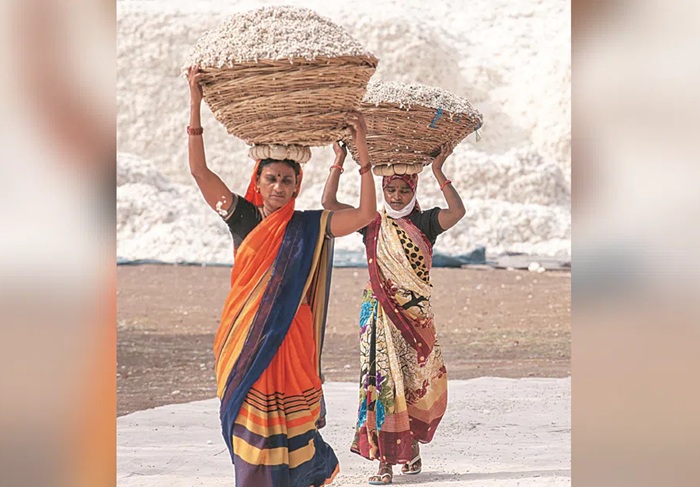
Perhaps for the first time Maharashtra may overtake Gujarat in terms of cotton production. Usually, Maharashtra produces around 60 to 70 lakh bales and around 20 lakh bales are sold to Gujarat. But this time, there could be a bumper production because of good rains.
Maharashtra’s cotton crop is expected to improve from 78 lakh bales in 2015-16 to 87 lakh bales in the current crop year. Gujarat may produce some 80 to 85 lakh bales. Incessant rains brought relief to the water-stressed Marathwada region, which had been suffering from drought for the past four years.
Total cotton supply for the crop season 2016-17 is estimated at 398 lakh bales, while domestic consumption is estimated at 309 lakh bales, thus leaving an available surplus of 89 lakh bales. Meanwhile cotton samples are being displayed to potential buyers in Bangladesh, Pakistan and Vietnam. A team visited Chinese buyers, traders, ginners, warehouses and provided samples of their cotton, which was tested by Chinese experts. This was followed by a visit by Chinese traders and ginners to farms.
China has been the biggest importer of cotton from India until now. The cotton season begins from October 1. However, because of the rains, there could be a delay of 15 to 20 days for the new arrivals to take place.
Chian’s Xinao Textiles opens knitwear development center
Written by FWChina’s Xinao Textiles, is one of the world’s leading worsted spinners of wool, producing machine knitting yarns for the sweater, sports, outdoor, underwear and sock industries. The company has now opened an innovative knitwear development center in China.
The center comprises a research and development unit, which houses laboratories and small scale processing machinery in order to conduct experimental trials, a training and education department containing a 100-seat lecture theatre devoted to training future textile technologists, designers and engineers, and a fully equipped textile testing laboratory. Students will get hands-on training.
The operation and activities of the knitwear center will be overseen and guided by an advisory board. The advisory board comprises both international and Chinese experts, who have wide experience in a range of fields such as design, knitwear manufacturing, spinning, finishing, processing machinery and textile chemistry and dyeing.
The center is a result of close cooperation with The Woolmark Company along with other strategic partners from the design, textile machinery, textile chemicals industries, textile universities and leading knitwear companies. Xinao is engaged in the research, development, manufacture and sale of worsted yarn. The company’s main products include worsted yarn and intermediate products of wool tops, mainly used for downstream textile and clothing sectors.
Companies in Tamil Nadu's textile belt are opting for IPOs now. Till now they had banked on debt to run their privately held businesses. Integrated firms manufacturing goods across the supply chain from yarn to finished apparel work out of Coimbatore, Tirupur and Erode. They boast of fairly high levels of operating margins, international clients like Walmart and Macy's and strong business continuity typical of family-run businesses. But they have thus far held back their exposure to capital markets. Lack of exposure limited the way they structured their companies -it was either proprietary or limited liability partnership. Some extended it to private limited companies.
A slow-but-promising European recovery, strong domestic demand and a gradual increase in exposure to how the capital markets work appear to have pushed entrepreneurs towards the markets now. Their ways of raising funds have changed.
Globalisation has expanded their horizons to the avenue of tapping public money. In a competitive, volumes-driven business environment, a company needs to have a strong fund flow. At a time of high interest costs, capital markets are seen as a great way to access funds. And clients feel safer buying from a listed company. Over the last decade, only a handful of Tamil Nadu's textile barons have taken to Dalal Street and fared well after their IPO and sustained interest among investors.
Monsanto decision poses a challenge to government’ seed policy
Written by FWMonsanto’s decision to withdraw its application for Bollgard II Roundup Ready Flex technology is posing a big challenge to the government’s policy on licensing seeds technology. The move is significant as it comes at a time when the government is in the middle of a consultation on whether to limit royalty rates of seed-tech companies at 10 per cent of the seed price for the first five years followed by a 10% reduction in each of the following years.
Since this order, by way of a gazette notification, came just before Prime Minister Narendra Modi’s visit to the US, media attention forced the government to pass it off as a discussion paper. Last year, the government came out with a seeds price order which not only resulted in the price of the GM seeds being cut sharply, the cut was far sharper for trait values, or the royalty that firms like Monsanto charge for giving their technology to seed-producing firms.
While the Bollgard II seeds price was cut from Rs 930 per bag of 450 grams of seed and 120 gram of refugia seed to Rs 800, the trait fee was cut from Rs 163 to Rs 42. While the seed company took a hit of Rs 121 per bag, other seed companies took a hit of just Rs 9 per bag.
Earlier this year, the Ministry of Agriculture made a complaint to the Competition Commission of India (CCI) and asked it to probe allegations of anti-competitive practices by Monsanto. This was based on the complaints of seed companies who were selling Monsanto’s seeds under license.