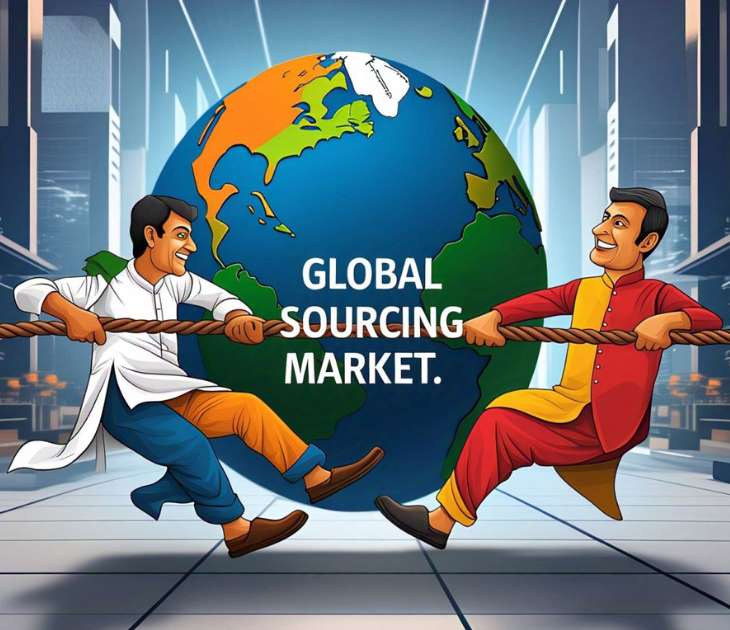
Garment makers feel that India needs to focus on getting duty-free access to European Union and the US, two of our biggest export markets, as the country has been facing very stiff competition from South Asian countries. Atul Ujagar, Nike’s Country Director, feels that other countries have been actively working on free trade agreements which would help their apparel secure ‘duty-free’ into developed countries. The textile and apparel industry in India is very strong and it would emerge one of the fastest growing in case ample support is given. The government should be more aggressive on securing duty-free status to up the EU and US markets.
Indian apparel exports are worth $17 billion which is less than the textile, yarn, and cotton exports which amount to around $20 billion. Together, textile and garment exports are at around $37 billion. The industry employs 45 million people which makes it one of the top three employers. India is not able to realise the full supply chain value, Ujagar observes.
Compared to other South-East Asian countries, India has a competitive labour rates. In fact, one of India’s core strengths is its cost-competitive labour but it lags behind in productivity and efficiencies in manufacturing. There needs to be a dedicated focus to improve India’s productivity, he said.
Anindya Ray, Senior Vice-President of Arvind Lifestyle feels, Chinese government provides a platform for buyers through huge exhibitions throughout the year. Indian textile industry is the second largest employer after agriculture. It is unfortunate that the government is not trying its best to help the industry. This industry will become a dying industry without government support. India exports around $17 billion, whereas Bangladesh exports around $24 billion and China’s exports are around $65 billion. China is becoming expensive and people want to move out despite the industry still growing there. India is not a position to make use of the minimum shift away China as India lacks infrastructure, he believes.
- 1
- 2
- 3
- 4
- 5
- 6
- 7
- 8
- 9
- 10
From field to fiber, Bharat CottonNet is closing India’s cotton value gap
India’s cotton economy is entering a decisive phase of reform with the rollout of Bharat CottonNet 2026 along with the... Read more
US apparel imports drop 13.5% as Vietnam gains and China’s grip breaks
The US apparel sourcing market has entered 2026 with a sharp demand decline but an equally important shift in supplier... Read more
H&M finds growth below revenue line as margin discipline pays off
H&M Group’s latest quarter signals a decisive shift in global fast fashion: scale is no longer the primary reason for... Read more
As Europe cuts orders, India sees a rare export window post-FTA
The sharp dip in EU apparel imports is not, at first glance, the kind of headline exporters celebrate. January’s 15.48... Read more
The Death of the "Stockpile" Model: Inside the Digital Textile disrupt…
For decades, the global textile industry has been a game of high-stakes gambling: manufacture thousands of identical garments, ship them... Read more
Fuel crisis, rising costs the geopolitical shockwave hitting Indian textiles
The hum of textile machinery in Panipat has gone dead. Over 400 dyeing units have put their shutters, not because... Read more
Price wars, fast fashion, diamond money leads to Surat’s industrial shake-up
The sound of Surat’s diamond polishing wheels, once the city’s heartbeat, is fading. In its place, the relentless pulse of... Read more
India’s textile market nears Rs 15 lakh cr as domestic demand rewrites growth
India’s textile and apparel economy is no longer being driven merely by population growth or festive consumption cycles. It is... Read more
China Discounts, Bangladesh Bleeds: Inside Europe’s new apparel sourcing crisis
Europe’s fashion imports opened 2026 with a hard jolt. Fresh Eurostat-linked trade data for January shows the European Union’s apparel... Read more
Geopolitical volatility triggers sharp decline in global textile confidence: Sur…
The global textile industry is grappling with a sudden and severe downturn in sentiment as regional conflicts disrupt essential trade... Read more