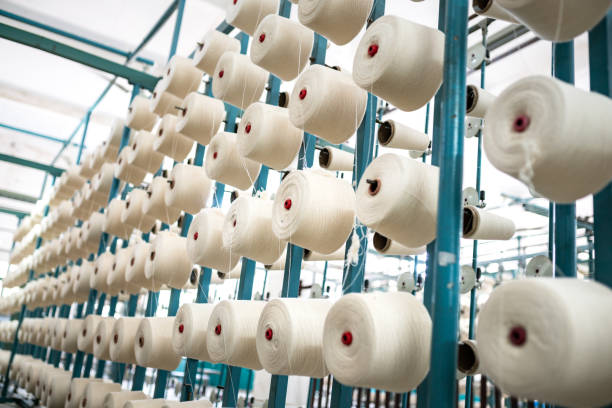
By focusing on flexibility, rapid delivery times and customised solutions, Italian textile companies are relying on innovative production technology. Fabrics carrying the Made in Italy label are always popular – a trend that is generating good business for machine builders. Italian weavers depend on Karl Mayer’s warp preparation machines. And Karl Mayer’s warp preparation business unit has also spotted this trend for expansion and renewal.
The Giro-O-Matic 24 and the Multi-Matic 128 sample warping machines and the Nov-O-Matic automatic, short-warp sectional warping machine have proven to be real bestsellers. The reason customers are interested in these innovative machines is their high operating speeds, exceptional beam quality, and their advantages in terms of the number of operatives needed to operate automatic systems. The performance of these machines is quite unique. They are currently without rival, and are in especially high demand in the weaving cluster.
Karl Mayer’s order books are full. It saw an increase in orders in 2014, but the real boom started in 2015, which is expected to continue until 2016. Italy represents elegance and exclusivity in fashion like no other country, and this country still heads the top price bracket. Premium Italian fabrics enjoy an excellent reputation, and are finding new customers in the emerging economies, where great importance is attached to high-end brands.
- 1
- 2
- 3
- 4
- 5
- 6
- 7
- 8
- 9
- 10
The New Rules of Resale: EPR turning secondhand into fashion’s strategic growth …
The global fashion industry is facing a decisive regulatory and commercial reset. What began as a sustainability narrative around reuse... Read more
The 2027 Mandate: Why denim’s future hinges on verifiable data
For decades, the global denim industry has relied on a narrative of durability, heritage, and authenticity. That narrative is now... Read more
Europe’s textile core unravels as costs, imports and policy pressure bite
Europe’s textile and apparel sector, long seen as a benchmark for craftsmanship and industrial depth, is slipping into a prolonged... Read more
Automation, innovation, regulation are the forces shaping textiles in 2026
The global textile sector has entered a new era. Early 2026 saw the industry breach a $1.06 trillion valuation, reflecting... Read more
The new Brussels rulebook, every EU apparel order is now a balance-sheet risk
The humble export order sheet is undergoing a transformation. What was once a straightforward commercial instrument: SKU, volume, FOB price,... Read more
Why 2026-27 could be a defining cotton year for India’s farm-to-fashion economy
The global cotton economy is entering a more constrained phase, and for India, the implications run far beyond the farm... Read more
Luxury resale’s next big battle is no longer digital, it is about who controls s…
For nearly a decade, the luxury resale story was written in the language of platforms. Market leadership was measured by... Read more
Digital Arms Race: Indian apparel giants deploy AI to neutralize tariff crisis
The Indian textile and apparel sector is in a digital survival phase in 2026, shifting from traditional labor-intensive models to... Read more
Europe’s Textile Endgame: Why Project FAE is becoming fashion’s most critical in…
Europe’s apparel majors are no longer treating circularity as a branding layer. With Project FAE or Feedstock Activation Europe, the... Read more
Engineering color at source, dye-free production is cutting cost, water, and tim…
For over a century, coloring has been anchored in wet processing, an energy-intensive, chemically saturated stage that happen post spinning.... Read more