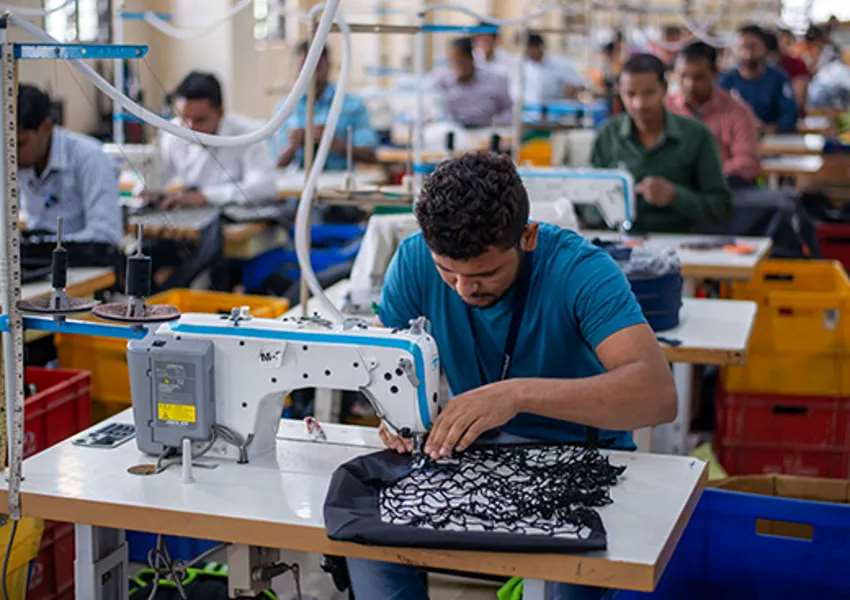
The Ramanathapuram District Cooperative Spinning Mill, started exclusively for dalits by former Tamil Nadu chief minister MG Ramachandran in 1982, has remained defunct for the last 10 years. The mill was reopened again at a cost of Rs.28.02 crores. The mill became defunct owing to labor problems and other factors, and based on the suggestions of the South India Textiles Research Association, the mill was modernized and reopened once again. About 200 dalits in the area are now employed with the reopening of the mill.
With an installed capacity of 12,096 spindles, the mills would start commercial production in a month and produce about 3,700 kg of cone yarn and hank yarn per day. The grey yarn would be supplied to the government for distribution to the cooperative societies which produced saris, dhotis and school uniforms for free distribution.
After receipt of funds, in a month’s time, the department would set in motion a revival package and place orders for new machines. The existing machines have become obsolete, the government therefore install modern spinning machinery (long frame automatic machines) to compete with private mills.
The government is also gearing up to modernize five cooperative spinning mills in the district. These mills are presently producing 10,000 to 25,000 spindles a day and the capacity would double after modernization.
- 1
- 2
- 3
- 4
- 5
- 6
- 7
- 8
- 9
- 10
The new Brussels rulebook, every EU apparel order is now a balance-sheet risk
The humble export order sheet is undergoing a transformation. What was once a straightforward commercial instrument: SKU, volume, FOB price,... Read more
Why 2026-27 could be a defining cotton year for India’s farm-to-fashion economy
The global cotton economy is entering a more constrained phase, and for India, the implications run far beyond the farm... Read more
Luxury resale’s next big battle is no longer digital, it is about who controls s…
For nearly a decade, the luxury resale story was written in the language of platforms. Market leadership was measured by... Read more
Digital Arms Race: Indian apparel giants deploy AI to neutralize tariff crisis
The Indian textile and apparel sector is in a digital survival phase in 2026, shifting from traditional labor-intensive models to... Read more
Europe’s Textile Endgame: Why Project FAE is becoming fashion’s most critical in…
Europe’s apparel majors are no longer treating circularity as a branding layer. With Project FAE or Feedstock Activation Europe, the... Read more
Engineering color at source, dye-free production is cutting cost, water, and tim…
For over a century, coloring has been anchored in wet processing, an energy-intensive, chemically saturated stage that happen post spinning.... Read more
The €11 bn deadlock, can Europe’s textile recycling catch up?
Europe is at a tipping point. Fast fashion consumption, led by rising incomes and a growing global middle class, has... Read more
From field to fiber, Bharat CottonNet is closing India’s cotton value gap
India’s cotton economy is entering a decisive phase of reform with the rollout of Bharat CottonNet 2026 along with the... Read more
US apparel imports drop 13.5% as Vietnam gains and China’s grip breaks
The US apparel sourcing market has entered 2026 with a sharp demand decline but an equally important shift in supplier... Read more
H&M finds growth below revenue line as margin discipline pays off
H&M Group’s latest quarter signals a decisive shift in global fast fashion: scale is no longer the primary reason for... Read more