The textile industry generates more harmful Co2 than the entire air and ship traffic as a whole.
Eighty billion pieces of clothes are bought every year, twice as much as 15 years ago and 23 billion pairs of shoes are produced annually.
Mountains of plastic waste, eroded landscapes, droughts or species extinction demonstrate massive environmental pollution, caused by humans and their predatory exploitation of nature.
More plastic than fish could swim in the sea by 2050.
Now consumers can choose environmentally-friendly, climate-neutral and recycled clothes and shoes – without having to accept any compromise on performance.
If we don’t close the textile loop soon with joined forces and thus don’t only prevent additional waste and chemicals, but also save precious resources, such as crude oil and water as well as balance CO2 emissions, such a nature will be a thing of the past.
With today’s customers becoming increasingly environmentally mindful, the timing has never been better to bring awareness to the ways that responsible sustainability can be incorporated into a fashion or lifestyle brand.
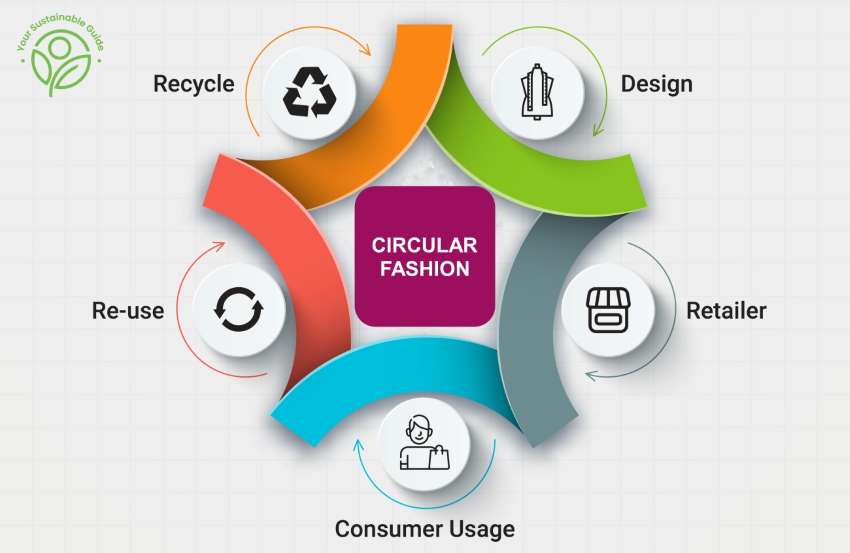
In the last ten years sustainable practices have merged into the overall circularity movement and have moved from vocabulary to real practice. Circularity in fashion can positively impact the bottom line when executed strategically.
- 1
- 2
- 3
- 4
- 5
- 6
- 7
- 8
- 9
- 10
Luxury in Retreat: Why the aspirational consumer is gone for good
The global luxury industry is confronting an unprecedented situation. The active consumer base, which peaked at 400 million in 2022,... Read more
The Invisible Bleed: How a single chemical is slowing India’s apparel machine
The global fashion industry has spent the better part of the past two years obsessing over visible disruptions viz. volatile... Read more
The Closet Paradox: How ‘nothing to wear’ is driving global overconsumption
In an era of overflowing wardrobes and instant fashion gratification, a striking paradox has emerged: the more clothes we own,... Read more
US trade rulings and labor slowdown reshape 2026 cotton supply chains
The global cotton industry is entering a period of adjustment, shaped by legal rulings, trade policy recalibrations, and a softening... Read more
Zero-tariff paradigm drives strategic re-sourcing at Global Sourcing Expo 2026
Projected to reach a valuation of $30.3 billion this year, the Australian textile and apparel market is entering a period... Read more
Strategic manufacturing takes center stage at Gartex Texprocess Mumbai 2026
A $179 billion industrial cornerstone contributing 2 per cent to the national GDP, the Indian textile and apparel sector is... Read more
The Hidden Tax on Fashion: 2026’s EPR rules squeeze margins and shake supply cha…
As the 2026 enforcement deadlines for California’s SB 707 and the European Union’s harmonized Waste Framework Directive loom, the global... Read more
Guess? Inc. retreats from China as American cool hits a cultural wall
For more than two decades, Guess? Inc., the emblem of ‘accessible American cool’, maintained an ambitious footprint in China. At... Read more
The Hormuz Effect: Why a distant war is shaking Bangladesh’s garment exports
The immediate impact of the Iran- Isarel-US conflict is being felt in the logistics arteries that connect Bangladesh’s factories with... Read more
The rise of localized luxury, MEA, North America, and India lead growth
The global luxury industry is no longer defined by relentless expansion. The ‘2025 Global Luxury Brandwatch Report’ highlights a sector... Read more