

This report is the eighth installment of the "Wrap Up 2025, Outlook 2026" series, providing a definitive roadmap for the industry’s high-growth categories and regional shifts.
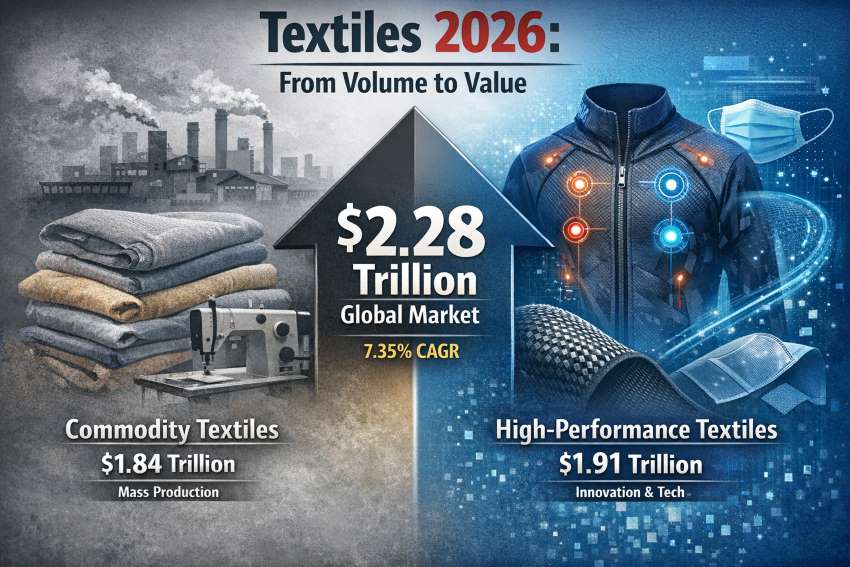
The 2026 global textile landscape is defined by a decisive move away from general-purpose manufacturing toward specialized, high-performance materials. As we move through the year, capital expenditure in the industry is being redirected into the "Double Agenda", fabrics that meet stringent performance requirements while remaining fully compliant with new global trade mandates. The total global textile market is valued at approximately $2,281.51 billion for 2026, maintaining a compound annual growth rate (CAGR) of 7.35%. This growth is increasingly concentrated in segments that offer measurable functional value over basic aesthetics.
2026 sector performance and growth projections
The following data outlines the market valuation and growth trajectories for the dominant industry segments as they stand in the current 2025–2026 cycle.
|
Sector/Segment |
2025 Market Size (Est) |
2026 Projected Size |
CAGR (2025-26) |
Key Growth Catalyst |
|
Apparel (Overall) |
$1.84 Trillion |
$1.91 Trillion |
3.80% |
Casualization & E-commerce |
|
Performance Textiles |
$105.40 Billion |
$113.72 Billion |
7.90% |
Biometric & Smart Sensing |
|
Knits & Sportswear |
$325.40 Billion |
$348.18 Billion |
7.00% |
Tech-Performance Blends |
|
Technical Textiles |
$255.12 Billion |
$271.83 Billion |
6.55% |
Med-Tech & Mobil-Tech |
|
Home Textiles |
$149.09 Billion |
$158.16 Billion |
6.08% |
Smart Bedding & Wellness |
|
Denim Apparel |
$78.90 Billion |
$84.11 Billion |
6.61% |
Waterless Dyeing & Circularity |
|
Bedroom Linen |
$67.09 Billion |
$71.16 Billion |
6.07% |
Functional Finishes |
Segment Analysis: Commercial dynamics and strategic stories
Performance Textiles: The "Sensing & Adaptive" suite
Performance textiles have emerged as the fastest-growing niche, projected to reach $113.72 billion in 2026 with an industry-leading 7.9% CAGR. This segment has evolved from simple moisture-wicking gear into "Adaptive Wear", fabrics that use conductive yarns and chromic materials to react to body temperature or environmental shifts. Commercial adoption is being driven by the integration of biometric sensors directly into the fiber matrix, allowing garments to track heart rate and muscle fatigue without external devices. In 2026, the market has split into two distinct tiers: high-end professional "Bio-data" wear and mass-market "Climate-adaptive" apparel that provides breathable insulation in cold weather and active cooling in heat. This segment is a primary winner for North American and Japanese firms, who hold the majority of patents for conductive textile polymers.
Home Textiles: The "Functional Wellness" suite
The home textile sector has transitioned from a decorative category into a health-focused "Functional Wellness" suite. Currently valued at $158.16 billion, the market is being driven by the "Bedroom Linen" sub-segment, which holds a commanding 45% share of the total home textile category. Commercial interest has moved beyond thread counts to "Smart Bedding", fabrics treated with phase-change materials for temperature regulation and silver-ion coatings for antimicrobial protection. These functional finishes are the primary engine behind the 6.08% CAGR, as consumers increasingly view their bedding as a tool for sleep hygiene. From a trade perspective, India has solidified its position as a global leader in this space by combining its massive organic cotton reserves with proprietary technical finishes to satisfy high-end retail demand in the US and EU.
Denim: From advocacy to "Invisible Circularity"
Denim has moved past the era of sustainability "pledges" into an era of rigorous engineering known as "Invisible Circularity." The segment is projected to reach $84.11 billion this year, with a 6.61% CAGR. The commercial goal for 2026 is the production of jeans that maintain a premium, heritage look but are designed for 100% recyclability. Nearly 40% of global manufacturers have now integrated waterless dyeing and laser-finishing technologies to remain compliant with tightening environmental standards in major import markets. The rise of mono-material denim, where even the stitching and hardware are made from shreddable, recyclable polymers;is the current benchmark for market entry. Turkey and India remain the dominant exporters in this high-tech denim race, while Mexico is securing a larger share of the US market through near-shore logistical advantages.
Knits & Sportswear: The "Bio-Performance" frontier
Knits and sportswear represent one of the fastest-growing categories, with a projected size of $348.18 billion and a 7.0% CAGR. The story here is the replacement of petroleum-based polyesters with bio-based synthetics derived from algae and corn. This shift is not just environmental but functional, as these new fibers offer superior moisture-wicking and cooling properties. The adoption of 3D Seamless Knitting has become the industry standard for high-performance brands, as it reduces fabric waste by roughly 30% and significantly lowers labor costs. Vietnam and Bangladesh are the primary winners in this segment, having aggressively upgraded their factory floors with automated knitting systems to capture volume from global athletic giants.
Technical Textiles: The "Industrial Backbone"
Technical textiles are the most resilient pillar of the industry, projected to reach $271.83 billion in 2026. This segment is no longer a niche but an essential industrial component. Growth is heavily concentrated in Med-Tech (implantable textiles and surgical non-wovens) and Mobil-Tech (lightweight, reinforced fabrics for electric vehicle interiors). This is a high-margin sector where intellectual property and patents dictate market power. Consequently, the USA, Japan, and Germany remain the dominant exporters of specialized technical fibers, while China focuses on the high-volume production of industrial filtration and protective gear.
Global Trade Matrix: Winners & Losers (2026 Forecast)
The global trade landscape is being reshaped by regional capabilities in technology and regulatory compliance. Countries that have invested in "green" infrastructure are seeing an influx of foreign direct investment, while those relying on low-cost, high-pollution models are seeing a contraction in orders.
|
Segment |
Regional Winners (Growth) |
Regional Losers (Stagnation) |
Primary Commercial Factor |
|
Performance Textiles |
USA, Japan, South Korea |
China (Standard Synth.) |
Biometric Patent Control & Smart Tech |
|
Home Textiles |
India, Turkey |
China (Volume), Pakistan |
Wellness certifications & Traceability |
|
Denim |
Vietnam, Mexico, Turkey |
USA (Manufacturing), Lesotho |
Near-shore logistics & Waterless tech |
|
Knits/Sportswear |
Bangladesh, Vietnam |
Italy (Mid-tier), Cambodia |
3D-Knitting & ESG Compliance |
|
Technical Textiles |
USA, Japan, Germany |
Rest of Asia (Low-end) |
IP Patents & MedTech Innovation |
Major Exporters and Importers: Leading Dynamics
● India: A major winner in 2026 due to the Production Linked Incentive (PLI) scheme, which has moved the country's export profile from raw cotton to high-value technical textiles and functional home linens.
● China: While remaining the world’s largest exporter by volume, China is losing market share in basic apparel as it moves its manufacturing base toward high-value synthetic fibers and AI-integrated textile machinery.
● Vietnam & Bangladesh: These nations have successfully transitioned from basic cut-and-sew operations to sophisticated, tech-enabled hubs for sportswear and high-end knits, benefiting from strategic free trade agreements.
● USA & EU: As the primary importers, these regions are the "gatekeepers" of the 2026 market. Their demand for supply chain transparency (via the Digital Product Passport) is forcing global exporters to adopt expensive but necessary traceability technologies.
Losers: Countries like Pakistan are facing commercial headwinds due to rising energy costs and a lack of investment in high-tech finishing, while Lesotho and Cambodia are seeing a decline in orders as brands prioritize "Green-ready" hubs that can guarantee lower carbon footprints.










