FW
Goller to introduce new Knit Merc at ITMA 2019
"Goller, a CHTC Fong’s International Group Company, will introduce the new Knit Merc at ITMA 2019 to be held from June 20-26, 2019 in Barcelona, Spain. The development will help in achieving the highest quality mercerisation of knitted fabrics at the lowest tension and with under 3 per cent variation in dimensional stability with high grade fabrics, for perfect dyeing results every time."
 Goller, a CHTC Fong’s International Group Company, will introduce the new Knit Merc at ITMA 2019 to be held from June 20-26, 2019 in Barcelona, Spain. The development will help in achieving the highest quality mercerisation of knitted fabrics at the lowest tension and with under 3 per cent variation in dimensional stability with high grade fabrics, for perfect dyeing results every time.
The Knit Merc is the result of intensive R&D developments at Goller and follows the successful introduction to the market of the company’s Sintensa Cyclone drum washing compartments for achieving the highest washing efficiency at the lowest tension.
The Knit Merc being can accommodate 8.4 metres of fabric in its impregnation compartment and a further four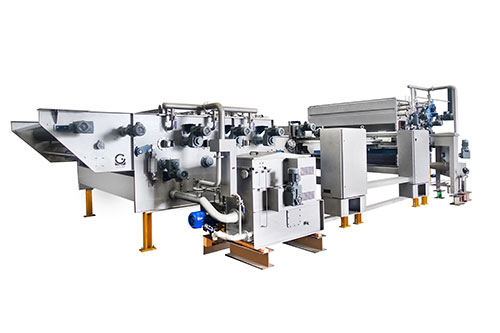 metres in its first chain section to achieve a production speed of 25m/min at 30 seconds dipping time.
It is designed for dry-on-wet mercerising, either cold or hot, and is equipped with an inlet combination of scroll and slat rollers for fabric guidance, a Tandematic uncurler in front of a rubberized de-airing roller and a grooved 320mm bottom roller with 320mm and 600mm perforated upper drums.
It benefits from automatic tension regulation and the low liquor content is ensured by the integrated lye tank and automatic circulation and filtration units.
An 8-tonne high efficiency squeezer is stationed at the exit before the chain section and a 5-tonne squeezer at the exit of the chain field.
Further fabric control and stability is provided by a cast iron pin chain with automatic optical and mechanical sensors, the Tandematic uncurler, an overfeed device and a driven belt arrangement for fabric support.
Kidswear market rides on fashion, comfort, sustainability
"Children’s fashion is not a child’s play,” says a recent kidswear advertisement featuring Amitabh Bachchan. Brands and retailers are scratching their heads over how to appeal to kids’ tastes besides keeping parents happy. They are not only consulting kids during their pre-production process besides offering them customised clothes."
 “Children’s fashion is not a child’s play,” says a recent kidswear advertisement featuring Amitabh Bachchan. Brands and retailers are scratching their heads over how to appeal to kids’ tastes besides keeping parents happy. They are not only consulting kids during their pre-production process besides offering them customised clothes.
Robust growth predicted, girls’ wear to dominate sales
As per Global Industry Analysts (GIA) estimated, the US market  for children’s wear is projected to exceed $76.4 billion by 2024. This would mean a CAGR of 3.9 percent from 2016 to 2024.The survey notes that an average household spends about $108 on kids’ clothes. Out of this, girls’ wear represents the largest product segment.
The Mintel Group also notes the influence kids are having on the children’s wear industry. The firm in its ‘Children’s Clothing US 2019’ report advises retailers and brands to consult kids while developing and designing clothing assortments. This would prove highly beneficial for brands as it help them cut down on wastes besides reducing their producing costs.
According to GIA, the preferred material for children’s clothing is cotton, due to its wash-friendly properties. Around 83 per cent of the surveyed parents opted for the cotton material with around 44 per cent expressing their concern over brands and retailers substituting synthetic fibers for cotton. Nearly half of the parents expressed their willingness to pay a slightly higher price to prevent brands from substituting cotton with synthetic fibers in their kids’ jeans.
Retailers and brands also need to remember that performance features such as shrink resistance, stain resistance, fade resistance, odor resistance and durability coax parents to pay more for their kids’ clothes. The Monitor™ research reveals that while discussing back-to-school apparel, 72 percent of parents expressed their willingness to spend more on shrink resistant clothes. This was followed by those who willing to pay more stain resistant, (70 percent), fade resistant (68 percent) and odor resistant (64 percent) clothes. Around 64 per cent of respondents also prefer clothes with durability enhancement features.
Parents opt for offline stores, kids prefer online shopping
The C&R Research “YouthBeat Shopping” report reveals parents prefer to shop at brick and mortar stores as it’s tough to gauge the exact size of their kids’ clothes without actually trying them on. Around 40 per cent of these parents prefer to shop in stores where they can do additional shopping, either for themselves or others.
While retailers remain their favorite choice, parents are increasingly opting for retailers who offer stylish and affordable clothing, as well as other items on their shopping list. Retailers therefore need to consider other ways to cater to the needs of these parents.
As parents prefer offline stores, kids are increasingly veering towards online stores such as Amazon, Walmart and Target. Amazon has emerged as the top choice among tweens and teens as it offers from toys to clothes, or video games to phone cases. As per C&R Research, Nike is the top apparel brand for children while Justice is the second-most popular brand. Under Armour ranks as the second most preferred brand among tweens.
Older parents go organic
The GIA report also points out that the changing American demographics are creating an increasing number of older parents who are in their late 30s and 40s, have higher disposable incomes and a willingness to invest in their children’s wardrobes. These consumers buy expensive designer outfits from brands such as Dolce and Gabbana, Hugo Boss, and Marc Jacobs. Also, parents prefer to buy the safest available clothes for their kids. This is translating into an increased interest in clothes made of organic and natural fibers, as well as recycled materials.
The Mintel Group notes a growing interest amongst dads about their child’s clothing. Around 45 percent of dads feel it’s important for their children to look stylish. And 26 percent believe price to be more important than quality.
Increasing bottom lines in FY19, Indian companies plan new strategies for growth
"FY 2019 has been a mixed year for Indian textile companies. For smaller companies like Morarjee Textiles, Bombay Rayon Fashions, Mafatlal and JCT, it was a challenging year as their quarterly earnings slipped below given estimates. However, for bigger companies like Arvind Mills, Raymond, Vardhman Textiles and Grasim Industries, the year yielded a positive outlook despite a challenging global business environment."
 FY 2019 has been a mixed year for Indian textile companies. For smaller companies like Morarjee Textiles, Bombay Rayon Fashions, Mafatlal and JCT, it was a challenging year as their quarterly earnings slipped below given estimates. However, for bigger companies like Arvind Mills, Raymond, Vardhman Textiles and Grasim Industries, the year yielded a positive outlook despite a challenging global business environment. Not only did these companies record higher growth in production and exports of garments, their revenues along the integrated chain also increased.
Raymond to launch eco-friendly fabrics
India’s largest textile and global conglomerate Raymond had a  robust FY ’19 as its revenue from the textile segment in the third quarter increased 10.3 per cent to Rs 847.7 crore from the earlier Rs 768.4 crore. The company’s revenue in the second quarter from branded textiles increased by 15 per cent to Rs 884 crore. The company is currently embarking on an expansion project by collaborating with Reliance Industries. This joint venture will launch the eco-friendly range of fabrics, Ecovera which will be manufactured using R|Elan, a technology from Reliance.
Arvind to increase manufacturing capacity
Ahmedabad-based textile manufacturer Arvind Mills demerged into three separate entities in November 2018. The company’s consolidated revenue of the continuing business for Q3 of FY ’19 decreased by 1 per cent year-on-year from Rs. 1,691 crore in Q3 of FY ’18 to Rs. 1,680 crore in Q3 of FY ’19. The management attributed this decline to lower volume sales by 5 million metres in the denim business.
The company produces nearly 250 million of fabric annually but converts only 10 per cent of this into garments. It now plans to increase this to 40 per cent over the next three years and 50 per cent by 2020. The company also plans to use more of its looms and mills for contract manufacturing of garments.
Yarn, fiber development focus for Vardhman Textiles
The revenue of Vardhman Textiles’ increased by 12.3 per cent year-on-year and 8.2 per cent quarter-on-quarter to Rs. 1,648 crore. Its revenue in Q2 of FY ’19 grew by 27.7 per cent year-on-year and 10.3 per cent year-on-year to Rs. 118 crore and Rs. 1,592 crore from the acrylic fibre and textiles segments respectively. The company plans to invest Rs 1,500 crore in its fabric and yarn manufacturing facilities over the next 2-3 years It also expects its fabric division to be more profitable compared to yarn division owing to less capital requirement.
Grasim Industries to expand India operations
Production of viscose stable fiber by Grasim Industries  increased by 11 per cent to 141,000 tonnes in Q3. Its sales volume increased to 134,000 tonnes, The net revenue of the company n Q2 of FY ’19 increased by 23 per cent to Rs. 2,606 crore.
The VSF business of the company will continue to expand in India by partnering with the textile value chains, achieving better customer connect through its brands Liva and Livaeco and enriching the product mix through a larger share of specialty fibres.
Morarjee Textiles to integrate supply chain
Ashok Piramal Group’s Morarjee Textiles reported a net loss of Rs 5.8 crore in Q3 ending December 2018. However, the company’s net sales increased by 0.08 per cent to Rs. 95.3 crore from Rs. 95.2 crore in the corresponding period.
In May last fiscal, the company undertook a backward integration project to incorporate its manufacturing processes and to reduce the dependence on vendors of yarn and woven fabric. The expansion project enabled the company to integrate its spinning, weaving and printing activities and thereby improve profits margins.
Egypt protects cotton purity
Cotton Egypt Association (CEA) is naming and shaming manufacturers who fail the accreditation protocol it established three years ago with Bureau Veritas. CEA has an information management partnership with testing and verification body Bureau Veritas.
This is part of a stepped-up effort to actively root out counterfeit from the supply chain. Only products made from 100 per cent trade-marked Egyptian Cotton can carry the trademarked pyramid cotton logo. Unscrupulous manufacturers mix Egyptian cotton with sub-standard fibers. As well as taking appropriate action, CEA will name and shame those trying to pass off non-genuine goods as Egyptian Cotton. In addition, CEA will soon activate a worldwide task force of secret shoppers who will purchase products labeled as Egyptian cotton from retailers in-store and online, which will be passed along for testing. CEA continues to conduct facility audits, traceability assessments and retailer surveillance. The process, which has been endorsed by several academic and professional bodies, includes extracting DNA from cotton fibers, yarns, woven, knitted, fabric or finished apparel to identify the percentage of genuine Egyptian cotton in a product.
Egyptian cotton is recognized as the most recognized luxury cotton brand in the USA and globally. People who are able to name a cotton brand cited Egyptian Cotton.
Lux Industries revenue up 13 per cent
Lux Industries revenue has grown 13 per cent for the year. In the current quarter the company has launched India’s first scented vest range under Lux Cozi. To fight the rising mercury during summers the refreshing scented vests will be a landmark product in the men’s innerwear category.
Lux aims at doubling production capacity over the next three or four years. Lux is one of India’s largest hosiery producers and exporters. It has set a turnover target of Rs 1,500 crores by 2020 and constantly adds new and innovative products for gaining a significant domestic and overseas market share. It manufactures 20 crore garment pieces a year, which is one of the largest in the Indian innerwear sector. Lux has invested in enhanced manufacturing automation (ultrasonic cutting systems) for increasing efficiency and global competitiveness. The company’s products are manufactured in-house with zero outsourcing. Lux has a 20 per cent share of the organised hosiery industry. Lux, incorporated in 1995, has invested in 350 fully automated circular knitting machines, cutting machines, knitting machines and has set up an integrated unit across knitting, processing and cutting which will enhance efficiency, productivity and profitability.
The Indian innerwear market is projected to grow to a level of Rs 47,000 crores by 2020.
US suspends GSP for India
The US has suspended GSP benefits for India. The Generalized System of Preference (GSP) is the largest and oldest US trade preference program and is designed to promote economic development by allowing duty-free entry for thousands of products from designated beneficiary countries. Under the GSP program, nearly 2000 products including auto components and textile materials can enter the US duty-free if the beneficiary developing countries meet the eligibility criteria. India was the largest beneficiary of the program in 2017.
Now the US wants to ensure that American companies have a level playing field. The country wants India to address policies including data localisation and e-commerce measures that stifle international investment from top tier companies. The US does not want to see market access barriers to American firms in India when Indian companies currently enjoy largely unfettered access to US markets. Depending on progress India can have GSP benefits restored.
There has been a significant growth in the bilateral trade relationship as well as a narrowing of the trade deficit. The bilateral trade is now at about $142 billion. Last year, the US exports increased 28 per cent. Trade deficit for goods and services stands at about $24 billion, which is about a 11.9 per cent reduction.
US slips in global competitiveness rankings
The United States is no longer the world’s most competitive economy. As per IMD World Competitiveness Center, China is hurting the ability of US companies to compete globally. The ongoing trade war with China is hurting companies in the United States more than in any other country. While the US dropped in the rankings, Asian-Pacific countries fared much better. Both Singapore and Hong Kong have more competitive economies than the US. Eleven of the 14 regional nations analyzed stayed the same or rose in the evaluation. Indonesia and Thailand both experienced significant rises. Some Middle Eastern nations also experienced significant progress in the rankings, with Saudi Arabia leaping 13 places and Qatar rising four to earn its spot as the world’s tenth most competitive economy.
High fuel prices and fluctuations in the dollar’s value have diminished the confidence-boosting impact of American tax policies. The ongoing trade war between the US and China has inflicted uncertainty upon, and caused rapid fluctuations among, global financial markets. Global markets plunged and oil prices dropped when the US announced tariffs increases on Chinese imports. In a single day, the Dow dropped 470 points before making up most of its losses. The next day, after the US confirmed it would be levying the tariffs, markets again plunged.
ITMA to host a special denim event
There will be a special session on denim production at Planet Textiles on June 22, at Itma, Barcelona. Discussion n key changes on jeans production and some of the predicted changes in denim production from how its sourced in future will be highlighted. A proposal to develop a blueprint for real change that buyers’ retailers and brands can use as a sourcing guide will be outlined. As one of the world’s most popular fabrics, denim has a big impact and it’s become a focal point for environmental change in the textile industry as a whole.
Everyone owns a pair of 100 per cent cotton jeans but this has a greater impact on the environment than making denim with manmade cellulosics or bast fibers. Indigo dye is synonymous with true blue denim look, but its use is problematic – not just because of the lengthy, resource-heavy dyeing process, but also because of some of its potentially hazardous properties.
Are new technologies such as laser technology to produce distressed denim really cost-effective? And do they have their own drawbacks to workers’ safety? How should the denim manufacturing industry make jeans by 2025? And what breakthroughs in technology and thinking are needed to make this happen?
Picanol to present new machines at ITMA
Picanol has nearly 40 years of experience in airjet weaving. The brand new OmniPlus-i represents a new benchmark in airjet weaving. The OmniPlus-i features a redesigned reed motion, optimized relay nozzle set up and can be combined with SmartShed, the full electronic controlled shedding motion.
Picanol conceives its machines around the principle of Smart Performance: an intelligent machine design combined with self-learning software, allowing the best possible practical speed and real performance under any given circumstances. When it comes to waste prevention and energy consumption reduction, Picanol has been taking up its responsibility for years. Its machines are conceived with a built-in capacity for sustainability. Since the first introduction of electronics on weaving machines in the ’70s, Picanol has been at the forefront of digitization. With every new machine, it continues to be a trendsetter in this field and to further deploy Industry 4.0 in the weaving industry. The self-setting machine is just around the corner. A user-centric design is integrated in the concept of its machines, making all operations and interventions intuitive, easy and self-explanatory.
At Itma, Picanol will present five new airjet weaving machines and five rapier weaving machines with many new developments. A rapier machine in jacquard execution will also be on display.
Pakistan hosiery manufacturers want zero rating tax regime to continue
Pakistan hosiery manufacturers want the sales tax zero-rating regime for five export-oriented sectors to be continued. They say, withdrawal of the zero-rated tax regime would unleash a flight of capital. During the last two decades the zero rating was undone twice. The five zero-rated sectors contribute 60 per cent to total national exports and generate 40 per cent to total employment.
The currency has lost 21 per cent of its value against the dollar in nine months. Exporters say this will add to the cost of machinery imports. Production costs of the export industry have already increased due to the interest rate hike. Nearly 60 per cent of the raw material of the export industry comes from other countries. In this situation, the industry fears having to acquire finance from banks at an interest rate of 15 per cent, which will increase the industry’s cost of doing business.
Another complaint of the industry is that significant volumes of liquidity are stuck in the form of sales tax refunds and customs rebates. Collection of sales tax and then refunding is seen as a futile exercise. The industry also wants a plan to increase the taxpayers’ base to help the country overcome its monetary deficit.